Welcome to the final lesson of our foundational module. In our last session, we delved into leverage and margin, understanding the mechanics that allow you to control positions larger than your capital. You now have a grasp of how to enter the market and how much trading power you can wield. Today, we address the final foundational question: what should you trade?
This lesson provides a high-level survey of the three primary asset classes you'll be focusing on as a day trader: equities, forex, and cryptocurrencies. For each, we'll identify its core characteristics, operational hours, and the typical pros and cons for an intraday trader. This overview will complete our groundwork, preparing us for the next module where we will begin to dissect the specific market structures of each.
The Arenas of Day Trading
An asset class is simply a grouping of financial instruments that share similar characteristics, are traded in the same markets, and are subject to the same rules and regulations. As a day trader, your focus is on asset classes that provide two crucial ingredients: liquidity and volatility. You need enough liquidity to enter and exit trades instantly without affecting the price, and enough volatility to ensure the price moves sufficiently within a single day to generate profit.
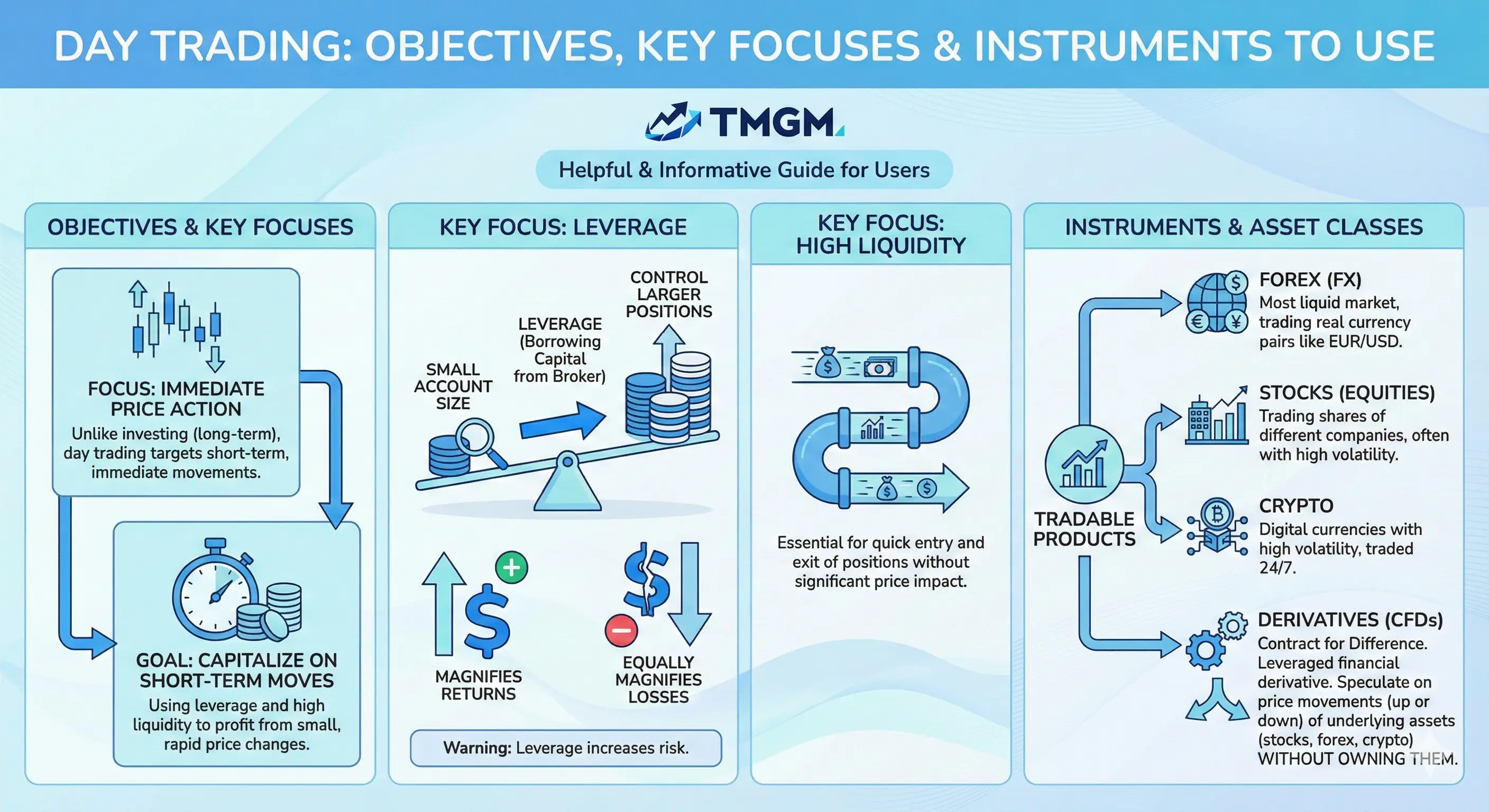
The infographic below highlights the primary instruments used by day traders, which fall into the asset classes we're about to explore.
Let's begin our survey with the most well-known asset class: equities.
1. Equities (Stocks)
Equities, or stocks, represent ownership in a publicly-traded company. When you buy a stock, you are buying a small fraction of that business. For a day trader, the goal isn't long-term ownership but to profit from the stock's price fluctuations during the trading day, which are often driven by company news, earnings reports, or broader market sentiment.
Key characteristics for a day trader include:
- Vast Selection: Thousands of stocks are available to trade, from large, stable "blue-chip" companies to smaller, more volatile firms.
- Structured Hours: Stock markets have defined trading hours. For example, the National Stock Exchange (NSE) and Bombay Stock Exchange (BSE) in India trade from 9:15 AM to 3:30 PM IST. This concentrated period often leads to predictable patterns of activity, but it also means you can't trade around the clock.
- Information Flow: A constant stream of news, analysis, and data is available, providing many potential catalysts for price movement.
The following video provides a good summary of the pros and cons of trading stocks.
The ONE Asset Class Every Beginner Trader Should Start With (6 Asset Classes Compared)
This video from Mind Math Money offers a concise comparison of different asset classes for traders.
Please watch the section covering stocks. The presenter discusses their liquidity, moderate volatility, and the limitations of their trading hours.
2. Foreign Exchange (Forex)
The Foreign Exchange or Forex market is the global marketplace for exchanging national currencies. It is the largest and most liquid financial market in the world. Instead of trading shares of a company, you are trading currency pairs, for example, speculating on whether the Euro (EUR) will strengthen or weaken against the US Dollar (USD).
Key characteristics include:
- Massive Liquidity: The enormous volume means that for major pairs (like EUR/USD, USD/JPY, GBP/USD), spreads are typically very tight, and you can execute large trades with minimal price impact.
- 24/5 Market: The market operates 24 hours a day, five days a week, as different financial centers (London, New York, Tokyo) open and close. This offers flexibility for traders in any time zone.
- Leverage: The forex market is known for offering very high leverage, which, as we learned, amplifies both gains and losses.
Let's return to the "Mind Math Money" video to see how Forex compares.
The ONE Asset Class Every Beginner Trader Should Start With (6 Asset Classes Compared)
Now, let's look at the characteristics of the Forex market.
Watch the segment on Forex. Note the discussion on its 24/5 nature, high liquidity, and the role of leverage. The presenter also touches on the complexity of the underlying economic factors.
The article below provides a quick look at the most common assets for day trading, reaffirming that major currency pairs and blue-chip stocks are prime candidates.
Forex Day Trading Guide for Beginners: Strategies, Risks, Rules and Tips | LiteFinance
This guide from LiteFinance identifies ideal assets for day traders.
First, read the section Best securities for day trading, which names EUR/USD and blue-chip stocks as prime examples. Then, scan the section on Best currency pairs to get a sense of the "majors" that dominate the market.
3. Cryptocurrencies
Cryptocurrencies are digital assets that use cryptography for security. Unlike traditional currencies issued by governments, many cryptocurrencies are decentralized. For day traders, their defining feature is extreme volatility.
Key characteristics include:
- Extreme Volatility: It's not uncommon for cryptocurrencies to move 5-10% or more in a single day, offering significant profit potential (and risk).
- 24/7 Market: The crypto market never closes. It trades 24 hours a day, 7 days a week, 365 days a year.
- Developing Regulation: The market is younger and less regulated than equities or forex, which can lead to both unique opportunities and heightened risks like scams or sudden shifts in market structure.
Finally, let's complete the comparison with the "Mind Math Money" video's take on crypto.
The ONE Asset Class Every Beginner Trader Should Start With (6 Asset Classes Compared)
This final clip covers the newest and most volatile of the three asset classes.
Watch the section on cryptocurrencies. The presenter emphasizes the high profit potential that comes with their extreme volatility and the benefit of a 24/7 trading schedule.
A Professional's View on Market Efficiency
You now have a textbook overview of the three markets. However, a crucial concept for a discretionary trader is market efficiency. This refers to how quickly and thoroughly an asset's price reflects all available information. In a highly efficient market, finding an "edge" is difficult because prices are almost always "fair." In less efficient markets, emotional reactions and fragmented information can create mispricings that a skilled trader can exploit.
The following video from a highly experienced professional trader offers a powerful, opinionated framework for comparing these markets based on efficiency and the quality of opportunities for a retail trader. This perspective will be valuable as you begin to think strategically about where to focus your efforts.
Why Forex SUCKS and Stocks WIN (Stocks vs Futures vs Crypto vs Forex)
In this video, trader Lance Breitstein gives his stark assessment of where the best opportunities lie for retail traders. He evaluates markets on factors like the quality of competition, liquidity, and the nature of the opportunities themselves.
Please watch his analysis on the three markets we've discussed: Forex: He argues that it is an extremely efficient and competitive market, making it difficult for retail traders. Crypto: He positions this as a "target-rich environment" due to its inefficiencies and emotional participant base, but with significant operational and volatility risks. Equities: He concludes this is the "best blend," offering enormous opportunity counts and quality, where human emotion consistently creates exploitable mispricings.
His argument boils down to this:
- Forex is a battle against giants (banks, hedge funds) in a hyper-efficient arena.
- Crypto is a wild, less-developed frontier with high rewards and high dangers.
- Equities offer a "sweet spot" where institutional presence is high, but the sheer number of stocks and the influence of human psychology on company-specific news still create frequent, exploitable inefficiencies.
This doesn't mean you can't succeed in Forex or Crypto, but it highlights that the nature of the challenge is different in each market. Your physics background gives you an appreciation for complex systems; you can think of these markets as systems with different levels of randomness, determinism, and feedback loops.
Conclusion
This lesson concludes our foundational module. We have journeyed from the basic economic principles of price to the practical tools of trading and, finally, to the arenas where you will apply this knowledge.
Here are the key takeaways on our three primary asset classes:
- Equities (Stocks): Offer a vast number of trading instruments within structured market hours. Opportunities are often driven by company-specific news and market sentiment, creating a fertile ground for exploiting emotional mispricings.
- Forex (Foreign Exchange): The world's largest market, offering unparalleled liquidity and 24/5 trading. It is, however, extremely efficient and competitive, presenting a significant challenge for discretionary retail traders seeking an edge.
- Cryptocurrencies: A 24/7 market defined by extreme volatility. It is a less efficient, "wild west" environment that presents both immense opportunity and significant operational and volatility risks.
You now have a foundational map of the trading landscape. In our next module, "Market Structures," we will zoom in and begin exploring the territory in detail. Our first lesson will be a deep dive into the specific structure of the Indian equity markets, covering the NSE and BSE, the role of the regulator SEBI, and the crucial details of their trading sessions.