A data center’s annual water use tells you how much water moved over a year, but not whether that use puts pressure on its surroundings. A facility may need the most cooling on the same hot days when river flows are low, groundwater replenishment is limited, and other users need more water.
This module moves from calculating water use to evaluating claims about its consequences. In this lesson, you will assess local water pressure by placing a facility’s withdrawals and returns alongside the basin’s seasonal conditions. The distinction matters even when a facility reports that it uses reclaimed rather than drinking-quality water. Allow about 40 minutes, including the readings.
Put the facility inside a water system
Start with the source, not the cooling equipment. “Municipal water” identifies a supplier, but the utility may obtain that water from a river, a reservoir, wells, or a combination. Likewise, “reclaimed water” identifies water that has been treated for reuse; it does not say what would have happened to that water otherwise.
The diagram below depicts a general human-influenced water system, not a data-center-specific one. Its useful feature here is that withdrawals, deliveries, evaporation, wastewater treatment, and returns occur at different places. A data center drawing water from a utility and sending cooling-tower blowdown to a sewer would occupy just part of this larger picture.
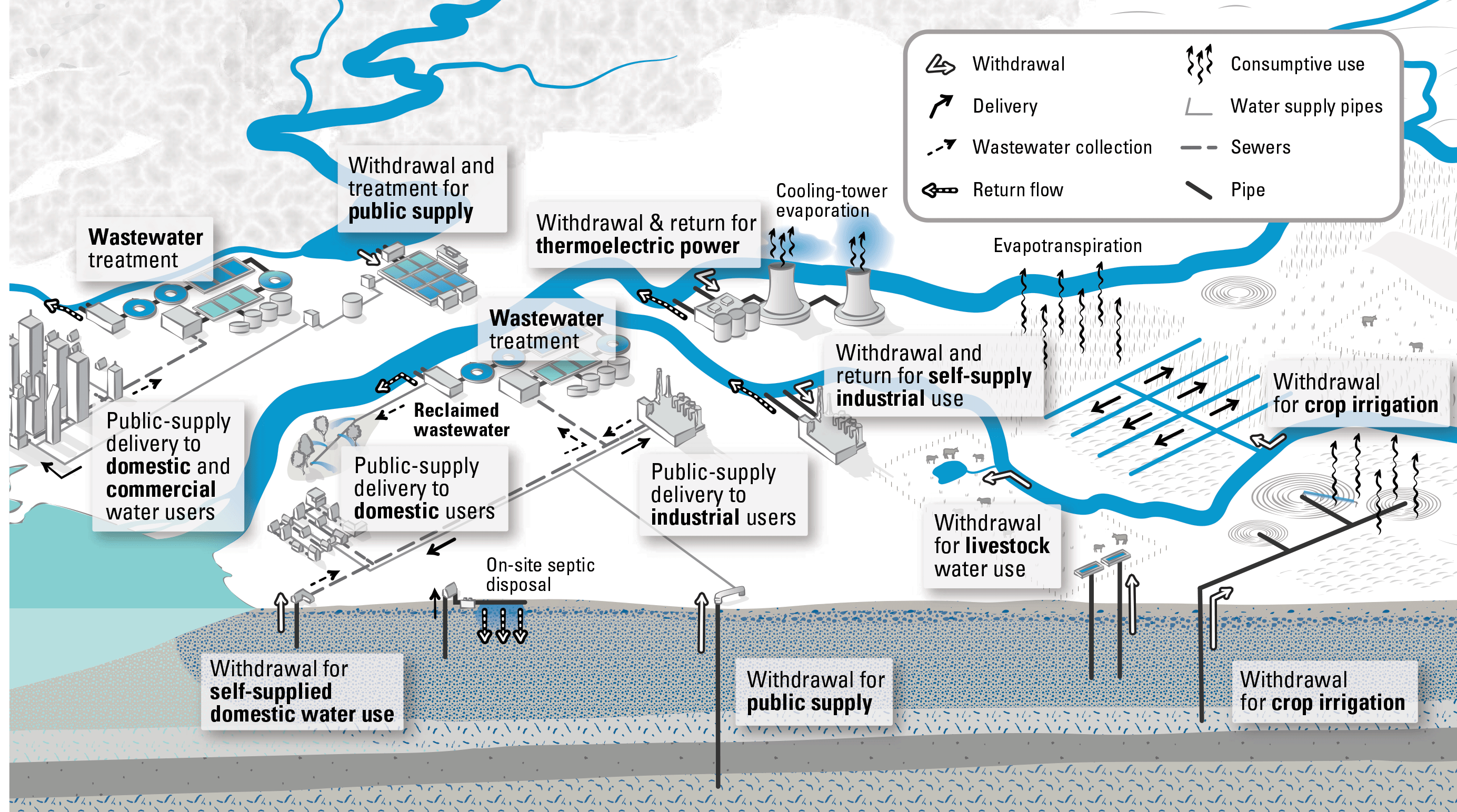
For a local assessment, draw a boundary around the relevant source basin: the connected river, reservoir, groundwater, and users whose available water could be affected. Then distinguish three quantities:
- Withdrawal is water taken from a source or delivered to the facility.
- Consumption, relative to a stated boundary, is water withdrawn that does not return to that boundary within the relevant period. Evaporation is a common reason.
- Discharge is water leaving the facility in liquid form. It may return to the source basin, enter another basin, or arrive too far downstream or too late to relieve a particular shortage.
A discharge volume is therefore not automatically an offset to local pressure. Its destination, timing, and quality matter. Water returned downstream of an affected reach does not restore flow in that reach. Water returned to a river may also require treatment or temperature controls before it can support the same uses as the water withdrawn.
Read the following account for the physical differences between groundwater pumping, surface-water withdrawal, and discharge impacts.
Understanding How Data Centers Impact Surface and Ground Waters | CAES Field Report
Read the CAES Field Report’s discussion of local water concerns to connect a facility’s reported volumes to particular rivers, aquifers, and discharge points.
In “What Water-Related Concerns Are Associated with Data Centers?”, read the “Aquifer Depletion” subsection from aquifer depletion. Then read from the start of “Surface Water Withdrawals” through “Thermal Pollution of Surface Waters” and “Chemical Discharge,” beginning surface and discharge impacts. Focus on which effects arise at the intake, which arise at the outfall, and why groundwater pumping can also affect connected streams.
A basin-stress rating is a useful warning signal, not a measurement of spare capacity at a facility’s intake. The relevant evidence also includes permitted and existing uses, ecological flow needs, drought conditions, and whether groundwater pumping draws down storage or connected surface water. These details prevent a small-looking regional percentage from masking a substantial effect on one supply system or stream reach.
Compare demand with water availability at the same time
An annual total can conceal the period that determines a facility’s local impact. Evaporative cooling demand can rise during hot weather. At the same time, a water supplier may face lower inflows, restrictions on withdrawals, or higher demand from other customers. A system capable of delivering the annual volume may still struggle to deliver a peak daily volume.
The Environmental Law Institute fact sheet places this issue in the context of utility planning. It also discusses why the source of cooling water matters.
Data Centers and Water Fact Sheet
Read the Environmental Law Institute fact sheet for its account of potable and reclaimed supplies, followed by its discussion of average and peak demand. Use it to distinguish a reduction in drinking-water demand from a reduction in watershed impact.
In “Water Consumption,” read from the discussion of potable, surface, groundwater, and reclaimed sources through the limits of returning evaporative-cooling water: water sources. Then find “Considerations for Utilites and Governments,” following the cooling-method discussion, and read planning considerations. Pay particular attention to the difference between average demand and demand during hot periods.
For a first-pass comparison, use a daily demand and a daily measure of water available after existing commitments and ecological needs have been considered. If the facility needs cubic meters on a hot day and only cubic meters per day are uncommitted under the specified drought conditions, its demand would occupy:
That 75% signals a potentially tight situation; it is not, by itself, a prediction that taps or rivers will run dry. The availability estimate may be uncertain, the supplier may have storage, and some discharged water may return. Conversely, a daily basin balance may miss a bottleneck in the pipes or treatment plant serving the facility. Keep those uncertainties attached to the comparison rather than replacing it with an annual average.
What reclaimed water changes—and what it may not
Using treated wastewater instead of drinking-quality water can reduce demand on a potable-water utility. It can also make use of water that would otherwise leave the area. Those are meaningful potential benefits, but reclaimed does not mean impact-free.
The decisive comparison is with the water’s alternative fate. If treated wastewater would otherwise have entered a local stream, diverting it to an evaporative cooling system can reduce flow in that stream. If it would instead have been discharged outside the basin, reuse may avoid a new freshwater withdrawal within the basin. If it was intended for groundwater recharge or another user, the effects differ again. Treatment and storage may ease a utility’s peak delivery problem without eliminating consumption through evaporation.
This is why the source label and the water balance answer different questions. “Reclaimed” describes what is supplied to the facility; withdrawal, evaporation, and return-flow information describe what changes in the basin. Reclaimed-water claims are strongest when they state where the water came from, where it would have gone without the project, and where any remaining discharge goes.
A worked local-pressure assessment
Consider a hypothetical facility with an annual withdrawal of cubic meters. Its cooling demand is seasonal:
| Period | Days | Facility withdrawal |
|---|---|---|
| Hot period | 120 | cubic meters per day |
| Remaining period | 245 | About cubic meters per day |
The hot-period withdrawal is cubic meters; the remaining cubic meters is spread across 245 days. An annual average of cubic meters per day would therefore understate demand on each hot day by one third.
Suppose that on a representative hot day, cubic meters do not return to the source basin within the relevant period, mainly because of evaporation. The remaining cubic meters leave as liquid discharge after appropriate treatment. Suppose also that the basin has cubic meters per day of uncommitted water under the stated drought conditions. The facility’s -cubic-meter withdrawal is substantial relative to that daily margin. To interpret the -cubic-meter discharge, however, its destination must be known.
Case A: river supply. The facility takes its water from the river, directly or through a utility. If the treated discharge returns to the same basin, its basin-wide non-return is approximately cubic meters for that day. Yet a river reach between the intake and the return point can still experience the full -cubic-meter reduction in flow while the water is absent. If the discharge goes to another basin, it cannot be counted as a return to this one.
Case B: reclaimed wastewater. The facility instead receives cubic meters of treated wastewater. This may avoid an equivalent new demand on drinking-quality supply. But suppose that, without the facility, the wastewater would have been discharged into a nearby stream above a sensitive reach. Diverting it removes that expected flow from the reach; returning cubic meters farther downstream does not restore the water in the intervening stretch. The source change helps the potable-water system, but it does not establish that the stream is unaffected. If the wastewater’s alternative destination were outside the basin, the comparison could favor reuse much more strongly.
These are illustrative assumptions, not measurements of a real site. They demonstrate why a defensible assessment keeps several findings separate: peak pressure on the supplier, change in basin-wide water availability, change in flow at particular reaches, and effects of the discharge itself. A single annual volume—or a single “reclaimed” label—cannot represent all four.
A concise evidence record for an actual facility would include its daily or monthly withdrawals and non-returns; the original source of municipal or reclaimed supply; drought-period availability and other demands; the wastewater’s alternative fate; and the discharge location, timing, and permitted quality. Missing items should be identified as uncertainties, not silently assumed to be favorable or unfavorable.
Key takeaways
Local water pressure depends on when a facility needs water, which source supplies it, and where and when water returns. Annual use is useful for scale, but hot-day demand must be compared with hot-day availability. Reclaimed water can reduce pressure on potable supply while still affecting a stream if it replaces wastewater that would otherwise have flowed there.
The next lesson turns from facility-level totals to per-query estimates. The same discipline will apply: an allocation becomes meaningful only when its assumptions and accounting boundary are visible.