Welcome back. The previous lesson distinguished water moving repeatedly through a cooling loop from water lost through evaporation. Now the boundary moves outward: a cooling facility can release liquid water without returning it to the source from which it was supplied. This lesson develops a way to classify withdrawals, consumption, and discharge by tracing water from its source to its eventual destination. Estimated study time: 35–40 minutes.
Start with a source, a place, and a time
A statement such as “the facility uses 1,000 liters of water” is incomplete even when the units are clear. The liters might describe water taken from a river, water delivered by a utility, water circulated through equipment, or water discharged after use. To classify a flow, first specify the source basin—the watershed or groundwater system whose water availability is being assessed—and the reporting period.
The U.S. Geological Survey (USGS) diagram below shows why this matters. It follows water from surface water and groundwater through public supply, industrial uses, wastewater treatment, and returns. It is a diagram of water use across several sectors, not a diagram of a data center. Its cooling-tower evaporation and industrial return paths are nevertheless useful for interpreting a cooling facility.
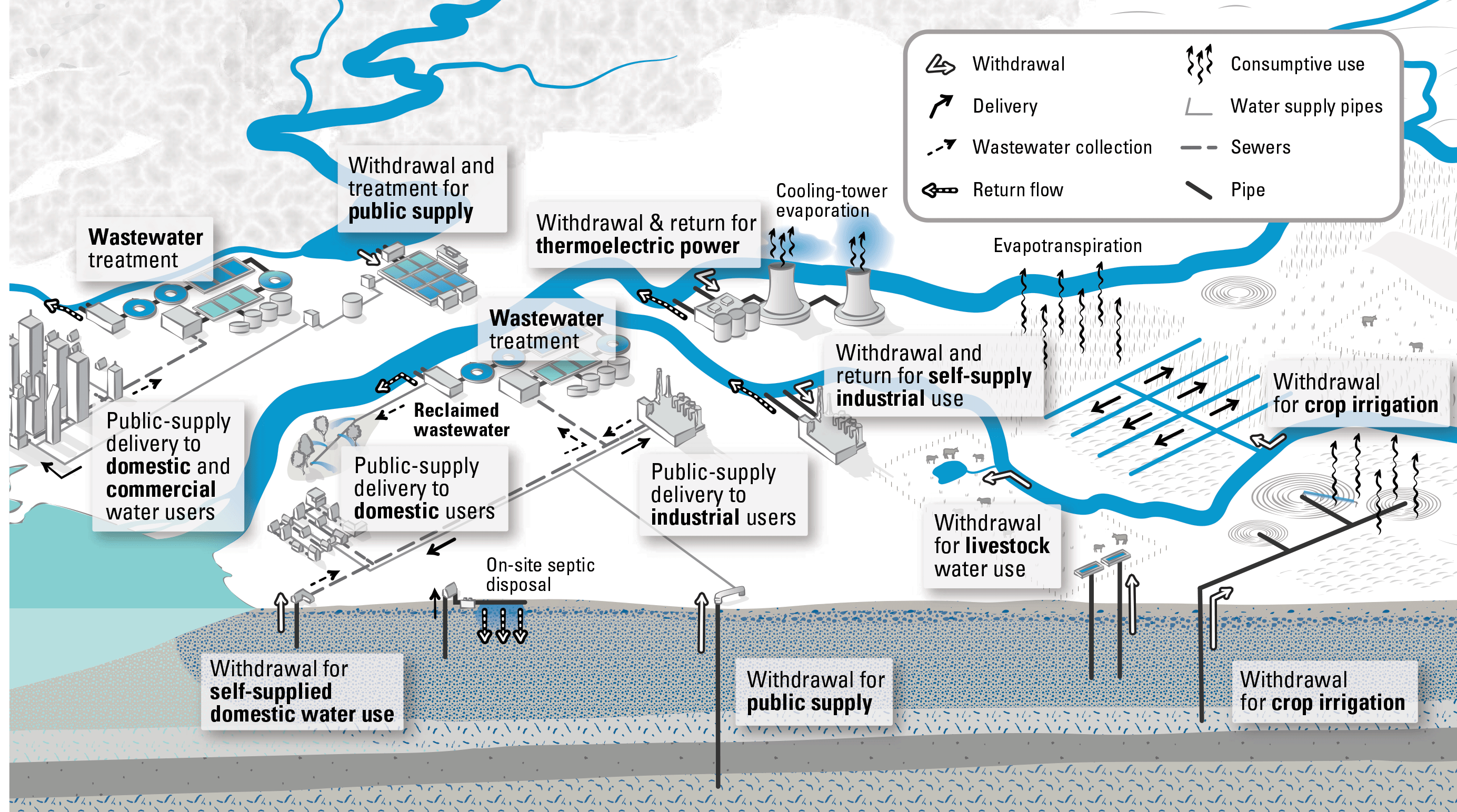
Follow the river intake serving industrial use in the diagram. Withdrawal occurs when water is removed from the source. A pipe may then deliver it to a user. After use, some water may evaporate; another portion may leave through a pipe. That outgoing pipe establishes a discharge from the user, but its endpoint determines whether the water becomes a return to the source basin.
Read the USGS discussion alongside the figure. It supplies the terms used in this lesson and cautions that different organizations do not always use them identically.
Water use across the conterminous United States, water years 2010–20
Read the USGS explanation to distinguish water removed from a source, water no longer readily available locally, and water returned for further use.
In the main text immediately above Figure 1, find the paragraph beginning “Water-use terms and concepts used in this chapter.” Read the core explanation through its discussion of return flows and their possible effects. Then look at Figure 1 and read the paragraph immediately below it, from the terminology caution through the distinction between “water use” and “water withdrawal.” Focus on why a return must reach groundwater or surface water to become available for reuse.
Classify the event before adding up the volumes
Use three distinct descriptions rather than treating “water use” as a single category.
A withdrawal removes water from a surface-water or groundwater source for use. For a self-supplied facility pumping from a river in the stated basin, the river intake is a withdrawal from that basin. If a public supplier pumps river water and sends it to a facility, the facility receives a delivery; that delivery is not a second withdrawal from the river. Which entity’s meter is being reported matters.
Consumption, in the USGS sense, is withdrawn water that evaporates or is otherwise removed from the immediate water environment rather than being readily available for another local use. Cooling-tower evaporation is a direct example. The vapor still exists, and it may eventually fall as precipitation, but it has not returned through a pipe to the source basin in the reporting period.
A discharge is water released from a facility after use. It is not necessarily consumed. Nor is every discharge already a return flow to the source basin: water sent into a sewer has left the facility, but its subsequent route through treatment and its final outfall still need to be traced. Water discharged to a river or aquifer becomes a return flow when it reaches that source and is available for further use.
| Observed flow | Classification for the facility | Source-basin implication |
|---|---|---|
| Water pumped from a basin river into the facility | Withdrawal | Water has been removed from the basin source for use. |
| Water delivered to the facility by a public supplier | Delivery | Trace the supplier’s intake before assigning a source-basin withdrawal. |
| Water pumped repeatedly around an internal cooling loop | Recirculation | Not a new withdrawal on every pass. |
| Water leaving a cooling tower as vapor | Consumptive loss | Not a liquid return to the source basin. |
| Liquid sent from the facility to a sewer | Discharge | Its basin return remains unknown until the sewer and treatment outfall are located. |
| Treated liquid released into the source-basin river | Return flow | Water is again present in that basin, though its timing and quality may have changed. |
The distinction between discharge and return flow prevents a common accounting error. A facility can accurately report that it discharged water while a basin assessment still finds that the water did not return to that basin.
Trace a complete route, not just a facility meter
Consider cooling-tower blowdown, the liquid drained to prevent minerals from accumulating in circulating water. At the point where it leaves the facility, blowdown is a discharge, not evaporation. Its later classification depends on its route:
- If treatment releases it to the same source basin, it can be counted as a return flow there.
- If treatment releases it in another basin, it is not a return to the original basin.
- If its destination is undocumented, the facility’s discharge volume alone cannot establish how much reached either basin.
The same care applies to water released onto land or lost from a pipe. Some may reach a local aquifer, while some may evaporate or take too long to reach a usable source to count as a return during the stated period. An identified sewer connection or infiltration pathway is therefore more informative than a generic statement that water “goes back into the environment.”
Time matters alongside location. Water withdrawn in one month and returned in the next is not permanently destroyed, but it is unavailable as a return during the first month. Report a delayed return as such rather than silently treating it either as immediate return or as evaporation. A same-basin return can also differ in temperature or quality from the water withdrawn; a volume ledger alone does not establish that the ecological effects cancel.
When the discharge crosses a basin boundary
The USGS discussion of interbasin transfers explains why the geographical scale of a boundary needs to be stated. A pipe can move water across a small watershed divide without crossing a larger basin boundary. The destination must be evaluated against the particular basin used for the claim.
Water use across the conterminous United States, water years 2010–20
Read this short continuation to understand why a constructed transfer can change availability in a source basin even when the water is discharged elsewhere rather than evaporated.
Under the subsection “Interbasin Transfers,” begin with the opening definition and continue through the end of that paragraph. Then read the start of the next paragraph, where boundary scale is explained. Focus on how the same conveyance can cross one chosen watershed boundary but remain inside another, larger one.
Here is a compact ledger for a single reporting period. Suppose a facility withdraws 1,000 liters from Basin A. Of that water, 200 liters evaporate, 700 liters are discharged and reach a river in Basin A, and 100 liters are discharged through a pipe into Basin B. Assume no change in stored water and no other flows.
At the facility, the accounting is 1,000 liters withdrawn, 200 liters evaporated, and 800 liters discharged as liquid. For Basin A, only 700 liters are confirmed to have returned. The remaining 300 liters have not returned to Basin A: 200 liters left as vapor, and 100 liters were transferred to Basin B. Calling all 300 liters “evaporation” would be wrong. Calling all 800 discharged liters a return to Basin A would also be wrong.
This example exposes a terminology choice in water-use claims. Under a physical evaporative-consumption measure, the identified consumption is 200 liters. Under an explicitly defined source-basin nonreturn measure, 300 liters are unavailable in Basin A during the period. Some accounting conventions include interbasin exports in “consumption,” while others report the export separately. The reliable comparison is not the word alone but the stated definition and destination of each flow.
Public-supply and reclaimed-water claims need the same route tracing. A facility receiving utility water has a delivery at its boundary, while the utility’s source intake may be elsewhere. A facility receiving reclaimed wastewater is using treated effluent rather than making a new direct intake from a river or aquifer at its site. Yet if that effluent would otherwise have returned to a local stream, diverting it to a cooling tower may change the stream’s return flow. “No direct river withdrawal at the facility” therefore does not, by itself, establish “no change to local water availability.”
Key takeaways
Withdrawal identifies water removed from a source; consumption identifies water no longer readily available locally, notably through evaporation; discharge identifies water released after use. A discharge becomes a return to the source basin only if its route actually takes it there within the period being assessed. Recirculation inside cooling equipment is none of these new source flows.
For any water-use claim, keep the source basin, reporting period, facility boundary, and discharge destination visible. Those details determine whether two apparently conflicting numbers measure the same thing. The next lesson will use these distinctions in a steady-state cooling-tower water balance, separating replacement water from evaporation and liquid outflows without counting circulation as a fresh withdrawal.