Hello. In the previous lesson, you put water rates and volumes on a common timeline, but left an important question open: what water is the reported flow measuring? A pipe can carry a large flow through cooling equipment even when much less new water enters the facility.
This lesson uses a cooling-loop diagram to distinguish water circulating within a system from water leaving it through evaporation. That distinction is essential before interpreting a data center’s water-use claim. Estimated study time: 30–40 minutes.
Read the diagram as two water loops
The diagram shows one common arrangement for cooling air-cooled IT equipment. Start at the racks on the right. Heat from the equipment warms room air; cooling equipment transfers that heat into a chilled-water loop. At the chiller, the heat passes into a separate condenser-water loop, which carries it to the cooling tower outdoors.
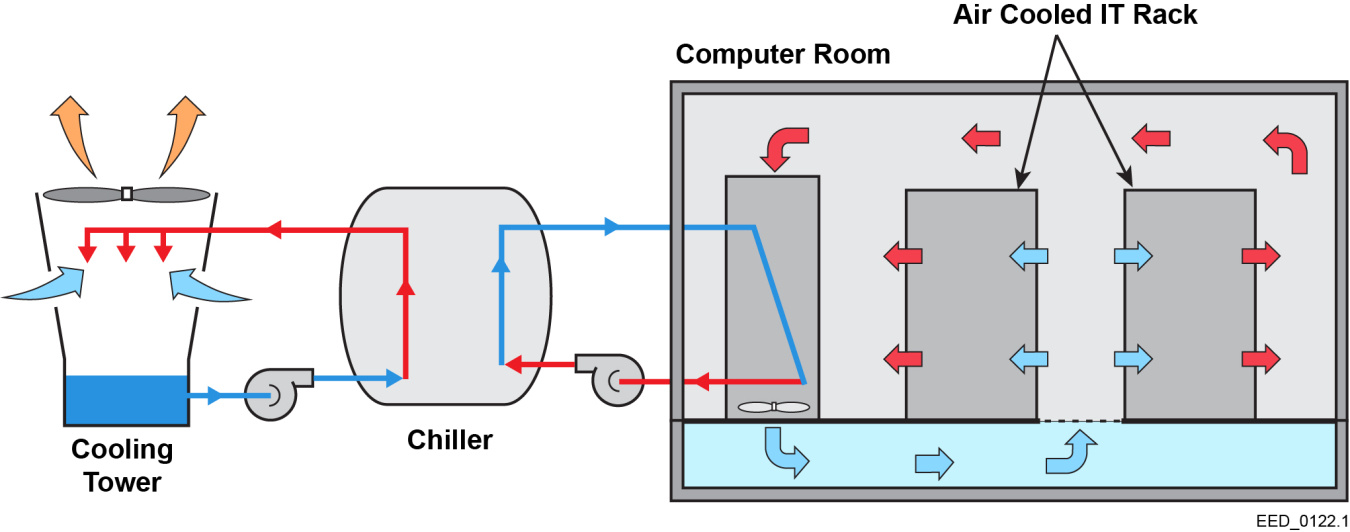
The red and blue paths help you follow warmer and cooler parts of the system, but do not treat every arrow as a fresh-water supply. The room-side chilled water returns to the chiller after collecting heat. The condenser water returns to the tower after collecting heat from the chiller. Returning water is still water already in the system.
Read the Department of Energy’s explanation alongside the diagram. Its short description identifies where heat changes hands without requiring you to know the chiller’s internal mechanics.
Cooling Water Efficiency Opportunities for Federal Data Centers | Department of Energy
Read the Department of Energy's description of a typical data center cooling system to connect the diagram's equipment to its two water loops.
In "Typical Data Center Cooling System," begin with the paragraph introducing Figure 1 and read the diagram explanation through the paragraph ending with heat dissipating to the surrounding atmosphere. Focus on which loop collects heat from the room and which loop takes it to the cooling tower.
The two loops have different jobs. Chilled water helps collect heat indoors but, in the arrangement shown, does not enter the cooling tower. Condenser water reaches the tower, where it can contact moving air. This is why the presence of a large chilled-water flow does not establish a large water loss—and why the tower is the key place to inspect for evaporation.
What happens when water reaches the tower?
Warm condenser water is distributed through the cooling tower. Some becomes water vapor and leaves with the outdoor air. That change of state takes energy from the water; the liquid left behind is cooler. It collects in a basin and is pumped back toward the chiller to carry more heat. The orange arrows above the tower indicate outgoing air carrying heat and moisture, not the entire circulating stream turning into vapor.
This short visual walkthrough makes the distinction between the returning liquid and the outgoing moisture easier to see.
Watch "How Cooling Towers Work" from The Engineering Mindset to see how water returns from the tower basin and how fresh water replaces losses.
Watch the circulating path, from warm water entering the tower through cooler water being pumped back to the chiller; notice that the outgoing air gains moisture. Then skip to the makeup inlet, where a supply line and valve maintain the basin's water level. The basin's return pipe carries circulating water; the supply line admits replacement water.
Circulation moves water; evaporation removes some of it from the liquid loop. The evaporated water has not ceased to exist. It has entered the atmosphere as vapor rather than returning through the tower basin. To keep operating at roughly the same water level, the system needs replacement water, often called makeup water.
Repeated use of the remaining liquid is precisely why a tower can circulate much more water than it takes in as makeup. Picture a pump moving the same bucketful through a circuit again and again. Counting every pass through the pump measures the work done by the circulating system, not the number of new bucketfuls supplied.
A large loop flow is not a large new-water flow
Suppose a tower system circulates 600 liters per minute through its condenser-water loop. A meter on that loop would register passing in an hour. That figure includes repeated passes by water already in the system; it does not mean of new water entered.
Now suppose 3 liters per minute evaporates and, for this simplified example, there are no other losses. Over an hour, evaporation removes . About of makeup water must enter to maintain the level—not . The pump can continue moving approximately around the loop because most of that water comes back.
Real towers can have other exits. Some water is deliberately drained as blowdown to control the buildup of dissolved minerals; small droplets may also escape with the air. Those outflows can increase the need for makeup water. They are not recirculation, but neither should every outflow automatically be described as evaporation or as water consumed by the surrounding basin. Where discharged water goes matters—a boundary question for the next lesson.
The Department of Energy describes evaporation and blowdown separately in the continuation of its article:
Cooling Water Efficiency Opportunities for Federal Data Centers | Department of Energy
Return to the Department of Energy article to see why the tower needs replacement water for more than one reason, without treating all of those reasons as evaporation.
Under "Low-Cost/No-Cost Water-Saving Opportunities at Existing Data Centers," find the paragraph beginning "A cooling tower system by necessity uses an extensive amount of water." Read the tower-water explanation through the parenthetical sentence about rising mineral concentration. Focus on the contrast between water that evaporates and water deliberately drained as blowdown.
When evaluating a reported flow, its meter location is therefore as important as its units. A meter on the condenser-water return describes circulating flow. A meter on the makeup line describes new supply entering the system. Even if both report liters per minute, they answer different questions.
Key takeaways
In the diagram, water repeatedly carries heat through cooling equipment, while the cooling tower provides an exit for heat to the outdoor air. Passing through a loop does not itself consume water: most liquid returns for another pass. Evaporation removes water from that liquid loop, so replacement water is needed to maintain its level. Other exits, such as blowdown, must be identified separately.
Next, you will set a clear boundary around the water system and distinguish water withdrawn, water consumed, and water discharged—including whether discharged water returns to its source basin.