Welcome. This course begins with the measurement problem behind many competing data-center water claims. Before comparing cooling systems or judging local impacts, you need to know whether two figures describe the same quantity over the same period.
In this lesson, you will convert water volumes and flow rates to liters or cubic meters, convert electrical power to energy over a stated period, and distinguish US from Imperial gallons. The aim is not to memorize a long conversion table; it is to make each comparison traceable. Estimated study time: 35–40 minutes.
Start with the kind of quantity, not the size of the number
A water volume is an amount, such as . A water flow rate is an amount per unit time, such as . Likewise, electrical power is a rate, measured in watts, while electrical energy is an amount accumulated over time, commonly measured in kilowatt-hours.
A rate cannot be compared directly with an amount. A report of “40 gallons per minute” does not specify a monthly volume unless you also know how long that flow continued. And a facility rated at 2 megawatts has not necessarily used the energy implied by running at 2 megawatts continuously: a rating may differ from its average operating power.
For this course, useful common units are cubic meters () for substantial water volumes and kilowatt-hours () for electrical energy. The bridge from smaller water volumes is:
The reporting period is part of the quantity. “Per month” might mean a specified 30-day interval or an actual calendar month of 28–31 days. Record which one a claim uses before converting it.
A gallon needs a qualifier
The image below shows why the word gallon alone is insufficient.
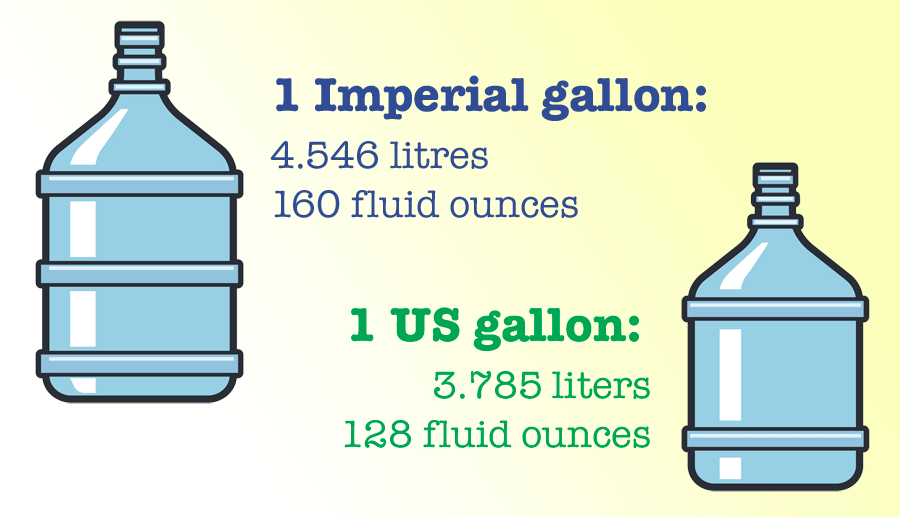
NIST gives more precise factors. Its table is a useful reference when a reported figure needs to withstand closer scrutiny.
NIST Guide to the SI, Appendix B.8: Factors for Units Listed Alphabetically | NIST
Read the National Institute of Standards and Technology's gallon entries to establish the two conversion factors used throughout this lesson.
In Appendix B.8, find the alphabetic “G” table. Read the gallon entries, beginning with the Imperial gallon rows and ending with the US gallon-to-liter row; stop before the “gallon (U.S.) per day” entries. Focus on the rows converting each gallon to liters and cubic meters. In the table's notation, “E+00” means multiply by one, while “E-03” means multiply by one-thousandth.
The factors to carry forward are:
For the same numerical gallon count, the Imperial volume is about 20% greater than the US volume. That is large enough to change the apparent gap between two claims. If a source says only “gallons,” preserve that uncertainty rather than silently treating them as US gallons. The same caution applies to “gallons per minute”: the gallon must be identified before you convert the rate.
Turn a water rate into a volume over a stated period
The central operation is straightforward: multiply a flow rate by the time for which it applies. The units show whether the calculation is set up correctly.
where is volume, is volumetric flow rate, and is elapsed operating time. For instance, multiplying liters per minute by minutes leaves liters.
Suppose a meter reports 40 Imperial gallons per minute while water is flowing. First convert the rate:
Now specify the period and schedule. If that rate holds for 8 hours per day over 30 days, the flow lasts minutes:
A common error is to use all 30 days as though the flow continued around the clock. Doing so would triple the result in this case, because 24 hours is three times the stated 8-hour daily operating period.
A rate may also vary rather than hold steady. In that case, calculate each interval separately and add its volume. For example, a rate of for two hours followed by for one hour gives:
An average rate over the entire period can be multiplied by the entire period. A rate measured during just one operating interval cannot safely be treated as that average. Neither calculation, by itself, tells you what the water flow represents—water entering a site, water moving within a cooling system, or something else. Later lessons will make that distinction explicit.
Turn electrical power into energy over the same period
Water claims often appear beside a facility's electrical load. To place both on a common timeline, keep power and energy distinct. A watt or megawatt expresses a rate of energy use; a watt-hour or megawatt-hour expresses energy used over time.
The following short video develops that distinction through worked calculations. Watch the specified portions; the later discussion of electricity-bill costs is not needed here.
What is a kWh - kilowatt hour + CALCULATIONS 💡💰 energy bill
Watch “What is a kWh – kilowatt hour + CALCULATIONS” from The Engineering Mindset for a visual explanation of power units and how operating time produces an energy total.
Watch power units for watts, kilowatts, and their relationship. Then watch worked calculations, focusing on why the duration must be expressed in hours when the desired answer is in kilowatt-hours.
The unit scales you will need are , , and . When power is constant—or is a known average for the stated period—energy is:
Suppose a facility's average electrical power is throughout the same 30-day period used above. That period contains hours. Its electrical energy is:
The word average matters. If were merely a maximum or equipment rating, the calculation would describe a continuous-operation scenario, not establish the facility's actual energy use.
As with water flow, changing power can be handled interval by interval. Use the power and duration for each interval, then add the resulting energies. Do not convert megawatts to megawatt-hours without a time assumption: they measure different kinds of quantities.
Put competing figures on one reporting sheet
Consider two statements about incoming water at otherwise comparable facility boundaries:
- Claim A: 1,000,000 US gallons over a specified 30-day period.
- Claim B: 40 Imperial gallons per minute, maintained for 8 hours per day during that same 30-day period.
Claim A is already a period total, so convert only its volume unit:
Claim B was converted above to approximately . Both can now be stated as cubic meters per specified 30-day period. You could also express each as an average cubic meters per day by dividing its 30-day total by 30—but retain the original schedule, because an average does not reveal when water was drawn.
This is a valid unit and time comparison only under the stated assumptions. It does not prove which facility has a greater environmental impact, and it would not compare like with like if one figure counted water entering a site while the other counted water circulating repeatedly inside it. Unit normalization removes one source of disagreement; it cannot repair a mismatch in what was counted.
A compact record for each claim is therefore: quantity measured, gallon system if applicable, original unit, operating schedule, reporting period, and normalized total. For electrical figures, also record whether a power value is a measured average, a maximum, or a rating.
Key takeaways
A volume or energy total needs a defined reporting period; a flow rate or power value needs time information before it becomes a total. Convert US and Imperial gallons with different factors, show units as they cancel, and use the same period for figures you intend to compare. If the schedule, gallon system, or meaning of a reported flow is unknown, leave the resulting uncertainty visible.
The next lesson moves from units to physical water flows. It will show why a large rate of water circulating through cooling equipment does not, by itself, mean that the facility consumes that much new water.