In our last lesson, we established a structured process for analyzing architectural trade-offs, concluding that every significant design choice is a compromise aimed at satisfying the most critical business drivers. Making a defensible decision is a crucial step, but it's only half the battle. How do you ensure that the rationale behind that decision—the context, the alternatives you rejected, and the consequences you accepted—survives beyond the meeting in which it was made? Without a record, teams can lose valuable institutional knowledge, new engineers lack context, and the same debates are often re-litigated months or years later.
This lesson introduces a simple yet powerful practice for solving this problem: the Architecture Decision Record (ADR). You'll learn how to write a concise ADR to document a significant design choice, its context, and its consequences, turning your architectural decisions into a lasting and valuable asset for your team.
The Problem of Lost Context
Before we dive into the "how," let's solidify the "why." With your extensive experience, you've undoubtedly encountered situations where you looked at a piece of a system and wondered, "Why on earth was it built this way?" The original reasons, which may have been perfectly valid at the time, are often lost as teams and priorities change.
The following video from the CodeOpinion channel clearly articulates this problem and introduces ADRs as a form of "log" that preserves the context surrounding a decision.
Architecture Decision Records (ADR) as a LOG that answers "WHY?"
This video, "Architecture Decision Records (ADR) as a LOG that answers 'WHY?'", effectively frames the core value proposition of ADRs.
Please watch the introduction where the problem is stated and the subsequent section on the importance of context. The speaker's emphasis on understanding the "why" and the circumstances of a decision is the foundational motivation for everything that follows.
As the video highlights, an ADR is not traditional documentation that can become stale. It is a point-in-time record of a decision, capturing the context of that moment. This collection of records becomes an immutable log of your architecture's evolution.
What Constitutes a "Significant" Decision?
ADRs are not meant for every technical choice. Documenting your choice of a JSON parsing library would be overkill. ADRs are reserved for architecturally significant decisions—choices that are difficult and costly to change. Michael Nygard, who popularized the concept, identified these as decisions affecting:
- The system's structure (e.g., microservices vs. monolith)
- Non-functional characteristics (the "-ilities")
- Dependencies between components
- Interfaces and APIs
- Construction or deployment techniques
The following flowchart provides a useful mental model for determining when a decision warrants an ADR.
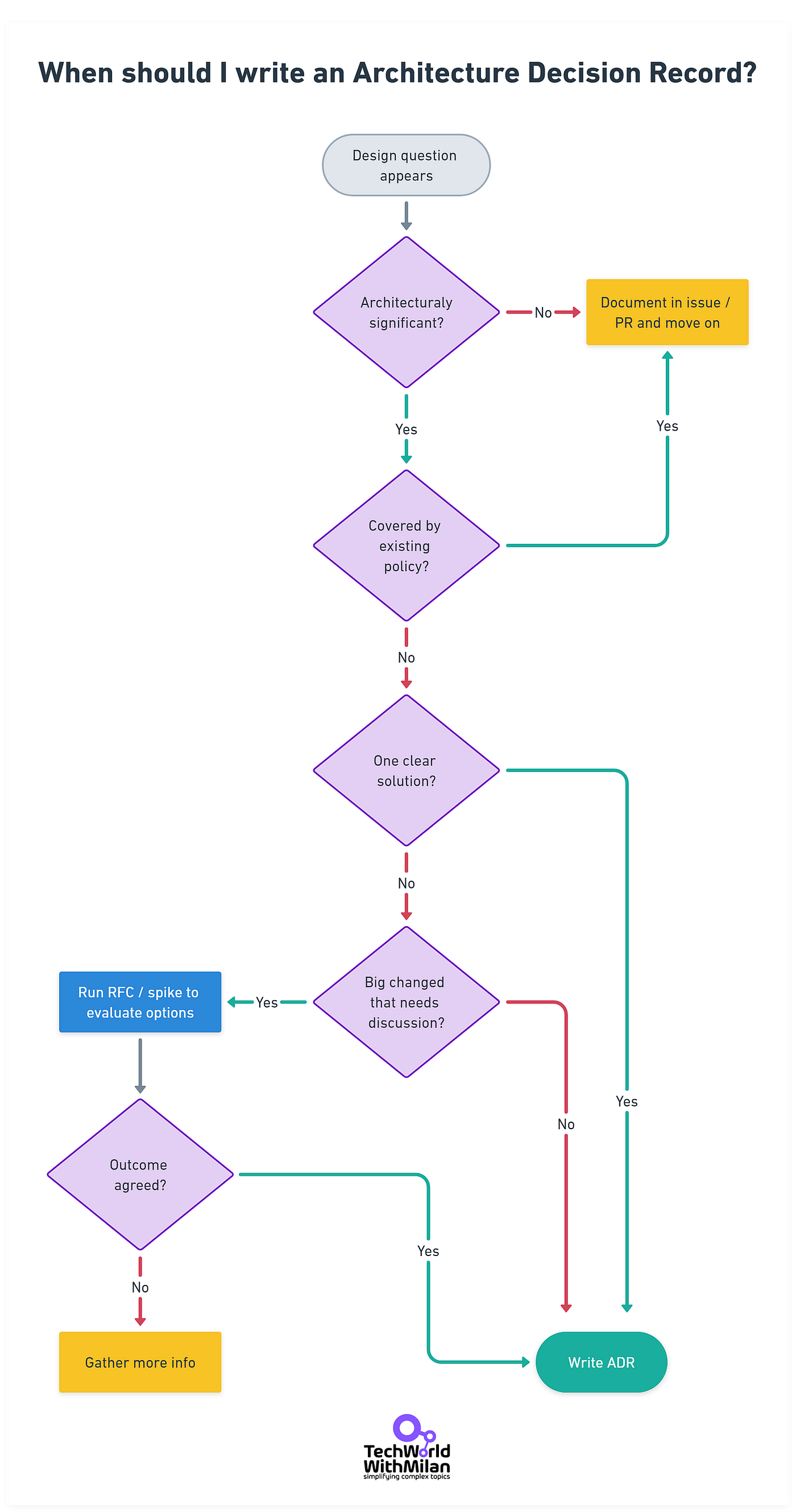
Essentially, if a decision is not easily reversible, has a wide-ranging impact, and involves trade-offs that are important for future architects to understand, you should write an ADR.
Architecture Decision Records (ADR): The Complete Guide - Archyl Blog
The Archyl Blog provides an excellent, practical guide to ADRs. This section gives clear criteria for when to write one.
Please read the section titled "When to Write an ADR". Pay attention to the distinction between decisions that are significant and those that are easily reversible or have a narrow scope.
The Anatomy of an ADR
While many templates exist, most share a common, lightweight structure. The goal is clarity and brevity, not bureaucracy. An ADR should capture a single decision and be no more than one or two pages.
In his "Software Architecture Monday" series, Mark Richards breaks down the five core sections of a classic ADR.
Lesson 55 - Architecture Decision Records
In this lesson on Architecture Decision Records, Mark Richards provides a concise overview of the essential components of an ADR.
Watch the segment from where he defines the five core sections: Title, Status, Context, Decision, and Consequences. This will give you a clear understanding of what each part is meant to capture.
As Richards explains, the key sections are:
- Title: A short, numbered phrase describing the decision.
- Status: The lifecycle state of the decision (e.g., Proposed, Accepted, Superseded).
- Context: The forces at play and the problem being solved. This is arguably the most critical section for future readers.
- Decision: The clear and unambiguous statement of the chosen course of action.
- Consequences: The trade-offs. What becomes better as a result of this decision, and what becomes worse?
Now, let's look at a detailed template and a complete example.
Architecture Decision Records (ADR): The Complete Guide - Archyl Blog
This article presents a well-structured template and a high-quality, realistic example that puts all the pieces together.
First, study the template provided in the section "The Standard ADR Template". Then, carefully read the complete example that follows, "ADR-0023: Use Apache Kafka for Inter-Service Communication". Note how the Context section includes concrete numbers and team skills, and how the Consequences section is intellectually honest about the negative outcomes.
The Kafka example you just read is a masterclass in writing an effective ADR. It is specific, references concrete business needs and technical constraints, evaluates alternatives thoughtfully, and transparently acknowledges the new problems the decision introduces (e.g., the need for distributed tracing).
Managing ADRs in Practice
To be effective, ADRs must be integrated into your team's workflow. They are living documents in the sense that their status can change, even if their content is a fixed historical record.
The most common and effective practice is to store ADRs as markdown files within your source code repository, often in a docs/adr or docs/decisions directory. This approach has several advantages:
- They are versioned alongside the code they describe.
- They are accessible to any developer who clones the repository.
- Changes to ADRs (e.g., moving from "Proposed" to "Accepted") can be reviewed via pull requests.
A key aspect of the ADR lifecycle is the Superseded status. You should never delete an old ADR. If a decision is later reversed, you create a new ADR for the new decision and update the status of the old one to "Superseded by ADR-XXXX". This preserves the historical rationale.
The video from Mark Richards briefly demonstrates a command-line tool that automates this process.
Lesson 55 - Architecture Decision Records
This final segment demonstrates how tools can simplify the management of ADRs.
Watch the part from where adr-tools is introduced. Focus on how it handles the creation of new ADRs and, more importantly, how it manages the "superseded" relationship between an old and a new decision.
Your Turn: Write an ADR
Now it's time to apply what you've learned. In the previous lesson, we analyzed the trade-offs between two architectural options for a payment system:
- A single, consolidated payment service.
- Separate services for each payment type (e.g., credit card, PayPal).
We concluded that if the primary business driver was time-to-market, then choosing separate services was the better decision, as it optimized for maintainability, testability, and deployability, despite the negative consequences for performance and data consistency.
Your task is to write an ADR for this decision. Use the template from the Archyl blog post and focus on clearly articulating:
- Context: The need to add new payment types quickly to support business growth.
- Decision: "We will implement separate services for each payment type."
- Alternatives Considered: Briefly describe the single service option and why it was rejected (e.g., slower to change, riskier deployments).
- Consequences: List the positive outcomes (faster time-to-market for new payment types) and the negative ones (increased latency for cross-service queries, need to manage consistency with patterns like sagas).
Take about 15 minutes to draft this. The goal is to create a concise record that would give a new team member all the necessary context to understand this crucial decision.
Conclusion
In this lesson, we have formalized the practice of documenting architectural decisions. You have learned that ADRs are a lightweight, agile-friendly tool for preserving the "why" behind your design choices, preventing knowledge loss and endless debate.
Here are the key takeaways:
- ADRs are a log, not documentation: They capture the context of a decision at a single point in time.
- Document significant decisions: Focus on choices that are impactful, have long-term consequences, and are costly to reverse.
- Use a simple, consistent template: A good ADR clearly states the context, the decision, the alternatives considered, and the consequences.
- Store ADRs with your code: Keeping them in the repository makes them accessible, versionable, and part of the team's daily workflow.
- Never delete; supersede: Preserve architectural history by creating new ADRs to overturn old ones.
By capturing the trade-off analysis from our previous lesson in a formal ADR, you've closed the loop from analysis to decision to documentation.
In our next lesson, we will broaden our perspective on architectural evaluation by examining the Architecture Tradeoff Analysis Method (ATAM). While ADRs provide a lightweight way to document individual decisions, ATAM offers a more comprehensive, stakeholder-driven framework for analyzing an entire architecture's fitness for purpose.