Welcome to the next lesson in our exploration of software architecture's foundations. In our previous session, we focused on Architecture Decision Records (ADRs), a lightweight practice for documenting the "why" behind individual, significant design choices. This ensures that the context and trade-offs of a decision are preserved over time.
However, architectures are more than just a collection of individual decisions; they are holistic systems where choices interact in complex ways. This raises a crucial question: how do we evaluate an entire architecture to ensure it meets its most important goals, especially when those goals conflict? This lesson introduces the Architecture Tradeoff Analysis Method (ATAM), a systematic framework for just that. You will learn its purpose as a risk discovery tool and understand the key phases of its structured process. For someone with your experience, this will likely formalize many of the implicit evaluation activities you've undertaken in past architectural reviews.
The Purpose of ATAM: A Risk-Finding Mission
At its core, ATAM is not about grading an architecture or proving it "correct." Instead, it is a method for identifying potential risks early in the lifecycle. The goal is to uncover areas where the architectural design might not adequately support the critical quality attributes—such as performance, security, or modifiability—that are driven by business goals.
The Software Engineering Institute (SEI) at Carnegie Mellon University, which developed ATAM, provides a precise definition of its purpose.
ATAM: Method for Architecture Evaluation
This document is the original, authoritative paper on ATAM. This first section clearly defines what ATAM is and what it is not.
Please read the introductory section, "What is the Purpose of the ATAM?". As you read, focus on its role as a risk identification method rather than a precise prediction tool.
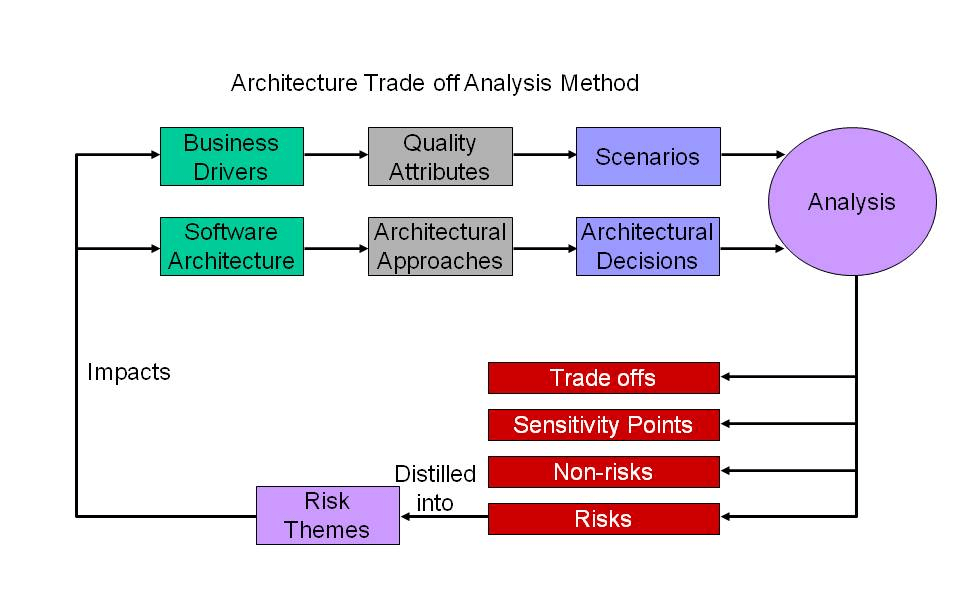
As the paper states, the analysis aims to reveal several key types of architectural properties:
- Risks: Architecturally significant decisions that are problematic, either because they haven't been made or their consequences are not fully understood.
- Non-Risks: Decisions that are confirmed to be sound.
- Sensitivity Points: Architectural properties (like the size of a thread pool or a network protocol) to which a specific quality attribute is highly sensitive.
- Trade-off Points: Architectural properties that are sensitivity points for multiple, conflicting quality attributes. For example, increasing encryption strength (a sensitivity point for security) might increase CPU load and latency (sensitivity points for performance), making the choice of encryption algorithm a trade-off point.
The ATAM process is designed to systematically uncover these points by connecting business drivers to architectural decisions.
The ATAM Process: A Tale of Two Phases
ATAM is a structured, multi-step process that is typically conducted in two main phases. This two-phase approach is a key practical insight, designed to make the evaluation efficient and effective.
-
Phase 1: Initial Analysis & Preparation. This phase involves a small group: the evaluation team, the architect, and perhaps a project manager. The goals are to perform an initial pass through the analysis, ensure the architecture is documented well enough to be evaluated, and prepare for the broader review. This is where the core architectural approaches are first identified and analyzed against the most obvious drivers.
-
Phase 2: Full Evaluation & Reporting. This phase brings in a wider group of stakeholders—developers, testers, users, maintainers, system administrators, and business representatives. Their diverse perspectives are crucial for uncovering a broader range of risks. The analysis from Phase 1 is validated and tested against scenarios brainstormed by this larger group.
This phased approach ensures that the valuable time of the full stakeholder group is used effectively, focusing on validation and deeper discovery rather than initial information gathering.
The Nine Steps of ATAM
Within these two phases, the ATAM unfolds over nine distinct steps. The following diagram provides a high-level overview of the sequence.

Now, let's get a concise description of what happens in each of these steps.
ATAM: A Comprehensive Guide to Architecture Evaluation
The blog "An Architect To Be" provides a clear and accessible summary of the ATAM process, which is a great way to get familiar with the steps before we break them down further.
Please read the section titled "The ATAM Process". This will give you a quick summary of the nine steps and how they are grouped into the two phases.
As you've just read, the nine steps provide a clear roadmap for the evaluation. Let's briefly contextualize these steps within four logical activities:
1. Presentation (Steps 1-3)
The evaluation begins by establishing a common understanding. The ATAM process is presented (Step 1), the business drivers are explained by project leadership (Step 2), and the architect presents the proposed architecture (Step 3). These initial steps ensure everyone is aligned on the goals of the system and the proposed solution.
2. Investigation and Analysis (Steps 4-6)
This is the core of Phase 1. The evaluation team works with the architect to identify the key architectural approaches (e.g., using a message queue, employing a layered style) (Step 4). Then, they collaboratively build a utility tree to prioritize the most important quality attribute requirements (Step 5)—a technique you'll recall from an earlier lesson. Finally, the architectural approaches are analyzed against these high-priority requirements to find the first set of risks, sensitivity points, and trade-offs (Step 6).
3. Testing (Steps 7-8)
Phase 2 kicks off by "testing" the analysis done so far. A broad group of stakeholders brainstorms a wide range of scenarios—use cases, growth scenarios, and exploratory "what-if" scenarios (Step 7). The group then votes to prioritize these. This step is powerful because it often reveals requirements and potential issues that the core team may have overlooked. The highest-priority scenarios are then used to re-analyze the architecture, potentially uncovering new risks or validating previous findings (Step 8).
4. Reporting (Step 9)
The evaluation concludes with the ATAM team presenting the consolidated findings to all stakeholders (Step 9). This includes a summary of the architectural approaches, the prioritized scenarios, the utility tree, and—most importantly—the documented lists of risks, non-risks, sensitivity points, and trade-off points. This final report becomes a critical input for the project's next steps, guiding efforts to mitigate risks and refine the architecture.
Conclusion
In this lesson, we have moved from documenting individual decisions with ADRs to evaluating an entire architecture with ATAM. You have learned that ATAM is a comprehensive, stakeholder-driven method designed to uncover architectural risks before they become major problems.
Here are the key takeaways:
- Purpose: ATAM's primary goal is to assess an architecture by identifying risks, non-risks, sensitivity points, and trade-off points where design decisions impact quality attribute requirements.
- Structure: The process is organized into two main phases—an initial analysis with a small team followed by a detailed evaluation with all relevant stakeholders.
- Key Phases: The nine steps guide the evaluation through a logical progression: presenting context, investigating the architecture, testing it with scenarios from diverse perspectives, and reporting the findings.
- Stakeholder & Scenario-Driven: ATAM's strength lies in its use of concrete scenarios and the involvement of a broad range of stakeholders to ensure a holistic evaluation.
Understanding the ATAM framework gives you a powerful mental model for conducting rigorous architectural reviews. The core of this process is the analysis itself—the activity in Steps 6 and 8 where you connect architectural decisions to quality requirements and identify potential issues.
In our next lesson, we will do a practical deep-dive into this very activity. You will be given a specific architectural approach and a set of quality requirements, and you will practice identifying the associated architectural risks and trade-off points, putting the analytical heart of ATAM into practice.