Welcome back. In our previous lesson, we organized our architectural requirements into a prioritized utility tree, giving us a clear view of our most important architectural drivers. We identified that the scenarios with both high business importance and high technical risk are the ones that must shape our design.
However, these drivers often pull the architecture in conflicting directions. A design choice that enhances performance might compromise security, and a decision that improves scalability might increase operational cost and complexity. This brings us to the very heart of the architect's role: navigating these conflicts. This lesson will equip you with a structured approach to analyze the trade-offs between competing quality attributes, enabling you to make conscious, defensible design decisions.
The First Law of Architecture: Everything is a Trade-off
As you know from your extensive experience building systems, there are no silver bullets. Every architectural decision involves a compromise. Mark Richards, a prominent software architect, famously codified this as the "First Law of Software Architecture: Everything is a trade-off." This principle states that no design choice is universally superior; its value is entirely dependent on the specific context and priorities of the system you are building.
Let's start by exploring this fundamental concept and some of the most common trade-offs architects face.
The First Law of Software Architecture: Understanding Trade-offs
This article from DEV Community provides a great introduction to the inevitability of trade-offs in architecture.
Please read the introduction, which states the "First Law," and the sections "Why Trade-offs Matter" and "Common Trade-offs". These sections list several classic conflicts between quality attributes, which will be familiar to you.
The article highlights pairs like Performance vs. Scalability and Cost vs. Reliability. The infographic below visualizes some of these common tensions in system design.
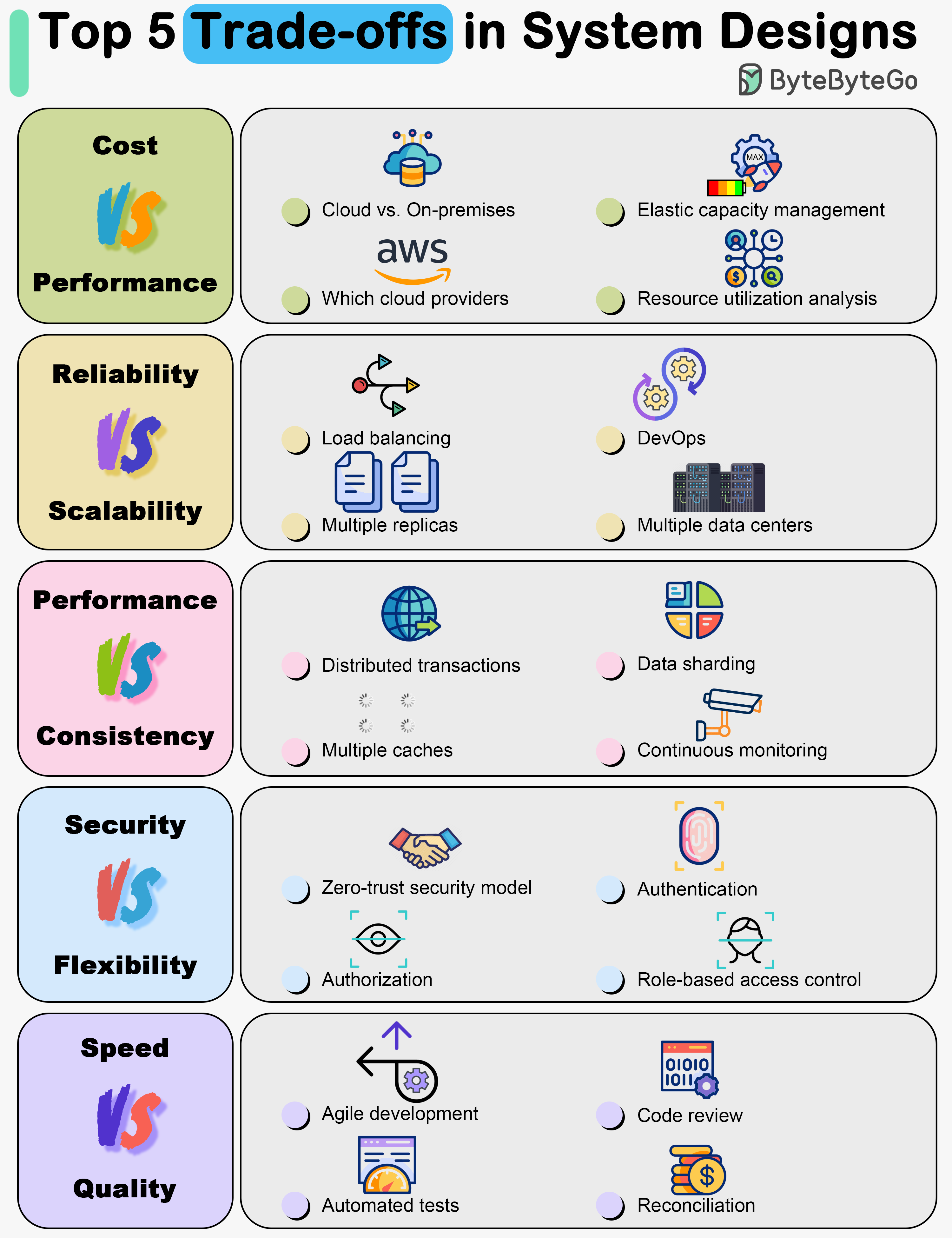
Making these trade-off decisions is the essence of architecture, distinguishing it from lower-level design. Architectural decisions are strategic, hard to change, and defined by their significant trade-offs. In the following video, architect Neal Ford explains this distinction and critiques older, more bureaucratic methods for trade-off analysis like ATAM (Architecture Tradeoff Analysis Method), setting the stage for more modern, agile-friendly techniques.
Modern Trade-off Analysis for Software Architecture - Neal Ford - DDD Europe
This talk from DDD Europe, "Modern Trade-off Analysis for Software Architecture," offers a contemporary perspective on this crucial skill.
Please watch the first two segments. The first part, The Essence of Architecture, introduces the "first law" and critiques traditional methods. The second part, Architecture vs. Design, clarifies why trade-off analysis is fundamentally an architectural concern, as it deals with system capabilities that cannot simply be "emerged."
As Neal Ford argues, the goal is not to find the "best" solution, which implies perfection, but rather the "least worst" combination of compromises that best serves the system's primary goals. To do that systematically, we need a structured approach.
A Structured Approach for Analyzing Trade-offs
A haphazard approach to trade-offs leads to inconsistent and fragile architectures. A structured process ensures that our decisions are deliberate, traceable, and aligned with business objectives. This process generally involves three key steps, which we will explore using a concrete example.
Step 1: Ground Decisions in Business Drivers
Our analysis must begin and end with the business. As we established in the previous lessons, architectural drivers are derived from business goals. A trade-off analysis that isn't connected to these goals is an academic exercise. For example, if the primary business driver is time-to-market, we translate this into architectural characteristics like maintainability, testability, and deployability. These become the criteria against which we measure our options.
Step 2: Analyze Scenarios and Extract Trade-offs
With our key characteristics identified, we can analyze how different architectural choices support or hinder them. We do this by walking through concrete usage scenarios.
Architect Mark Richards provides a crystal-clear demonstration of this process in the following video. He analyzes the decision between creating a single, consolidated payment service versus separate services for each payment type (e.g., credit card, PayPal, gift card).
Lesson 145 - Analyzing Tradeoffs
This short lesson from the "Software Architecture Monday" series provides a concise walkthrough of a practical trade-off analysis.
Watch the segments that demonstrate the structured process. First, see how to link business drivers to architectural characteristics. Then, follow the scenario analysis, where he evaluates the two options against different scenarios (updating a payment type, adding a new one, and using multiple types) to extract the specific trade-offs.
As the video demonstrates, the analysis revealed a clear conflict:
- Separate Services excelled in maintainability, testability, and extensibility.
- Single Service was superior in performance and data consistency.
Step 3: Make and Justify the Decision
The final step is to weigh the trade-offs against the prioritized business drivers. In the example from the video, because the primary driver was time-to-market, the characteristics of maintainability and deployability were paramount. Therefore, choosing separate services was the correct decision in that context, even though it introduced challenges around performance and distributed transactions. The analysis provides the rationale for this choice and also highlights the new problems the architecture must now solve (e.g., managing sagas for consistency).
This kind of analysis is often captured in a simple matrix to make the comparison explicit. This image from AWS shows how different resilience patterns stack up against various "-ilities" or quality attributes.

A Deeper Dive: Sensitivity and Formal Analysis
While the scenario-based approach is highly practical, your interest in formal methods like ATAM points to a deeper concept: sensitivity analysis. This involves identifying which architectural parameters have the most significant impact on quality attributes. A small change in a sensitive parameter can cause a large change in system behavior.
The classic SEI paper that first detailed the ATAM provides an excellent, quantifiable example. The authors model a remote temperature sensing system and analyze how changing a single parameter—the number of servers—creates trade-offs between performance, availability, and security.
[PDF] Steps in an Architecture Tradeoff Analysis Method: Quality Attribute ...
This document from the Software Engineering Institute (SEI) is one of the foundational papers on ATAM. While the modeling is mathematically intensive, the conclusion of the analysis is very insightful.
You don't need to read the complex model derivations. Instead, go directly to the section titled "5.2 Sensitivity and Tradeoffs" on page 26. Study the introduction to the concept of sensitive parameters and then carefully examine Table 5-1 and the accompanying explanation. Focus on how increasing the number of servers from 1 to 3 has positive effects on performance and availability but a negative effect on security.
As the paper demonstrates, increasing the number of servers:
- Improves Performance: Latency decreases because the load is distributed.
- Improves Availability: The downtime per year drops dramatically.
- Degrades Security: The probability of a successful "spoof attack" increases because there are more servers that could potentially fail, creating an opportunity for an attacker.
This is a perfect illustration of a win-win-loss trade-off. By identifying the number of servers as a sensitive parameter, architects can focus their attention on the decision that will have the most profound impact and can reason about the consequences in a principled way. This is the core value proposition of formal evaluation methods.
Conclusion
In this lesson, we've explored the fundamental challenge of architectural trade-offs. You now have a structured way to approach these critical decisions, moving from intuition to a defensible, evidence-based process.
Here are the key takeaways:
- Architecture is the Art of the Trade-off: There is no single "best" solution. The architect's primary job is to find the right balance of compromises for a specific context.
- Use a Structured Approach: Ground your analysis in business drivers, translate them into measurable architectural characteristics, and use concrete scenarios to evaluate your options.
- Visualize with Matrices: Tools like trade-off matrices make the consequences of different architectural choices clear to all stakeholders.
- Identify Sensitive Parameters: Focus on the architectural decisions that have the biggest impact. Formal methods like ATAM are designed to help uncover these "sensitivity points" and their cross-cutting effects.
Now that we have a method for analyzing trade-offs and making a decision, the next logical step is to document that decision clearly and concisely. In our next lesson, we will learn how to write an Architecture Decision Record (ADR), a lightweight but powerful tool for recording the context, decision, and consequences of a significant architectural choice.