Welcome to our third lesson on the foundations of political authority. In our previous discussions, we explored the stark choice presented by Hobbes between absolute sovereignty and chaotic anarchy, and then examined Locke's more optimistic vision of a limited government designed to protect pre-existing natural rights. Now, we turn to Jean-Jacques Rousseau, a thinker who offers a radical and profoundly different conception of the social contract.
Rousseau challenges the very terms set by his predecessors. He agrees with Hobbes that the state of nature is problematic and with Locke that freedom is paramount. However, his solution is neither to surrender freedom for security nor to delegate power to protect it. Instead, he proposes a form of association in which individuals merge to become a collective, and in doing so, transform the very meaning of freedom.
Today's lesson centers on Rousseau's most famous and challenging concept: the general will (volonté générale). We will explore what it is, how it differs from a simple majority vote, and its deep implications for how a community can and should make decisions. Understanding the general will is crucial, as it provides a powerful philosophical basis for collective action and a justification for a state that is far more interventionist than Locke could ever have endorsed.
The Social Contract as Transformation
Rousseau begins his most famous work, The Social Contract, with the dramatic declaration: "Man is born free, and everywhere he is in chains." Unlike Locke, he does not see a way to simply secure our natural freedom within society. For Rousseau, the moment we become dependent on others, our natural freedom is lost. The challenge of politics is not to preserve it, but to create a new, superior kind of freedom: civil and moral freedom.
This is achieved through a unique form of social contract. It is not a bargain where individuals give up rights in exchange for protection. Rather, it is an act of total alienation where "each of us puts his person and all his power in common under the supreme direction of the general will, and, in our corporate capacity, we receive each member as an indivisible part of the whole."
Through this act, individuals are transformed. They cease to be isolated persons and become citizens, indivisible parts of a new collective entity—the sovereign.
To begin, let's watch a brief overview of how this contract is structured and how it introduces the idea of the general will as its guiding principle.
Jean-Jacques Rousseau - The Social Contract | Political Philosophy
This video by James Muldoon, from the same series as the one we watched on Locke, outlines Rousseau's fundamental problem and how his social contract aims to enhance, rather than merely protect, freedom.
Please watch the section from the beginning of the discussion on the social contract. Pay close attention to how Rousseau frames the problem: finding a form of association where each person, while uniting with all, "obeys no one but himself and remains as free as before." Note the key phrase: the contract places everyone "under the supreme direction of the general will."
The General Will vs. The Will of All
The entire legitimacy of Rousseau's state rests on this concept of the general will. So, what is it? It is perhaps easiest to understand by first understanding what it is not. Rousseau draws a critical distinction between the general will and the will of all.
- The Will of All (volonté de tous) is simply the sum of all the private, selfish interests of individuals. It's what you get when you ask everyone "What do you want for yourself?" and tally the votes. This often results in compromise, conflict, and policies that benefit powerful factions.
- The General Will (volonté générale), in contrast, is the will of the community when it is focused on the common good. It emerges when citizens ask themselves, "What is best for the community as a whole?" It is a singular, collective, rational will that always aims at the well-being of the body politic.
Let's clarify this crucial distinction with a reading and a short video analogy.
Understanding Rousseau's Theory of General Will
This article from the PolSci Institute provides a very clear explanation of the difference between the 'will of all' and the 'general will', using a helpful canteen example.
Please read the section titled "General Will vs. Will of All: The crucial distinction." Focus on the conceptual difference: the will of all is an aggregation of private interests, whereas the general will emerges when citizens focus on the collective benefit.
The following video offers another simple, effective illustration of this idea.
PHILOSOPHY - DEMOCRACY 5: Rousseau’s Defense of Democracy
This video from Wireless Philosophy uses a modern example to make the distinction between a person's particular will and the general will perfectly clear.
Watch the segment from the introduction of the general will. The analogy of choosing to drive a car (particular will) versus taking the bus to reduce pollution for everyone (general will) is an excellent way to grasp the core concept.
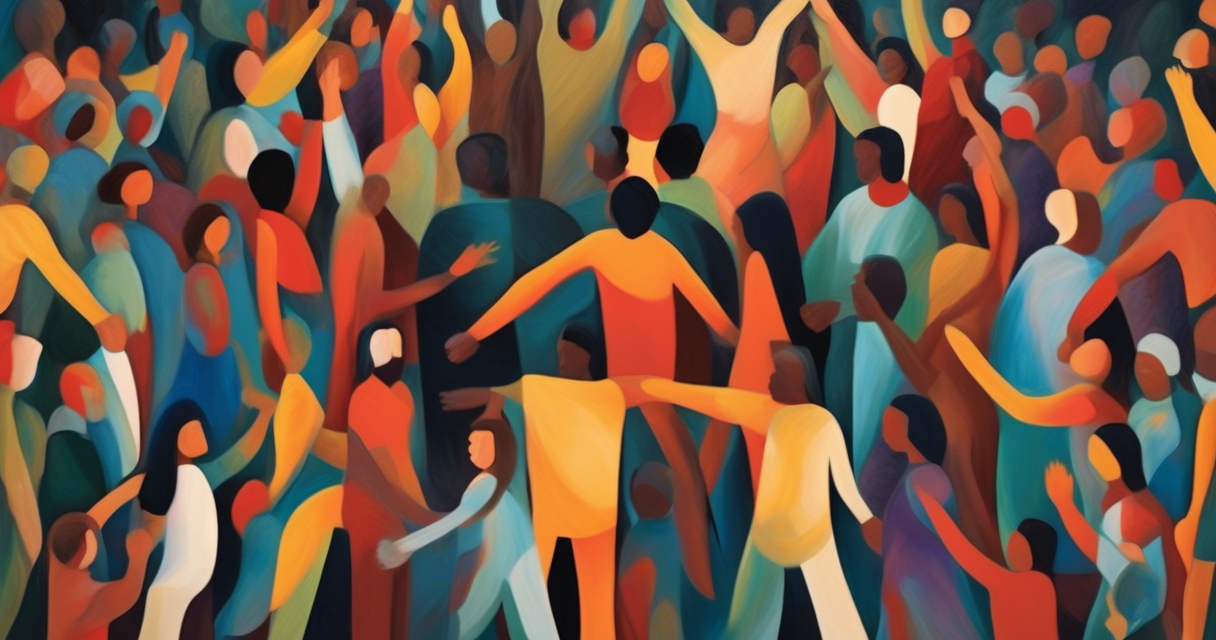
The general will, therefore, is not a compromise between interests but a shared commitment to the interest of the whole. When individuals come together to form a state, they create a collective body, a public person. The image below abstractly captures this idea of individuals forming a unified whole, a "people" capable of having a single, collective will.
The Conditions for the General Will
Rousseau was not naive; he understood that the general will would not magically appear every time a vote was called. He argued that several demanding conditions must be met for a community to be capable of discerning and enacting it:
- Informed and Deliberating Citizens: The people must understand the issues. Critically, Rousseau argued against the formation of factions or political parties. He believed deliberation should happen within each citizen's own mind, as they reflect on the common good, not as they are swayed by interest groups.
- Focus on the Common Good: Citizens must be motivated by civic virtue. They must enter the legislative assembly with the intent to discover what is best for all, not to push for their private advantage.
- A Substantial Degree of Equality: Rousseau famously stated, "No citizen shall ever be rich enough to buy another and none poor enough to be forced to sell himself." If economic inequality is too great, the rich and poor will no longer share a common interest, and politics will devolve into class warfare, making a true general will impossible.
- Generality of Law: The general will can only decide on matters that affect everyone equally. It must create laws that are general and abstract, never targeting specific individuals or groups. As the Stanford Encyclopedia of Philosophy entry explains, this forces citizens to think from a universal perspective. Because the law will apply to them just as it applies to everyone else, their self-interest guides them toward impartial rules.
This academic resource provides a more rigorous analysis of these conditions.
Jean-Jacques Rousseau - Stanford Encyclopedia of Philosophy
This entry provides a deeper analysis of the nature of the general will and the conditions for its existence.
In the section "3.1 The idea of the general will," please read the second paragraph. Focus on the formal aspect that the law must be general and universal. Note the crucial insight that this condition works only when the "situation of citizens is substantially similar to one another," highlighting Rousseau's emphasis on equality.
"Forced to be Free": Reconciling Authority and Freedom
This brings us to the most controversial and paradoxical statement in Rousseau's philosophy. If the general will is the expression of the people's sovereignty, and a law is passed accordingly, what about those who voted against it? Rousseau's answer is startling: "whomsoever refuses to obey the general will shall be constrained to do so by the whole body, which means nothing other than that he shall be forced to be free."
How can being forced to do something make you free? The logic depends on Rousseau's redefinition of freedom.
- Natural Freedom: This is the freedom of the state of nature—doing whatever you want, limited only by your own power. Rousseau sees this as the freedom of an animal, a slave to impulse.
- Civil Freedom: This is the freedom you gain in civil society—the security of being protected by the laws of the community and having your property rights guaranteed.
- Moral Freedom: This is the highest form of freedom. It is "obedience to a law which we prescribe to ourselves." It is the freedom of self-governance, of acting rationally and in accordance with principles you have chosen, rather than being ruled by your appetites.
For Rousseau, the general will is the law that we, as rational citizens, have prescribed for ourselves. When your particular, selfish will conflicts with the general will, it is your lower, impulsive self rebelling against your own higher, rational self. Therefore, when the community compels you to obey the law, it is liberating you from your own base instincts and forcing you to act in accordance with the freedom you yourself willed as a citizen.
Let's examine this challenging idea more closely.
Jean-Jacques Rousseau - Stanford Encyclopedia of Philosophy
This section of the SEP article unpacks Rousseau's claim to reconcile freedom and authority.
Please read the section "3.3 Rousseau’s claim to reconcile freedom and authority." Pay close attention to the distinction between natural, civil, and moral freedom. This is the key to understanding his argument that obedience to the general will is the highest form of liberty.
Implications and Criticisms
Rousseau's theory has profound implications. It establishes a concept of popular sovereignty where the people themselves, assembled together, are the ultimate legislative authority. This sovereignty is absolute, inalienable, and indivisible. Unlike Locke, Rousseau argues that sovereignty cannot be represented; the moment a people gives itself representatives, it is no longer free.
However, the theory also opens the door to significant dangers, which critics have pointed out for centuries:
- The Tyranny of the Majority: What if the majority is wrong? Rousseau's claim that a dissenting individual has simply "made a mistake" about the general will can seem to dismiss legitimate minority viewpoints and rights.
- The Identification Problem: In a large, complex society, how can we truly know what the general will is? The concept can be easily hijacked by charismatic leaders or a ruling party claiming to speak for "the people" while actually pursuing their own agenda. This has led some to view Rousseau as an intellectual forerunner of modern totalitarianism.
- Suppression of Individuality: The requirement for cultural homogeneity and the condemnation of factions can be seen as hostile to the pluralism and diversity that characterize modern liberal democracies. For Rousseau, there are no pre-political, inalienable rights in the Lockean sense. All rights are granted by the community and can be modified by the general will for the sake of the common good.
Conclusion
Rousseau's concept of the general will is a powerful and unsettling idea. It offers a vision of a truly democratic society where citizens are not just protected by the law but are the authors of it. It elevates the collective and the common good over the private and the individual. In doing so, it provides a strong justification for a state that actively shapes its citizens and intervenes in social and economic life to maintain the equality necessary for the general will to function. This stands in stark contrast to Locke's minimal state, which acts merely as an umpire for pre-existing individual rights.
Key Takeaways:
- The general will is the collective will of the citizen body when it is focused on the common good, as distinct from the will of all, which is the sum of private interests.
- For the general will to emerge, society requires conditions like economic equality, civic virtue, and the absence of factions.
- Rousseau redefines freedom. Moral freedom, the highest form, is obedience to a law one prescribes for oneself.
- The concept of being "forced to be free" means compelling an individual to obey the general will, thereby liberating them from their own selfish impulses and making them realize their true, rational freedom as a citizen.
- Sovereignty for Rousseau is the exercise of the general will; it is popular, absolute, and cannot be represented. This has radical democratic but also potentially illiberal implications.
We have now examined three competing visions of the social contract. Hobbes gives us security at the price of liberty. Locke gives us limited government to protect our natural liberty. Rousseau gives us a radical transformation of liberty itself, finding its highest expression in collective self-rule.
In our next lesson, we will place these three monumental thinkers side-by-side. We will systematically compare and contrast their theories of the state of nature, the social contract, and the scope of government authority to fully map out the foundational arguments that shape our entire debate on state intervention.