Welcome to the fourth lesson in our module on the foundations of political authority. Over the past three lessons, we have delved into the individual philosophies of Thomas Hobbes, John Locke, and Jean-Jacques Rousseau, exploring their unique conceptions of the state of nature and the social contract. We've seen Hobbes's argument for an all-powerful Leviathan to save us from chaos, Locke's case for a limited government to act as a neutral arbiter protecting our natural rights, and Rousseau's radical vision of a society governed by the collective "general will."
Now, it is time to bring these three foundational thinkers together for a direct, systematic comparison. This lesson will place their theories side-by-side to highlight their crucial points of divergence. By examining their contrasting assumptions about human nature, the structure of their social contracts, and their ultimate conclusions about sovereignty, we will map out the philosophical landscape that underpins the entire debate about the proper role and scope of government. This comparative analysis is essential for understanding how different answers to the question "Why do we have government?" lead to vastly different political systems.
A Tale of Three Contracts: An Overview
At the heart of the social contract tradition lies a single question: How can the authority of the state be justified? Hobbes, Locke, and Rousseau each provide a distinct answer, but their paths diverge right from the beginning. To get a quick sense of their contrasting positions, let's start with a video that concisely lays out their core arguments.
Hobbes vs. Locke vs. Rousseau - Social Contract Theories Compared
This video from Korczyk's Class provides an excellent high-level comparison of the three major social contract theorists. It will help frame our more detailed analysis.
Please watch the entire video. As you watch, focus on the following key comparisons: Hobbes's view of human nature as "destructive" versus Locke's "blank slate" (Hobbes and Locke). Rousseau's belief that society itself is the source of corruption (Rousseau's view). The video's final summary of their "catchphrases": Hobbes's "nasty, brutish, and short," Locke's "life, liberty, and property," and Rousseau's "everywhere in chains" (Summary).
This overview sets the stage. Now, let's dissect their theories in greater detail by consulting a foundational academic text. This will provide the necessary depth for our point-by-point comparison.
The Internet Encyclopedia of Philosophy provides clear, concise, and academically rigorous entries. Reading these sections will solidify your understanding of each philosopher's complete argument before we compare them.
Please read the sections on each of our three thinkers: Navigate to section "2. Modern Social Contract Theory." Read subsection a. Thomas Hobbes. Then, read the following subsection, b. John Locke. Finally, read subsection c. Jean-Jacques Rousseau. As you read, mentally construct a table comparing their views on human nature, the state of nature, the reason for forming a contract, and the nature of the resulting government.
Point of Departure: The State of Nature
As you've now seen, the final destination (the nature of the state) is determined by the starting point (the nature of man).
- Hobbes begins with a deeply pessimistic view. For him, the state of nature is a "war of all against all." Humans, being fundamentally self-interested and driven by a fear of violent death, live lives that are "solitary, poor, nasty, brutish, and short." There is no right or wrong, only a perpetual struggle for survival.
- Locke offers a more moderate perspective. His state of nature is governed by a divinely given Law of Nature, which reason allows us to comprehend. This law dictates that we have natural rights to life, liberty, and property. His state of nature is not a state of war, but it is fraught with "inconveniences"—namely, the lack of an impartial judge, a known law, and the power to enforce just rulings.
- Rousseau presents an almost romanticized vision. His "noble savage" lives a solitary, simple life, driven by self-preservation and a natural pity (pitié) for others. This state is peaceful and content. It is the invention of private property and the development of society that corrupt this natural goodness, leading to inequality, envy, and conflict.
This fundamental disagreement on the initial human condition is the first and most important point of contrast. Hobbes's solution must be potent enough to tame beasts, Locke's need only remedy inconveniences among rational men, and Rousseau's must aim to restore a lost purity in a new social form.
The Pact: How the Contract is Formed
Given their different diagnoses of the problem, it is no surprise that they prescribe different kinds of contracts.
[PDF] Social Contract Theories of Hobbes, Locke and Rousseau
This article provides a direct comparison of the contract terms and the resulting character of sovereignty, which is exactly what we need to focus on now.
Please read the section titled Terms of the Contract. Focus on how the article distinguishes between a single contract (Hobbes, Rousseau) and a multi-stage one (Locke), and the crucial difference in what rights are surrendered.
As the reading highlights, the structure of the agreement differs significantly:
-
Hobbes: The Pact of Alienation. Individuals, desperate to escape the state of nature, make a single, irreversible pact. They agree with each other to surrender all of their rights and powers (except for the right to defend their own life) to a third party—the Sovereign. The Sovereign is a result of the contract, not a party to it, and is therefore not bound by its terms. It is a one-way transfer of power for the sake of security.
-
Locke: The Pact of Delegation. This is a two-step process. First, individuals agree to form a political community. Second, that community agrees to set up a government and delegate specific, limited powers to it. Crucially, they only give up one right: the right to personally judge and punish offenders of the Law of Nature. All other natural rights (life, liberty, property) are retained. The government acts as a "trustee," and if it violates the terms of that trust, the people can dissolve it.
-
Rousseau: The Pact of Association. Like Hobbes, this is a single, total alienation. However, individuals do not surrender their rights to an external ruler. They surrender them to the community as a whole. In doing so, they create a new, collective entity: the sovereign "people" governed by the general will. As Rousseau sees it, because each person gives himself to all, he gives himself to no one. They lose their "natural liberty" but gain a more profound "civil and moral liberty" as an indivisible part of the whole.
The Leviathan, The Umpire, and The General Will: The Scope of Authority
The differences in the state of nature and the terms of the contract culminate in three vastly different models of government authority. The following video offers a superb visual and conceptual breakdown, particularly contrasting Hobbes and Locke.
Thomas Hobbes and John Locke: Two Philosophers Compared
Tom Richey's comparison of Hobbes and Locke is exceptionally clear. He uses a graphic organizer to great effect, which we will use to structure our final comparison.
Watch the video from his discussion of Hobbes through the end of the graphic organizer comparison. Pay close attention to the chart that directly contrasts Hobbes and Locke on the purpose of government, the location of sovereignty, and the right to revolution.
Using the structure from the video and incorporating Rousseau, we can summarize their positions in a comparative framework. The table below, "Comparisons Between Hobbes, Locke and Rousseau," is an excellent tool for this synthesis.
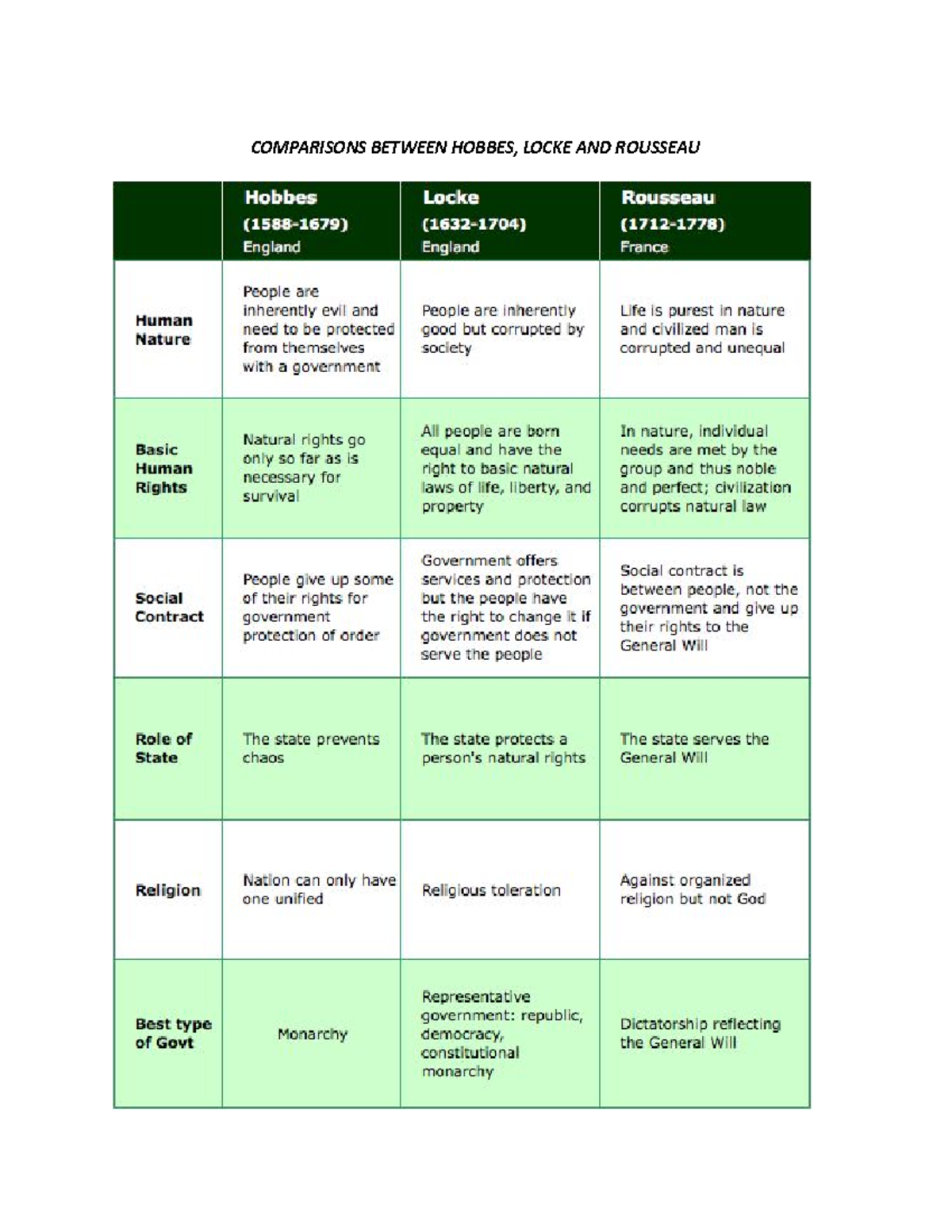
Let's break down the key categories from this table:
-
Sovereignty:
- Hobbes: Lies with the monarch or ruling assembly (the Leviathan). It is absolute and indivisible.
- Locke: Ultimately lies with the people, who delegate limited powers to a government. Power is separated and limited by law.
- Rousseau: Lies with the people as a collective body expressing the general will. It is absolute, inalienable, and indivisible, just like Hobbes's, but it is a popular sovereignty.
-
Role of the State / Scope of Authority:
- Hobbes: To prevent chaos and maintain order. The scope of authority is unlimited. The sovereign can do whatever is necessary to ensure peace, and there is no right to resist.
- Locke: To act as a neutral judge and protect the natural rights (life, liberty, property) that individuals already possess. The scope is strictly limited by the Law of Nature and the terms of the trust. If the state oversteps, it can be overthrown.
- Rousseau: To enact the general will and serve the common good. The scope is potentially total. Since all rights are granted by the community, the general will can legislate on any matter—including property, education, and public morality—to foster civic virtue and maintain the equality necessary for the state's functioning.
-
Liberty:
- Hobbes: True liberty is found only in the "silence of the law"—areas where the sovereign has not issued a command. Security is valued far above liberty.
- Locke: Liberty is a natural right, protected from government interference. It means being free from arbitrary power, constrained only by the rule of law which protects everyone's rights.
- Rousseau: Liberty is transformed from the "natural freedom" to do as one pleases into "moral freedom"—obedience to a law one prescribes for oneself as part of the general will. One can be "forced to be free."
Conclusion
In this lesson, we have systematically compared the social contract theories of Hobbes, Locke, and Rousseau, revealing how they construct three distinct justifications for state authority. Their profound disagreements are not arbitrary but flow logically from their initial premises about human nature.
Key Takeaways:
- Starting Assumptions Dictate Outcomes: Hobbes's pessimistic view of human nature leads to an absolute sovereign for security. Locke's view of rational individuals with natural rights leads to a limited government for protection. Rousseau's belief in natural goodness corrupted by society leads to a totalizing general will to achieve collective freedom.
- Sovereignty is the Core Issue: For Hobbes, sovereignty is alienated to a ruler. For Locke, it is delegated in trust but retained by the people. For Rousseau, it is fused into a new, collective popular sovereign.
- The Scope of Government Varies Dramatically: Hobbes justifies an unlimited government to prevent anarchy. Locke justifies a minimal "night-watchman" state to protect property and rights. Rousseau justifies a potentially all-encompassing state that can regulate society to serve the common good.
These three models are not merely historical artifacts. They represent three enduring paradigms of political thought. Hobbes provides the ultimate argument for security over liberty. Locke provides the foundational grammar for classical liberalism and constitutionalism. Rousseau provides the most powerful case for popular sovereignty and the pursuit of a collective good.
In our next lesson, we will see how these foundational theories directly inform the arguments for and against government intervention. We will explore how Hobbes's focus on order, Locke's emphasis on individual rights, and Rousseau's concern for the collective good set the stage for the entire debate that is the focus of this course.