Welcome to the final lesson of our first module. In the previous lesson, we conducted a detailed comparative analysis of Hobbes, Locke, and Rousseau, placing their theories of the social contract side-by-side. We established how their differing views on human nature and the state of nature lead to three distinct models of political authority: Hobbes’s absolute sovereign, Locke’s limited government, and Rousseau’s collective general will.
This lesson builds directly on that comparison. Our goal now is to connect these foundational theories to the central theme of our course: the debate over government intervention. We will move from the abstract question of why government is legitimate to the practical question of what a legitimate government is entitled to do. You will see how each philosopher’s social contract theory provides a distinct and powerful justification for a particular stance on the scope of state action, laying the intellectual groundwork for the major pro- and anti-interventionist arguments we will explore in later modules.
From Social Contract to Government Action
The link between a social contract theory and its implications for government intervention is not arbitrary; it is a matter of logical consistency. The purpose for which the state is formed dictates the legitimate scope of its powers. A useful way to formalize this is to think of every social contract theory as having a common logical structure.
Overview of Social Contract Theories
This academic paper offers a framework for understanding social contract theories that will be very helpful for our purposes. It describes the structure of the argument in a way that clarifies how different starting points lead to different conclusions about the rules of society.
Please read the first section of the paper, "What They Are, What They Are For", and then focus on the formalized description that follows. Pay close attention to the formula: N chooses R in M.
As the paper explains, we can think of any social contract theory as an argument where:
- N represents the idealized individuals (the agents making the choice).
- M is the choice situation (e.g., the State of Nature).
- R is the set of rules or social arrangements they agree to.
The core of our lesson today is to see how the different specifications of N and M by Hobbes, Locke, and Rousseau lead to fundamentally different sets of rules (R), which in turn define the legitimate scope of government intervention.
Hobbes: Intervention for Security and Order
Hobbes's starting point is the most severe. His choice situation (M) is a "war of all against all," and his agents (N) are rational but driven primarily by the fear of violent death. The only rational choice is to agree to a set of rules (R) that establishes an absolute sovereign with unlimited power to maintain peace.
What does this "unlimited power" mean for government intervention? It means the sovereign can, and should, intervene in any aspect of life—including the economy—if it serves the ultimate goal of security. For Hobbes, economic matters are not separate from political stability; they are integral to it.
Economic Views of Thomas Hobbes Author(s): Aaron Levy ...
This article by Aaron Levy is an excellent resource because it focuses specifically on the economic implications of Hobbes's political philosophy. It demonstrates that his views on state intervention are a direct consequence of his core principles.
Please read the following sections from the article: First, to understand the state's role in the economy, read about its function to promote industry and welfare, starting from the sentence "Since the desire for peace...". Next, read the short passage on public charity, which begins "For those who through misfortune...". Most importantly, read the section on property rights. This is crucial. Start at "In relation to economic doctrine..." and continue to where it discusses the subject's liberty, ending here. As you read, consider how each form of intervention is justified by the overarching need for stability.
The key takeaways from this reading are profound for the intervention debate:
- Property is a creation of the state: In the Hobbesian framework, there is no natural right to property. Property rights ("mine and thine") are defined and distributed by the sovereign’s law. This means the sovereign has the ultimate authority to regulate, tax, and even redistribute property to maintain order.
- Economic welfare is a political tool: Hobbes argues that the sovereign should promote commerce, encourage industry, and provide public charity for the infirm. This is not out of a primary concern for justice or equality, but because poverty and idleness lead to unrest and sedition. A prosperous and orderly economy is a secure state.
- Individual liberty is residual: Economic freedoms, like the liberty to buy and sell, exist only in the "silence of the law"—areas where the sovereign has not legislated. There is no protected sphere of economic activity that is off-limits to the state.
Conclusion for Hobbes: The Hobbesian social contract provides a powerful argument for a highly interventionist state. The government's mandate is to ensure security, and this justifies extensive control over economic life, from defining property to managing welfare, all in the service of preventing a return to chaos.
Locke: Intervention as a Threat to Liberty
Locke presents a starkly different model. His choice situation (M) is a state of nature governed by natural law, and his agents (N) are reasonable beings endowed with natural rights. The problem is not a war of all against all, but the "inconveniences" of lacking a neutral judge to protect these rights. Therefore, the rules (R) they agree to establish a limited government whose sole purpose is to act as a trustee, protecting the pre-political rights to life, liberty, and especially property.
This framework lays the foundation for arguments against government intervention.
- Property is a natural right: Unlike Hobbes, Locke insists that property rights exist prior to government. Individuals create property by mixing their labor with the natural world. The government is formed to protect this pre-existing right, not to create it.
- The "Night-Watchman" State: The legitimate function of government is analogous to that of a night watchman: to protect citizens from force and fraud. It acts as an impartial umpire, enforcing contracts and protecting property. It is not meant to manage the economy, direct investment, or redistribute wealth.
- Taxation as a Violation: From a strict Lockean perspective, taxation is deeply problematic. Since the government’s purpose is to protect property, taking that property through taxation is a potential violation of its core mandate. It is only made legitimate by the consent of the governed (or their representatives) and only for the limited purpose of funding the state's protective functions. Widespread redistribution of wealth would be an illegitimate use of state power, as it involves taking property from one person to give to another, violating the natural rights of the former.
The video below, which you saw in the last lesson, effectively contrasts Locke's vision of a limited government with Hobbes's Leviathan.
The Social Contract - Thomas Hobbes & John Locke
This video from Philosophy Vibe clearly explains the Lockean model.
To refresh your memory on Locke's position, re-watch the sections explaining his theory of natural rights and the limited role of government, and the subsequent discussion of the right to overthrow a government that oversteps its bounds.
Conclusion for Locke: The Lockean social contract is the philosophical bedrock of classical liberalism and libertarianism. It provides a rights-based argument for minimal government intervention. The state should be a neutral protector of rights, not an active manager of society. Any intervention beyond this limited scope is a threat to individual liberty.
Rousseau: Intervention for the Common Good
Rousseau offers a third, distinct logic for intervention. His diagnosis is that the "noble savage" in the state of nature is corrupted by society, particularly by the emergence of private property and the resulting inequality. The choice situation (M) is an agreement to form a new collective entity, and the agents (N) surrender themselves completely to this community. The resulting set of rules (R) is the expression of the "general will," which aims for the common good.
This framework can justify a form of government intervention that is both extensive and transformative.
- Property is subordinate to the community: As with Hobbes, individuals surrender all their rights, including property, upon entering the social contract. However, they surrender them not to a monarch, but to the community itself. The state, as the enforcer of the general will, can therefore regulate property to prevent the extreme inequality that Rousseau saw as the source of society's ills. The right to property is conditional on its alignment with the common good.
- The State as a Moral Agent: For Rousseau, the state is not just a security apparatus (Hobbes) or an umpire (Locke); it is a moral agent with a positive mission. Its purpose is to foster civic virtue and make people "free" by ensuring they live under laws they have prescribed for themselves as part of the collective. This can justify a wide range of interventions—in education, public morality, and the economy—designed to shape citizens and promote equality.
- Redistribution for Equality: A Rousseauian state could justify significant wealth redistribution not as charity, but as a necessary condition for a functioning republic. If vast inequality makes the rich dominate the poor and corrupts the general will, then the state has a duty to intervene to reduce that inequality.
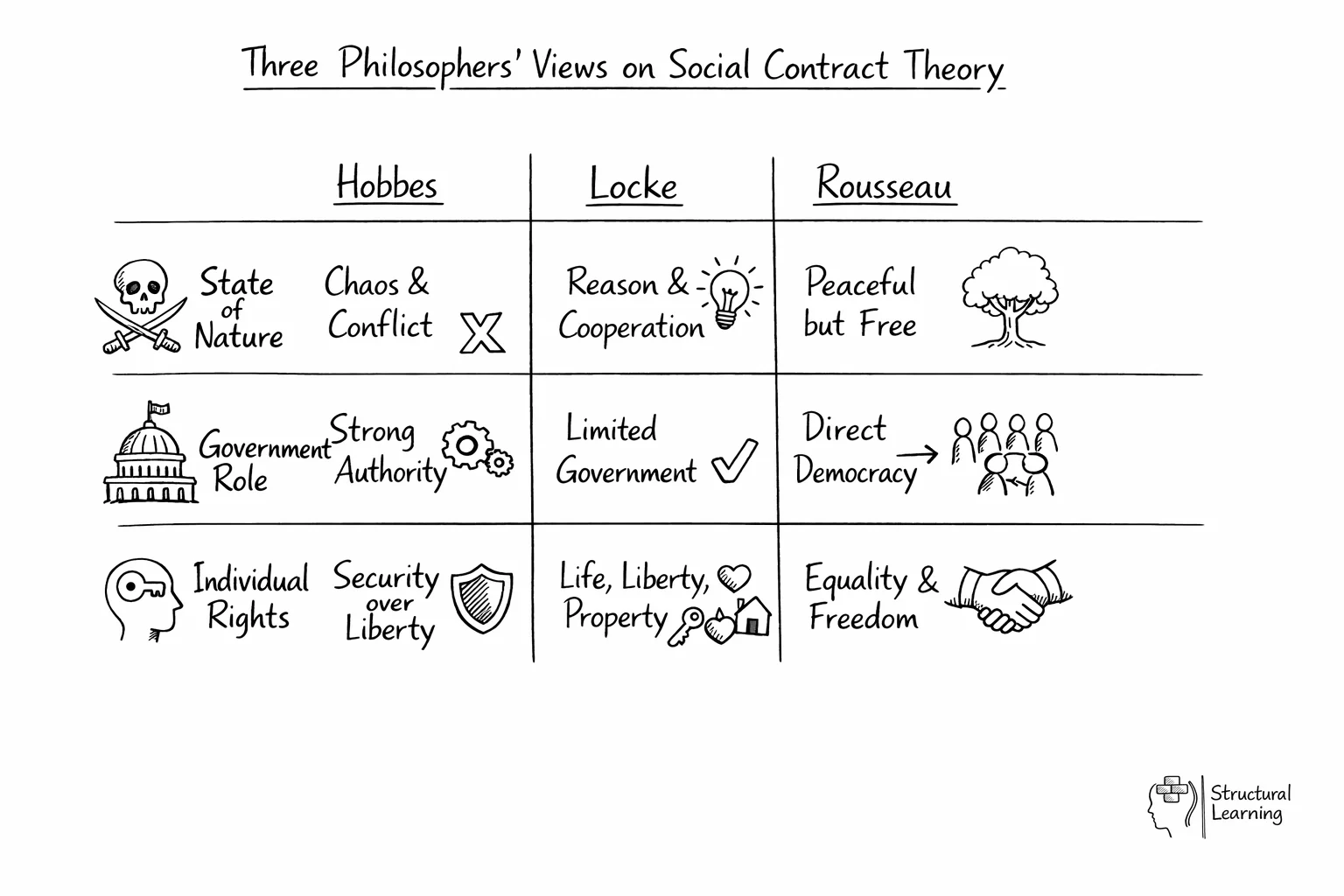
This graphic provides a helpful visual summary of these three competing visions of government's role and its relationship to individual rights.
Conclusion for Rousseau: Rousseau's social contract theory provides a foundation for more collectivist, communitarian, and socialist arguments. It justifies a state that actively intervenes to promote social and economic equality, not merely for security, but as a moral imperative to realize the common good and achieve true collective freedom.
Conclusion: Three Logics of Intervention
In this lesson, we have seen how the foundational political philosophies of Hobbes, Locke, and Rousseau provide three distinct and enduring logics for the role of government in society. They are not just historical theories but living paradigms that continue to shape modern political discourse.
Key Takeaways:
- Hobbesian Logic: The state's primary purpose is security and order. This justifies extensive intervention as a tool to prevent chaos and ensure stability. Economic freedom is secondary to the survival of the commonwealth.
- Lockean Logic: The state's primary purpose is the protection of pre-existing natural rights, especially property. This justifies minimal intervention (a "night-watchman state") and provides a strong argument against redistributive policies, which are seen as a violation of rights.
- Rousseauian Logic: The state's primary purpose is to realize the common good and promote collective freedom and equality. This justifies transformative intervention to shape society, reduce inequality, and foster civic virtue.
These three frameworks—intervention for security, intervention for liberty, and intervention for equality—form the fundamental coordinates of the debate we will be exploring throughout this course.
As we move into our next module, we will sharpen our conceptual tools. We have seen that Hobbes, Locke, and Rousseau all speak of "liberty," but they mean very different things by it. Our next lesson will delve into Isaiah Berlin's famous distinction between "negative liberty" (freedom from interference) and "positive liberty" (freedom to self-actualize), a distinction that maps closely onto the differences between Locke's and Rousseau's ideals and will give us a more precise language for analyzing the intervention debate.