In our previous lesson, we grappled with Thomas Hobbes's formidable argument for an absolute sovereign, born from the chaos of a "war of all against all." He presented a stark choice: absolute authority or absolute anarchy. Now, we turn to another giant of the 17th century, John Locke, who offers a profoundly different vision. While Locke also begins his analysis with a "state of nature," his assumptions about humanity and natural law lead him not to absolutism, but to a framework for limited government founded on the protection of individual rights.
This lesson will explore Locke's state of nature, his theory of natural rights—especially the right to property—and his justification for a government whose powers are both derived from and limited by the consent of the governed. Understanding Locke is essential, as his ideas form the bedrock of classical liberalism and provide the foundational arguments for the side of our debate that champions minimal government intervention.
The State of Nature: A State of Liberty, Not License
Where Hobbes saw the state of nature as a battlefield, Locke envisioned a state of "perfect freedom" and "equality," but one governed by reason. This is the crucial distinction. For Locke, the state of nature is not a lawless void; it has a law to govern it, which he calls the Law of Nature.
John Locke - Second Treatise | Political Philosophy
This video from James Muldoon provides a clear overview of Locke's political philosophy, beginning with his conception of the state of nature. It effectively contrasts his view with that of Hobbes.
Please watch the section from the start of the discussion on the state of nature up to the explanation of the "problem of partiality." Pay close attention to how Locke grounds his argument in natural equality and the divine origin of the law of nature, which obliges everyone not to harm another's "life, health, liberty, or possessions."
As the video explains, the Law of Nature, which is accessible to all through reason, dictates that because all human beings are the creation of an omnipotent and wise maker, they are equal and independent. Therefore, no one has the right to harm another. This is not merely a suggestion; it is a moral law with binding force, even in the absence of government. In this state, every individual has the right to execute the Law of Nature, meaning they have the right to punish those who transgress it. This is a state of liberty, but as Locke famously states, it is "not a state of license."
To delve deeper into this foundational concept, the Stanford Encyclopedia of Philosophy provides a more rigorous definition.
This entry clarifies the definition and scholarly interpretations of Locke's state of nature.
Please read the first two paragraphs of the section titled "2. State of Nature." Focus on the primary definition: the state of nature exists where there is a lack of a common judge with authority. Note also how it is a relational concept, describing moral rights and responsibilities between people, rather than just a pre-historical phase.
Natural Rights and the Origin of Property
The Law of Nature endows individuals with natural rights that pre-exist any government. For Locke, the most fundamental of these are the rights to Life, Liberty, and Property. He often uses the general term "Property" to encompass all of these: our lives, our liberties, and our material possessions ("estates").
But if the earth was given to humanity in common, as Locke believed, how does any individual come to have an exclusive right to any part of it? This was a critical question, and Locke's answer has been enormously influential. He argues that property is acquired when an individual mixes their labor with the common stock of nature.
Let's turn to Locke's own words in his Second Treatise of Government to understand this powerful idea.
Property: John Locke, Second Treatise, §§ 25--51, 123--26
This excerpt contains Locke's famous argument for how private property is generated from a state of common ownership.
Please read from the beginning of Chapter V, section 25, through section 34. Pay close attention to these key steps in his argument: Every person has property in their own person and their own labor (§ 27). By mixing labor with a resource, one removes it from the common state and makes it their own (§ 28). This appropriation is limited by two "provisos": one must not let the resource spoil (§ 31), and one must leave "enough, and as good" for others (§ 33).
This "labor theory of property" is a cornerstone of Locke's thought. It establishes property as a natural right, not a right created by government. This implies that the government's role is to protect pre-existing property rights, not to create or redistribute them—a central tenet in the argument against extensive government intervention.
The "Inconveniences" of the State of Nature
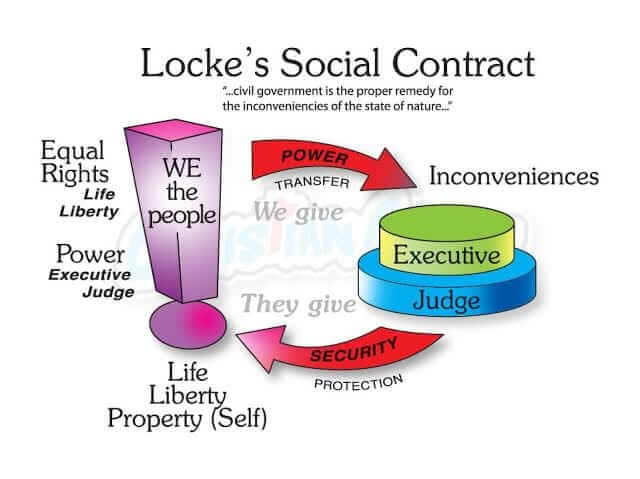
If the state of nature is governed by a moral law and endowed with natural rights, why would anyone willingly leave it? Locke's answer is that while the state of nature is not the hellish war Hobbes imagined, the enjoyment of one's rights within it is "very uncertain, and constantly exposed to the Invasion of others." He identifies three key deficiencies, or "inconveniences," that make forming a civil society a rational choice.
We can again turn to Locke's Second Treatise for his direct explanation.
Property: John Locke, Second Treatise, §§ 25--51, 123--26
In this chapter, Locke explains precisely why people agree to leave the state of nature and form a government.
Please read sections 123 through 126. Focus on the three specific things that are "wanting" in the state of nature: An established, known law to act as a common standard. A known and impartial judge to settle disputes. Power to execute the law and enforce just rulings.
The core problem is human bias. In the state of nature, everyone is a judge in their own case. Passion, revenge, and self-interest are likely to cloud judgment, leading to disproportionate punishments and escalating conflicts. The state of nature can easily degrade into a state of war, even if it doesn't begin as one. To remedy these inconveniences, people agree to form a social contract.
The Social Contract and Limited Government
To escape the inconveniences, individuals consent to form a political community. This is Locke's version of the social contract. It's a two-step process: first, individuals unanimously agree to form a community, and second, that community agrees by majority rule to establish a government.
Crucially, this is a contract with specific and limited terms.
The Social Contract - Thomas Hobbes & John Locke
This video from Philosophy Vibe provides a concise comparison between Hobbes's and Locke's social contracts, highlighting the unique features of Locke's theory.
Please watch from the beginning of the segment on John Locke. Focus on how the social contract is formed to protect the natural rights of life, liberty, and property. Note the critical difference from Hobbes: the government receives only limited powers and can be overthrown if it violates the contract.
The key points of Locke's contract are:
- Consent: Legitimate government is based on the consent of the governed. Individuals give up their personal right to execute the law of nature and entrust it to the community.
- Limited Purpose: The government's power is limited to the public good, which Locke defines as the preservation of the people's life, liberty, and property. It has "no other end but preservation."
- Right of Revolution: Because the government is a party to the contract and holds its power in trust, if it acts against that trust—by invading the people's property or exercising arbitrary power—it puts itself in a state of war with the people. The people then have the right to dissolve that government and create a new one. This right of revolution is the ultimate safeguard against tyranny.
Conclusion
Locke provides a powerful counter-narrative to Hobbes. He argues that government is not created to save us from our own depraved nature, but as a rational instrument to better secure rights we already possess by nature. This reframing has profound implications for the limits of state power.
Key Takeaways:
- Locke's state of nature is a state of freedom and equality, governed by a Law of Nature that is discoverable by reason.
- Individuals possess natural, pre-political rights to life, liberty, and property. Property is originally acquired by mixing one's labor with common resources.
- The state of nature has "inconveniences" (no common law, judge, or executive power) that make the enjoyment of rights insecure.
- To remedy this, people enter a social contract, consenting to form a government whose sole purpose is the preservation of their property (life, liberty, and estates).
- This results in a limited government based on the consent of the governed. If the government violates its trust and infringes upon natural rights, the people retain the right to revolution.
Locke's philosophy lays the essential groundwork for one side of our central debate. The idea that rights are natural, that property pre-exists the state, and that government's only legitimate role is to act as a protector and umpire, provides the classic liberal justification for strictly limiting government intervention, especially in the economic sphere.
In our next lesson, we will explore a third, equally influential vision of the social contract from Jean-Jacques Rousseau. He will challenge both Hobbes and Locke with his concept of the "general will," introducing a powerful argument for collective sovereignty that complicates the simple dichotomy between absolute power and individual liberty.