Welcome to your first lesson. To begin our exploration of the centuries-long debate over government intervention, we must first understand the foundational arguments for why the state should exist at all. Different justifications for the state's authority lead to vastly different conclusions about its proper role and limits.
In this lesson, we will delve into the political philosophy of Thomas Hobbes. His work provides one of the most powerful and enduring arguments for a strong, centralized state. We will explore his famous thought experiment—the "state of nature"—to understand his diagnosis of the human condition without government. From there, we will trace his logic to its conclusion: the necessity of an absolute sovereign to save humanity from itself. This perspective forms a crucial baseline for the "pro-intervention" side of the debate we will be dissecting throughout this course.
The Problem of Civil War
To grasp Hobbes's conclusions, we must first understand the problem he was trying to solve. Writing in the mid-17th century, he was a direct witness to the chaos and brutality of the English Civil War, a period of profound political and religious turmoil. This experience convinced him that the greatest evil was not tyranny, but anarchy and civil war. His life's work in political philosophy was an attempt to discover the "scientific" principles upon which a stable and lasting political order could be built.
The following video provides an excellent overview of this historical context and Hobbes's revolutionary ambition.
Thomas Hobbes and the State of Nature
This lecture from Emory University sets the stage by discussing Hobbes's life during the English Civil War and his intellectual project to overturn older philosophical traditions and build a new, modern political science.
Please watch the first part of the video, which introduces Hobbes, his context, and his reputation as a pessimistic thinker who paradoxically laid the groundwork for modern political ideas. Pay close attention to the description of the political and religious turmoil of his time, and the speaker's argument that Hobbes was a "secret grandfather of modern liberalism," a point we will return to in later lessons. You can watch up to the 18:25 mark.
As the video explains, Hobbes's project was to create a political order so stable it would never again collapse into civil war. His method was to perform a thought experiment: strip away all aspects of law, society, and government to understand the raw, natural condition of humankind.
The State of Nature: A War of All Against All
Hobbes begins his analysis with a materialist conception of human beings. He sees us not as divinely ordered creatures or naturally political animals (as Aristotle did), but as complex machines. We are matter in constant motion, driven by fundamental impulses: "appetites" (desires for things like food, wealth, and honor) and "aversions" (the avoidance of things like pain and death). The most fundamental and powerful drive is for self-preservation.
From this psychological foundation, Hobbes asks: what would life be like if there were no common power to keep us all in awe? This hypothetical scenario is his famous "state of nature."
The Stanford Encyclopedia of Philosophy provides a rigorous breakdown of this concept. It explains the assumptions Hobbes makes about human nature and how they inevitably lead to a state of war.
Hobbes's Moral and Political Philosophy
This article offers a precise, academic explanation of Hobbes's state of nature. Focus on how he builds his argument from a few plausible assumptions to a terrifying conclusion.
Please read the sections titled "The State of Nature" and "The State of Nature Is a State of War." In the first of these sections, focus on Hobbes's definition of the state of nature as a condition of "perfectly private judgment" and his famous description of the miseries it contains, starting from this passage. Next, read the subsection that begins just below, which details the empirical and normative assumptions Hobbes makes about human beings—our relative equality, our desire to shun death, and our "right of nature" to do whatever we judge necessary for our preservation. Finally, read the section "The State of Nature Is a State of War," which explains how these assumptions lead to conflict driven by three principal causes: competition, diffidence (distrust), and glory.
As you've read, Hobbes argues that three principal passions lead to conflict in the state of nature:
- Competition: Individuals desire the same things, leading them to invade for gain.
- Diffidence (Distrust): Fearing that others will try to take what they have, individuals rationally choose to strike first as a form of self-defense.
- Glory: Humans desire reputation and will fight over perceived insults or to establish dominance.
Without a government to enforce rules, there is no industry, no culture, no knowledge, and worst of all, "continual fear, and danger of violent death." This is the infamous condition where the life of man is "solitary, poor, nasty, brutish, and short."
To make this grim picture more plausible, Hobbes invites us to look at our own behavior. In the following excerpt from a Yale lecture, Professor Steven Smith highlights this appeal to experience.
PLSC 114 - The Sovereign State: Hobbes, Leviathan
This lecture transcript provides a vivid illustration of Hobbes's argument.
Please read the paragraph that begins here. Hobbes asks why we lock our doors at night and lock our chests against our own family members, even when we live under the protection of laws. He argues these actions reveal our true, deep-seated distrust of one another, which would run rampant in a state of nature.
The Escape: Reason, Fear, and the Social Contract
If the state of nature is so horrific, how do we escape it? Hobbes argues that we possess the tools for our own salvation: passion and reason.
While passions like pride and glory lead us into conflict, the most powerful passion of all—the fear of violent death—inclines us toward peace. This fear awakens our reason, which allows us to discover what Hobbes calls the Laws of Nature.
It is crucial to distinguish these from the Right of Nature.
- The Right of Nature is the liberty each person has in the state of nature to use any means necessary for self-preservation. In practice, this becomes a "right to all things," including other people's bodies.
- The Laws of Nature are precepts, discovered by reason, that dictate what we should do to preserve our lives. They are essentially a rational person's guide to survival through peace.
The first and most fundamental Law of Nature is: Seek peace and follow it. The second follows directly: Be willing, when others are also willing, to lay down your right to all things, and be contented with so much liberty against other men as you would allow other men against yourself.
This mutual laying down of rights is the basis of the social contract. The following video clearly explains this transition from natural rights and laws to the creation of the state.
Thomas Hobbes - Leviathan | Political Philosophy
This video provides a clear and concise explanation of the state of nature, the distinction between the right and laws of nature, and the formation of the contract that creates the sovereign.
Watch the segment from The State of Nature. Pay close attention to the distinction made between the right of nature and the laws of nature, and the explanation of how the contract creates the artificial person of the state, or "Leviathan."
The Leviathan: Justifying Absolute Sovereignty
The contract leads to the creation of a commonwealth, or what Hobbes calls the "Leviathan." This is an artificial person whose will, by the authority of all the individuals, represents the will of all. This entity is the sovereign.
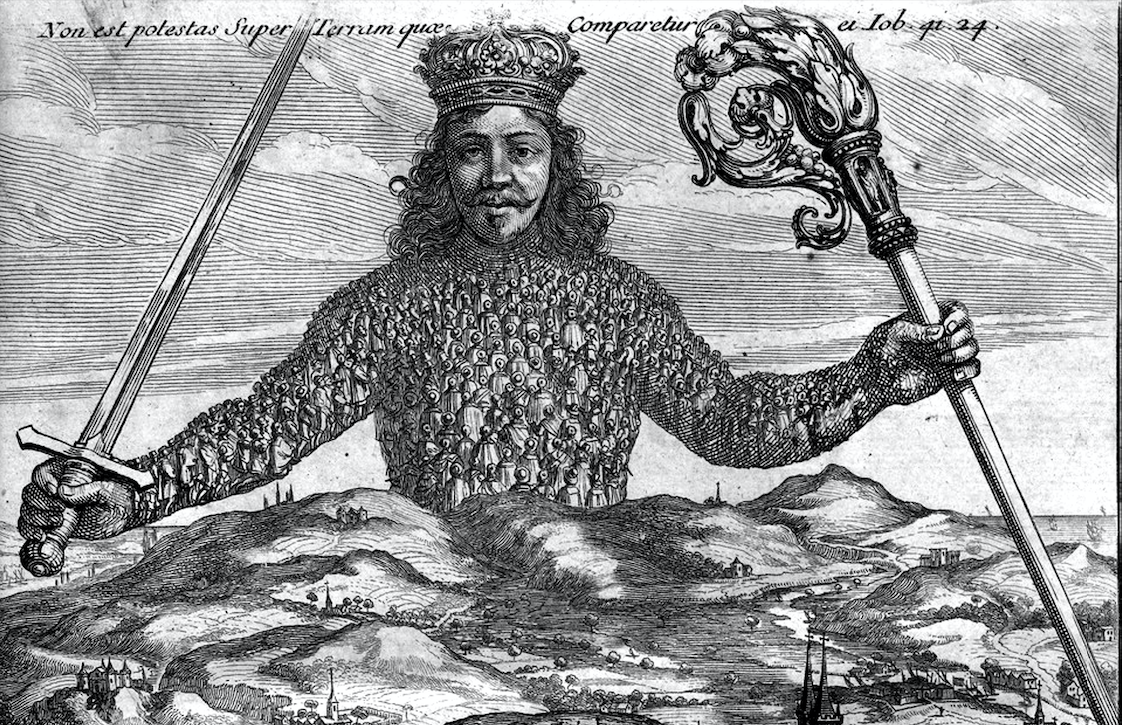
For Hobbes, the sovereign's power must be absolute. Why? Because his entire system is designed to prevent a return to the state of nature. He argues that any division or limitation of sovereign power is a recipe for disaster.
- If powers are divided (e.g., between a king and a parliament), disagreements will arise.
- If there is no ultimate authority to settle these disagreements, society will be paralyzed or, worse, descend back into civil war.
Therefore, to ensure peace, the sovereign must have the final say on all matters: legislation, adjudication, taxation, and war. Subjects give up their right to judge for themselves and agree to abide by the sovereign's judgment. The alternative is the chaos and death of the state of nature. Political obligation lasts only as long as the sovereign is able to provide protection. The moment protection ceases, individuals revert to their natural right of self-preservation.
Conclusion
This first lesson has established one of the most formidable arguments for a powerful state. Hobbes presents us with a stark choice: absolute government or a terrifying state of war.
Key Takeaways:
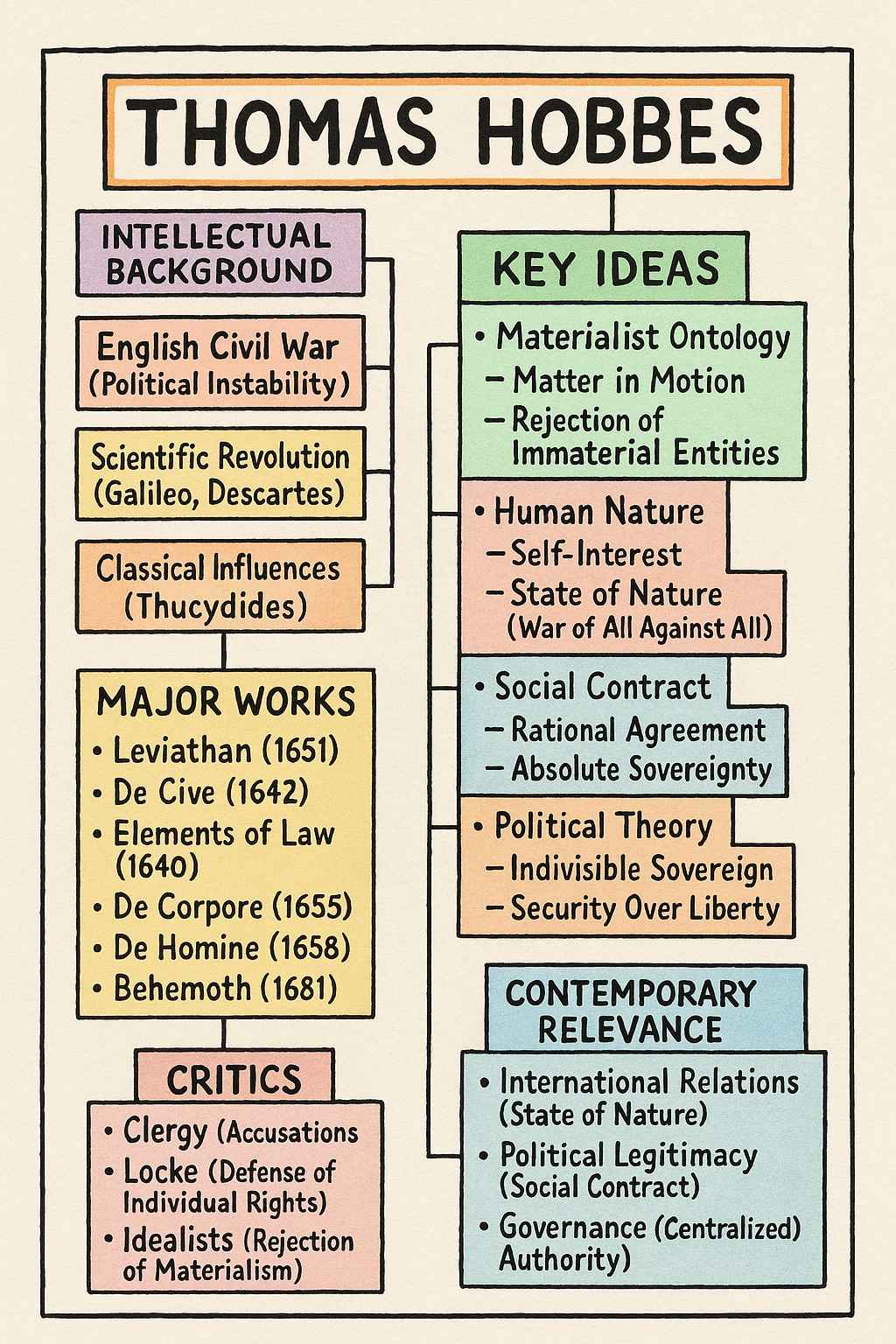
- Hobbes's theory is a product of the English Civil War, designed to establish a foundation for perpetual peace.
- The "state of nature" is a thought experiment where, without a common power, human desires for gain (competition), safety (diffidence), and reputation (glory) lead to a "war of all against all."
- Life in this state is "solitary, poor, nasty, brutish, and short."
- Reason, spurred by the fear of death, leads individuals to discover the Laws of Nature—the rules for peaceful coexistence.
- To escape the state of nature, people form a social contract, surrendering their right to govern themselves to an absolute sovereign (the Leviathan).
- The sovereign's power must be undivided and unlimited to prevent disputes that could lead back to civil war. Security is exchanged for liberty.
In our next lesson, we will turn to John Locke. He also uses the state of nature as his starting point, but his different assumptions about human nature and natural law lead him to a radically different conclusion: a justification not for an absolute sovereign, but for a limited government whose primary purpose is to protect pre-existing natural rights. This will set the stage for the fundamental conflict between security and liberty that animates the entire debate over government intervention.