Hello! Welcome to the final lesson in our "Core Number Skills and Estimation" module.
In our last lesson, we explored bounds, which allow us to find the exact range of possible values a calculation can have due to rounding. Today, we're tackling a related but distinct skill: estimation. This directly addresses one of the areas you identified as a weakness.
The learning outcome for this lesson is to use estimation by rounding to 1 significant figure to predict and verify the reasonableness of calculator answers.
While bounds give you a precise answer about the limits of accuracy, estimation is a rapid, mental-math tool. It's your first line of defence in an exam to catch significant errors, like a misplaced decimal point or a typo on your calculator, ensuring you don't lose easy marks.
1. The Core Idea: What is Estimation and Why Use It?
In an exam, you'll see questions with command words like "evaluate" or "calculate," which mean "find the exact answer." However, when you see the word "estimate," it's a signal to use a specific approximation technique. The goal isn't precision; it's to get a rough idea of the answer's magnitude quickly.
The standard method for estimation in your IGCSE exam is simple:
Round every number in the calculation to one significant figure (1 s.f.).
First, let's watch a short video that introduces this concept and clearly distinguishes it from an exact calculation.
Estimating Complex Calculations (1)
This video from HEGARTYMATHS clearly explains the difference between 'estimate' and 'evaluate' and introduces the core method of rounding to 1 significant figure.
Watch from the beginning until 01:55. Focus on the distinction he makes between the command words and the two-step process he outlines.
As a quick refresher, here is a visual guide to identifying the first significant figure and rounding.

2. The Method in Action: From Simple to Complex
Once you've rounded each number to 1 s.f., the calculation becomes much simpler, often something you can do without a calculator. Let's see how this works with some typical exam-style problems.
Basic Multiplication and Division
We'll continue with the HEGARTYMATHS video to see how this simple rule is applied to multiplication and division problems.
Estimating Complex Calculations (1)
Let's watch how to apply the 1 s.f. rounding rule to some calculations. Notice how complex-looking problems become much more manageable.
Watch from 01:55 to 07:49. Observe how he rounds each number first, then performs the calculation. Pay attention to the way he handles the zeros in '40 x 10' and '5000 x 40'. In the division example, notice the strategy of cancelling zeros or common factors to simplify the fraction.
Here's a summary of the process shown in the video:
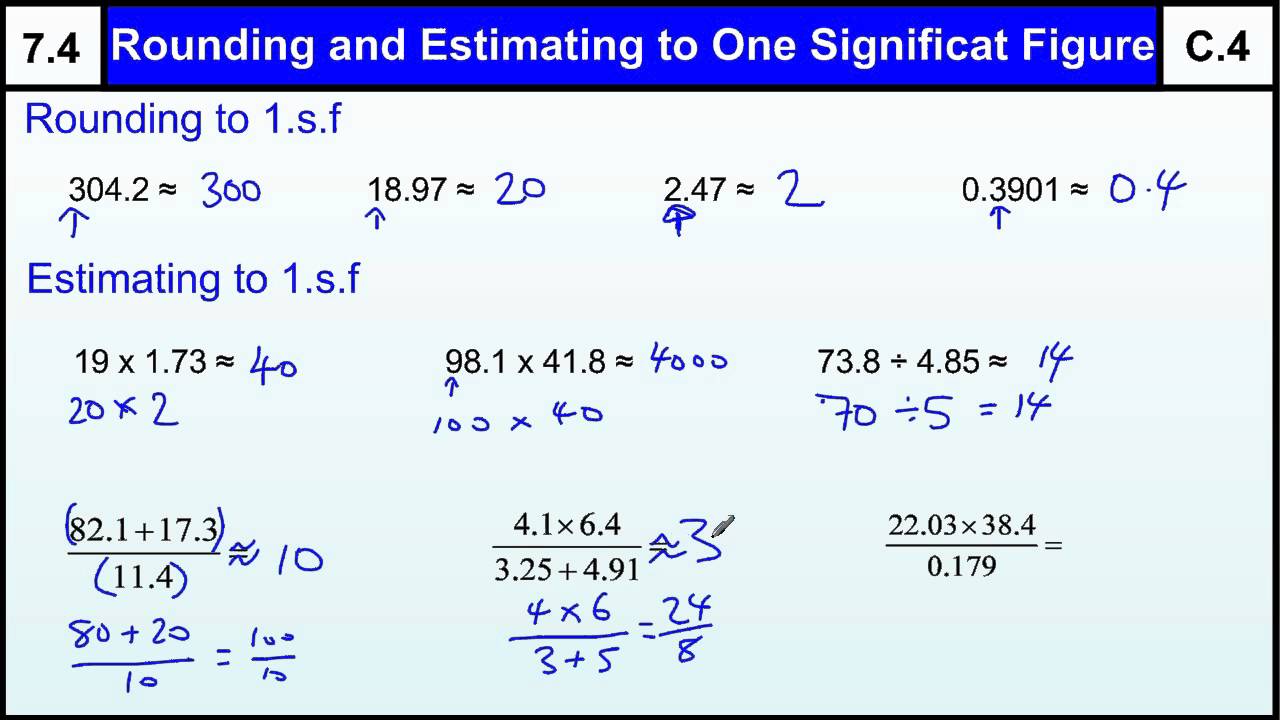
Dealing with Fractions, Roots, and Powers
The IGCSE loves to present estimation problems in the form of complex fractions involving square roots or powers. The principle remains exactly the same: round every number inside the calculation to 1 s.f. before you compute anything.
O LEVELS 4024 | IGCSE 0580 | SIGNIFICANT FIGURES AND ESTIMATION WORKSHEET
Now for a more exam-style question. This video from ZAINEMATICS works through a past paper worksheet. The style is less polished, but it's great practice. We'll look at one example involving a square root and division.
Watch the specific example from 35:48 to 37:05. The problem is estimating the value of (298 × √15.98) / 0.1975. Follow the steps of rounding each component to 1 s.f. first.
Let's break down that example:
- Original problem:
- Step 1: Round each number to 1 s.f.
- . Wait! Since it's under a square root, it's smarter to round to a nearby square number. is very close and its square root is simple. So we'll use . This is a key strategic choice.
- Step 2: Substitute and calculate.
- Estimate
- To divide by 0.2, you can multiply the top and bottom by 10: .
Test your understanding!
By writing each number correct to 1 significant figure, estimate the value of:
Show answer
-
Round each number to 1 s.f.
- (This is a convenient square number close to 98.5)
-
Substitute and calculate:
- Estimate
- Dividing by 0.5 is the same as multiplying by 2.
The estimated value is 180.
3. Using Estimation to Verify Answers
The most practical use of estimation in an exam is to quickly check your own calculator work. If you calculate 14.1 × 18.3 and your calculator shows 25.803, a quick mental estimate can save you.
Unit 14 Section 2 : Estimation
This text from CIMT provides a perfect example of using estimation to spot an error. It highlights the main purpose of this skill in an exam context.
Read 'Example 2' from the resource. Notice how the estimate (200) immediately tells you that answers like 25.8 or 2580 must be wrong.
The example shows:
- Calculation:
14.1 × 18.3 - Estimate:
10 × 20 = 200 - Your calculator shows
258.03. This is in the same "ballpark" as 200. - If your calculator showed
25.803or2580.3, your estimate would instantly signal that you've likely made a decimal point error.
This technique is also tested directly in questions that ask you to identify the correct answer from a list.
4. Overestimates and Underestimates
Sometimes a question will ask why your estimate is larger or smaller than the exact answer. You can determine this by looking at how you rounded.
Rounding, Estimation & Bounds | Cambridge (CIE) IGCSE ...
This resource from Save My Exams provides a clear table and a worked example for determining if your estimate is an overestimate or an underestimate.
Read the section 'How do I know if I have underestimated or overestimated?'. Then, review the 'Worked Example' that follows. The key idea for a fraction is to see what you did to the numerator and the denominator.
The logic is simple for a fraction :
- If you make the numerator (top) bigger and the denominator (bottom) smaller, you get a definite overestimate.
- If you make the numerator smaller and the denominator bigger, you get a definite underestimate.
- If you round both up, or both down, it's harder to tell without more information.
In the worked example (17.3 × 3.81) / 11.5:
- The numerator
17.3 × 3.81was rounded to20 × 4. Both numbers were rounded up, so the numerator got bigger. - The denominator
11.5was rounded to10. The denominator got smaller. - Making the top bigger and the bottom smaller guarantees the result is an overestimate.
Key Takeaways
- Estimation vs. Bounds: Bounds give the exact limits of a value. Estimation gives a quick, rough approximation.
- The Golden Rule: Round every number to 1 significant figure before doing any calculations.
- Strategic Rounding: For numbers under a root (e.g., ), it's often better to round to a nearby square number (e.g., 49) to make the calculation easier.
- The 'Ballpark' Check: Use estimation to verify your calculator answers. If your estimate is 800 and your calculator gives you 7.8, you've almost certainly made an error.
- Show Your Work: In an estimation question, you must write down the rounded values you are using (e.g.,
50 × 20 / 10). This is where you earn your method marks.
This lesson concludes the "Core Number Skills and Estimation" module. You have now covered standard form, bounds, and estimation—three distinct but related skills for handling numbers with precision and with approximation.
Next, we will begin Module 3: Algebraic Foundations and Quadratics. We'll start by mastering the fundamental skill of expanding and simplifying expressions, where the attention to detail and precision we've been practising will be essential.