Hello! Welcome to your next lesson in the "Core Number Skills and Estimation" module.
In our last lesson, we mastered standard form, which is a precise way to handle very large and small numbers. Today, we're shifting our focus to the opposite end of precision: how to deal with the uncertainty that arises when numbers are rounded.
This lesson addresses the learning outcome: Apply rules of bounds to determine the upper and lower limits of calculations involving rounded measurements. This is a common and high-value topic on the IGCSE Paper 4 exam. It requires careful logical thinking, which is a key skill we're aiming to build. Mastering the methods for bounds will help you secure crucial "method marks," even if you make a small calculation error under pressure.
1. The Core Idea: Error Intervals
Whenever a measurement is rounded, the original, precise value is lost. However, we know it must lie within a specific range, or error interval. The edges of this range are called the upper and lower bounds.
The fundamental rule for finding these bounds is the "Half-Unit Rule".
IGCSE Maths: Degree of Accuracy, Bounds & Error Intervals
To start, let's get a clear definition of bounds and the 'Half-Unit Rule'. This resource from GetYourTutors explains the concept well.
Read the section titled '2. Limits of Accuracy: Upper and Lower Bounds (H)'. Focus on the 'Finding the Bounds (The Half-Unit Rule)' and 'Error Intervals' subsections. Pay close attention to the inequality notation: LB ≤ x < UB.
As you've just read, the process is:
- Identify the degree of accuracy: e.g., nearest cm (unit = 1), nearest 10 (unit = 10), 1 decimal place (unit = 0.1).
- Find the tolerance: This is half of the unit of accuracy.
- Calculate the bounds:
- Lower Bound (LB): Rounded Value - Tolerance
- Upper Bound (UB): Rounded Value + Tolerance
The most important thing to remember is that the true value can be equal to the lower bound, but must be less than the upper bound.
For example, if a length is 12 cm correct to the nearest cm:
- The unit of accuracy is 1 cm.
- The tolerance is cm.
- LB = cm.
- UB = cm.
- The error interval is written as: cm.
2. Calculations with Bounds: The Four Rules
Things get interesting when you have to perform calculations (addition, subtraction, multiplication, or division) with rounded numbers. To find the maximum or minimum possible outcome, you must choose the correct bound for each number in the calculation.
This is a key area where "method selection" is vital. Addition and multiplication are intuitive, but subtraction and division require you to think carefully.
The table below summarises the logic.
IGCSE Maths: Degree of Accuracy, Bounds & Error Intervals
This 'Logic Table' is the most important tool in this topic. It shows you exactly which bounds to use for any calculation. Memorise these rules.
Read the section '3. Calculations with Bounds (The Grade 9 Skill)' and study 'The Logic Table' carefully. The key insight is that for subtraction and division, the bounds are 'crossed' to get the maximum or minimum result.
Here's a summary of those crucial rules:
| Operation | To Find Maximum (Upper Bound) | To Find Minimum (Lower Bound) |
|---|---|---|
| Addition (A+B) | UB(A) + UB(B) | LB(A) + LB(B) |
| Subtraction (A-B) | UB(A) - LB(B) (Start Big - Take Small) | LB(A) - UB(B) (Start Small - Take Big) |
| Multiplication (A×B) | UB(A) × UB(B) | LB(A) × LB(B) |
| Division (A÷B) | UB(A) ÷ LB(B) (Biggest Top / Smallest Bottom) | LB(A) ÷ UB(B) (Smallest Top / Biggest Bottom) |
3. Bounds in Action: Worked Exam Questions
The best way to master these rules is to see them applied to IGCSE past-paper questions. The following video works through numerous examples covering all four operations, as well as common exam scenarios like unit conversions.
Everything you need to know about IGCSE Upper and Lower Bounds in 27 minutes
This excellent video from Ginger Mathematician is packed with worked examples. We will go through it section by section to see how each rule is applied in practice.
You don't need to watch the whole video in one go. We will refer back to specific segments as we cover each operation.
Subtraction and Addition
Let's see how to find the bounds for subtraction and addition.
Everything you need to know about IGCSE Upper and Lower Bounds in 27 minutes
Watch the first example in the video, which deals with finding the upper bound of the difference between two times. Notice how it follows the 'UB - LB' rule.
Watch from 00:00 to 03:13. See how the presenter first finds the bounds for each individual time and then selects the correct ones to maximise the difference.

Now for addition, which is more straightforward.
Everything you need to know about IGCSE Upper and Lower Bounds in 27 minutes
Now, let's look at an addition problem: finding the upper bound of a perimeter. This uses the simple 'UB + UB' rule.
Watch from 07:34 to 10:05. The key takeaway here is to find the upper bound for each side length and then add them all together.
A crucial exam tip mentioned here is do not round your final answer unless the question specifically tells you to. The exact value is the required answer.
Multiplication and Division
Now let's tackle multiplication (e.g., for area) and division (e.g., for speed).
Everything you need to know about IGCSE Upper and Lower Bounds in 27 minutes
This segment shows how to calculate the upper bound for an area, which involves multiplication. It also includes a unit conversion, a common trap.
Watch from 21:09 to 23:55. To find the maximum area, you multiply the maximum possible length (UB) by the maximum possible width (UB).
Everything you need to know about IGCSE Upper and Lower Bounds in 27 minutes
Finally, let's watch an example of division to find the lower bound for speed (Speed = Distance / Time). This will use the 'LB / UB' rule.
Watch from 23:55 to 27:12. To get the slowest possible speed, you need the shortest possible distance divided by the longest possible time.
Test your understanding!
A triangle has an area of 56 cm², correct to the nearest whole number.
Its height is 8 cm, correct to the nearest cm.
The formula for the area of a triangle is .
Calculate the upper bound for the length of the base, .
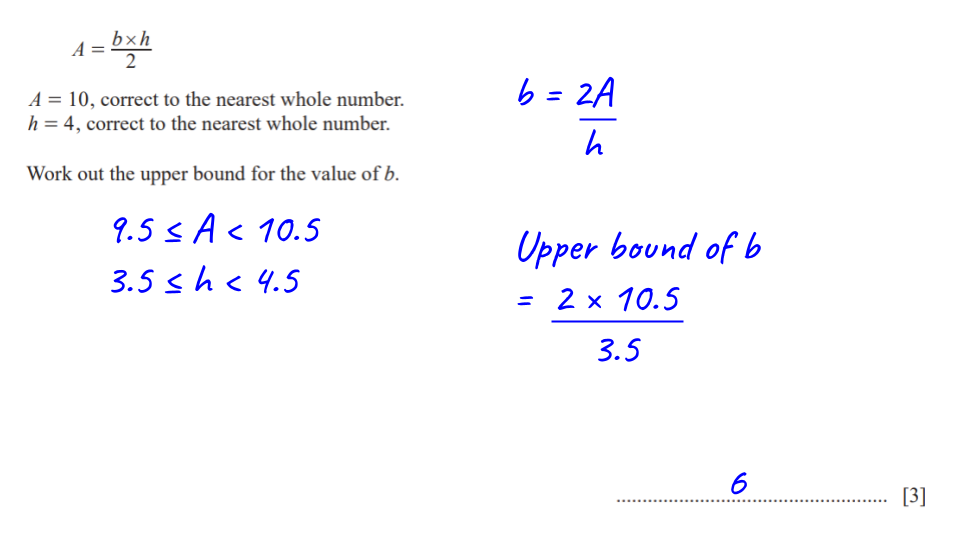
Show answer
-
Rearrange the formula to make the subject:
-
Find the bounds for and :
- Area cm² (nearest 1 cm²): Tolerance = 0.5.
So, . UB(A) = 56.5. - Height cm (nearest 1 cm): Tolerance = 0.5.
So, . LB(h) = 7.5.
- Area cm² (nearest 1 cm²): Tolerance = 0.5.
-
Apply the division rule for the Upper Bound:
To find the Upper Bound of , we need the largest possible numerator divided by the smallest possible denominator.- UB() =
-
Calculate:
- UB() =
- The upper bound for the base is 15.06̇ cm (or an equivalent fraction).
4. Advanced Application: "Suitable Degree of Accuracy"
A common Grade 9 style question asks you to calculate a value "to a suitable degree of accuracy." This has a very specific method.
- Calculate both the Upper Bound and the Lower Bound for the final value.
- Write down both full calculator answers.
- Find the most precise level of rounding (e.g., nearest integer, 1 d.p., 2 s.f.) at which both bounds give the same value.
- This rounded value is your answer. You must state the bounds you calculated to justify your choice.
Upper and Lower Bounds - GCSE Higher Maths
This question type is a bit different. Let's watch how to tackle it. The key is to find where the upper and lower bounds 'agree' when rounded.
Watch the final example in this video from 1st Class Maths from 14:51 to 18:19. It clearly explains the process of comparing the full UB and LB values to find the 'suitable' answer.
Key Takeaways
- Error Interval: All bounds problems start by finding the error interval for each rounded value using the half-unit rule: .
- The Four Rules: The logic for combining bounds is crucial. Addition/multiplication are straightforward (UB with UB, LB with LB), but subtraction/division are "crossed" to find the maximum or minimum.
- Think Logically: For division like , ask yourself: "To make the result as big as possible, do I want the top number to be big or small? What about the bottom number?" This will help you select the right bounds.
- Show Your Working: Write down the bounds you are using (e.g.,
UB(A) / LB(B)) and the substituted values. This is where method marks are earned. - Do Not Round (Usually): Unless asked for a "suitable degree of accuracy," give the full, exact answer from your calculator.
In our next lesson, we will cover the final topic in this module: estimation by rounding to 1 significant figure. This is a different skill from bounds. Bounds give the exact limits of possibility, while estimation gives a quick approximation to check if a calculator answer is in the right ballpark.