Hello! Welcome to the second lesson in our module on Core Number Skills.
In our previous lesson, we focused on the essential skills of working with fractions, decimals, and percentages. We saw that they are different ways to represent the same value, and the key to solving problems is knowing how and when to convert between them.
Today, we'll continue this theme by exploring standard form, another way of writing numbers. This lesson will equip you to perform calculations involving standard form and convert between ordinary and standard notation. This skill is vital for both calculator and non-calculator IGCSE papers, especially in questions related to science, astronomy, or population statistics. Mastering this will help you handle very large and very small numbers efficiently and accurately.
1. Understanding Standard Form and Conversions
Standard form, also known as scientific notation, is a compact way of writing numbers. You'll have seen it in your physics or chemistry studies for things like the speed of light or the size of an atom.
Let's start by looking at the precise definition and the methods for converting numbers to and from this format.
IGCSE Standard Form: Complete Guide
This guide from Tutopiya clearly defines standard form and its rules. It's crucial to master this definition as it's the foundation for everything that follows.
Read the first three sections: 'Understanding Standard Form' 'Converting Ordinary Numbers to Standard Form' 'Converting Standard Form to Ordinary Numbers' Pay close attention to the strict rule for the number 'a' (that it must be a number greater than or equal to 1 and less than 10). Also, focus on the direction you move the decimal point and how that affects whether the power of 10 is positive or negative.
Key Conversion Rules: A Summary
As you've just read, the process is all about moving the decimal point.
- Standard Form Format: A number is in standard form if it is written as , where and is an integer.
- Ordinary to Standard:
- For large numbers (>1), move the decimal point to the left until you have a number between 1 and 10. The number of places you moved is your positive power .
- Example:
5,400,000becomes5.4by moving the decimal 6 places left. So, it's .
- Example:
- For small numbers (<1), move the decimal point to the right. The number of places you moved is your negative power .
- Example:
0.0008becomes8by moving the decimal 4 places right. So, it's .
- Example:
- For large numbers (>1), move the decimal point to the left until you have a number between 1 and 10. The number of places you moved is your positive power .
- Standard to Ordinary:
- For a positive power , move the decimal point places to the right, making the number larger.
- For a negative power , move the decimal point places to the left, making the number smaller.
Test your understanding!
- Write 345,000,000 in standard form.
- Write 0.0000702 in standard form.
- Write as an ordinary number.
- Write as an ordinary number.
Show answer
- (decimal moves 8 places left)
- (decimal moves 5 places right)
- 610,000 (decimal moves 5 places right)
- 0.0099 (decimal moves 3 places left)
2. The Final Step: Adjusting Your Answer
A common reason students lose marks is that they perform a calculation correctly but forget to ensure their final answer is in proper standard form. For example, a calculation might give you 35 × 10^7, which is not in standard form because 35 is not between 1 and 10.
Let's watch a video that focuses specifically on this adjustment step. This is a key exam technique for preventing simple errors.
This is a crucial skill for securing full marks. This segment from Corbettmaths shows you how to adjust an answer into correct standard form, a common final step in exam questions.
Watch from 04:28 to 07:01. Focus on the logic: if you make the front number 10 times smaller (e.g., from 52 to 5.2), you must make the power of 10 one step larger (e.g., from 10⁴ to 10⁵) to keep the overall value the same. The reverse is also true.
The principle is simple: you are balancing the two parts of the number.
- If you make the coefficient 10 times smaller, you must make the power larger by 1.
- If you make the coefficient 10 times bigger, you must make the power smaller by 1.
3. Calculations with Standard Form
The method for calculation depends on the operation. Multiplication and division are handled differently from addition and subtraction. This is a classic area where choosing the right method is essential.
Multiplication and Division
For these operations, you handle the coefficients and the powers of 10 separately.
- Multiply/Divide the coefficients (the 'a' parts).
- Add/Subtract the powers (the 'n' parts) using the laws of indices.
- Adjust the final answer to ensure it's in standard form.
Calculations using standard form - GCSE Maths Revision
The rules for multiplication and division are a direct application of the laws of indices. This BBC Bitesize guide explains it clearly with exam-style questions.
Read the section 'How to multiply and divide in standard form without a calculator'. Study the two worked examples to see the full process: calculate, then adjust the answer into correct standard form.
Addition and Subtraction
For these operations, you cannot simply add or subtract the coefficients unless the powers of 10 are identical.
- Adjust one of the numbers so that both have the same power of 10. It's usually easiest to change the number with the smaller power to match the one with the larger power.
- Add/Subtract the new coefficients. The power of 10 remains the same.
- Adjust the final answer if necessary.
All of iGCSE Standard Form In 20 Minutes!
Addition and subtraction have a different, crucial rule. The key is to make the powers of 10 identical first. This video explains the technique used in non-calculator questions.
Watch from 02:06 to 04:15. The vital step is adjusting one of the numbers (e.g., changing 2 × 10⁹⁸ to 0.02 × 10¹⁰⁰) so you can perform the operation on the coefficients.
Test your understanding!
Calculate the following without a calculator, giving your answers in standard form.
Show answer
- Multiply:
- Multiply coefficients:
- Add powers:
- Result:
- Adjust:
- Divide:
- Divide coefficients:
- Subtract powers:
- Result: (already in standard form)
- Add:
- Make powers the same. Let's make them both .
- Add coefficients:
- Result: (already in standard form)
4. Exam Application and Calculator Fluency
On Paper 4, you'll use your calculator for standard form questions. To improve your speed and accuracy, it is essential to use the dedicated standard form button, not type it out manually.
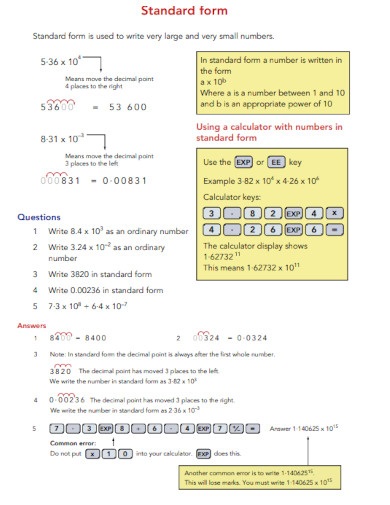
Now, let's apply all these skills to a typical IGCSE exam question.

Show solution
(a) Which country has the largest population?
To compare numbers in standard form, first look at the power of 10. The largest power is , which belongs to China.
- Answer: China
(b) Calculate the difference between the population of China and the population of the USA.
- Set up the subtraction:
- Make the powers of 10 the same. Let's convert the USA's population to the power of 9.
- Subtract the coefficients:
- Write the final answer:
(c) The population of a European country is 12 million. Write the population of this country in standard form.
- Write the number in full: 12 million = 12,000,000
- Convert to standard form: Move the decimal point 7 places to the left.
Key Takeaways
- The Golden Rule: A number is only in standard form if it's in the format , where . Always check your final answer.
- Method Selection: Use different strategies for different operations.
- Multiply/Divide: Handle coefficients and powers separately.
- Add/Subtract: Make the powers of 10 identical before you do anything else.
- Calculator Fluency: For speed and accuracy, always use your calculator's dedicated standard form button (
EXP,EE, orx10^x). - Adjust and Check: The final, most important step is to adjust your answer to be in correct standard form. This is where easy marks are often lost.
In our next lesson, we will tackle the final topic in this module: applying rules of bounds. This is a frequent topic on Paper 4 and requires careful logical thinking to determine the upper and lower limits of calculations involving rounded numbers.