Hello! Welcome to the first lesson of our module on Core Number Skills.
In our last session, we mastered how to use your calculator's advanced functions to improve speed and accuracy. This is crucial for complex problems on Paper 4. However, the IGCSE exams also test your fundamental arithmetic fluency, often in "show your working" questions where a calculator answer alone scores zero. Today, we'll build that fluency.
This lesson is designed to help you calculate fluently with fractions, decimals, and percentages, converting between them as needed. This is one of the most fundamental skill sets in mathematics, and mastering it will help you prevent the small arithmetic errors you've mentioned, while also building a solid foundation for more advanced topics like probability and ratio.
1. The Three Faces of a Number: F, D, and P
Fractions, decimals, and percentages (FDP) are simply different ways to represent the same value. Being able to switch between them effortlessly is key to solving many problems efficiently. Often, the easiest way to compare or calculate with a mix of FDP is to convert them all to a single format.
Let's start by watching a video that walks through the essential conversion methods.
Fractions, Decimals and Percentages | Conversions | Grade 5 Crossover | GCSE Maths Tutor
This video from The GCSE Maths Tutor provides a clear, step-by-step guide on how to convert between fractions, decimals, and percentages. It also demonstrates why this skill is useful for ordering numbers.
Please watch the following sections: 00:40 - 04:00: Converting a decimal to a percentage and a fraction. 04:00 - 06:01: Converting a percentage to a decimal and a fraction. 07:49 - 09:57: Converting a fraction to a percentage and a decimal. 11:46 - 15:22: An example of ordering numbers by converting them all to percentages. Focus on the core rule for each conversion (e.g., 'to get from a decimal to a percentage, you multiply by 100').
Summary of Key Conversions
Based on the video and standard rules, here is a summary of the conversions you must know.
| From | To | Method | Example |
|---|---|---|---|
| Decimal | Percentage | Multiply by 100. | |
| Percentage | Decimal | Divide by 100. | |
| Percentage | Fraction | Place over 100 and simplify. | |
| Decimal | Fraction | Write as a fraction over a power of 10 (10, 100, 1000, etc.) and simplify. | |
| Fraction | Decimal | Divide the numerator by the denominator. |
Converting a Fraction to a Percentage: Method Selection
As you saw in the video, converting a fraction to a percentage has a couple of methods. Choosing the right one can save you time.
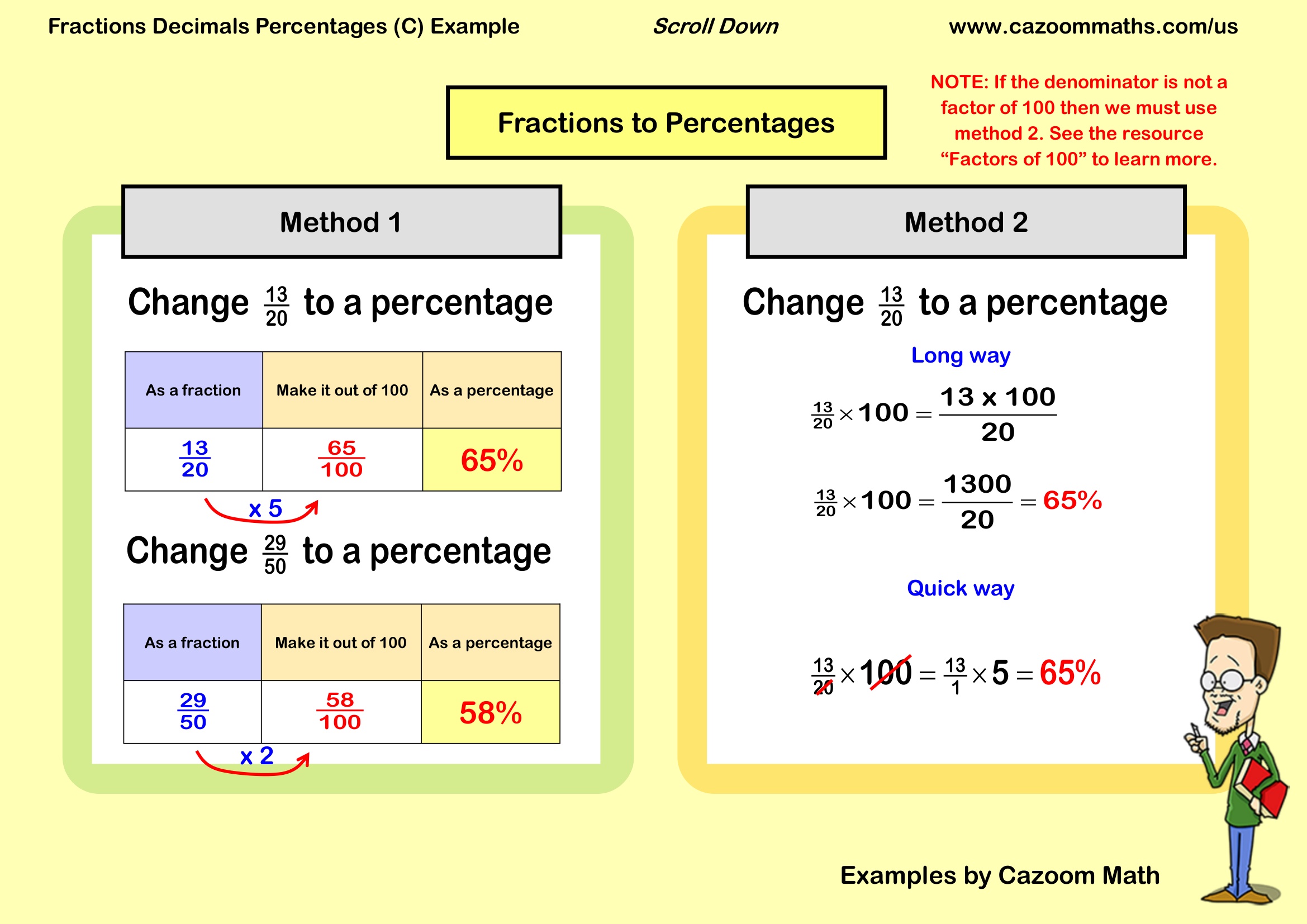
- Method 1 (Denominator is a factor of 100): If the denominator is 2, 4, 5, 10, 20, 25, or 50, it's fastest to create an equivalent fraction with a denominator of 100. The numerator is then the percentage.
- Example:
- Method 2 (Universal Method): Multiply the fraction by 100. This always works.
- Example:
2. The Special Case: Converting Recurring Decimals to Fractions
Some fractions, like , produce recurring decimals (0.333...). For your IGCSE Extended paper, you need to be able to do the reverse: convert a recurring decimal back into a fraction. This is a classic "show that" question where you must demonstrate the correct algebraic method.
This process involves a clever algebraic trick to eliminate the infinitely repeating part of the decimal.
Converting Recurring Decimals to Fractions - GCSE Higher Maths
This video from 1st Class Maths clearly explains the algebraic method needed to convert any recurring decimal into a fraction.
Watch the video carefully, paying close attention to the algebraic steps. 02:02 - 04:05: See how to handle a simple case like 0.222... 04:05 - 07:52: Learn how the method extends to decimals with multiple repeating digits, like 0.373737... 07:52 - 11:40: Focus on the most common exam-style question, where the repeating part does not start immediately, like 0.1555...
Let's summarise the method for (which means 0.1555...):
- Set up the equation: Let
- Shift the decimal: We need to create two equations where the part after the decimal point is identical.
- Multiply by 10:
- Multiply by 100:
- Subtract: Now, and both have
.555...as their decimal part. Subtracting them will cancel this out. - Solve for x:
The key is to multiply by powers of 10 until you find two results that have the exact same recurring decimal part, then subtract them.
3. Fluency with Fraction Calculations
For many IGCSE questions, especially on the non-calculator paper or when method marks are at stake, you must perform fraction arithmetic accurately and show your steps.
This guide from TJP TOP TIPS provides a concise summary of the rules for fraction arithmetic. The key message is that you have to show your working!
Read 'Page 10' and 'Page 11' of the PDF, under the heading 'FRACTIONS'. Focus on the skills for: Converting between mixed and top-heavy (improper) fractions. Multiplying fractions (and the tip to cancel first). Dividing fractions (the 'KFC' method). Adding and subtracting fractions (finding a common denominator).
Key Rules for Fraction Arithmetic:
- Mixed Numbers: For multiplying and dividing, always convert mixed numbers to improper ("top-heavy") fractions first. For adding and subtracting, this is the safest method to avoid errors.
- Addition and Subtraction: You must find a common denominator.
- Multiplication: Multiply the numerators and multiply the denominators. Crucial tip: Cancel any common factors between a numerator and a denominator before you multiply. This keeps the numbers small and simplifies the calculation.
- Division: Keep the first fraction, Flip the second (find its reciprocal), and Change the operation to multiplication.
Test your understanding!
Calculate . Show all your working.
Show answer
- Deal with the brackets first (BIDMAS). Start by converting the mixed number to an improper fraction.
- Add the fractions inside the brackets. Find a common denominator, which is 10.
- Perform the division. Flip the second fraction and multiply.
- Cancel common factors before multiplying. The numbers 10 and 4 share a common factor of 2.
- Convert back to a mixed number (optional but good practice).
4. Percentage Calculations in Context
Percentages are used everywhere, from calculating discounts to analysing statistics. Being fast and accurate with them is essential. The most efficient way to handle percentage calculations is by using decimal multipliers.
IGCSE Fractions, Decimals and Percentages
This article from Tutopiya provides excellent examples of how to approach common percentage problems, including finding the original value after a change.
Read the sections 'Percentage Calculations' and 'Worked Examples'. Pay special attention to the formulas and methods for: Finding a percentage of a quantity. Percentage increase and decrease (especially the alternative methods using multipliers). Finding the original value (reverse percentages).
The Multiplier Method:
This is the fastest and most reliable method for most percentage problems.
- To find a percentage of an amount: Convert the percentage to a decimal and multiply.
- Find 23% of 150:
- To increase by a percentage: Add the percentage to 100%, convert to a decimal, and multiply.
- Increase 80 by 15%:
- To decrease by a percentage: Subtract the percentage from 100%, convert to a decimal, and multiply.
- Decrease 120 by 30%:
- Reverse Percentages (Finding the original): This is a classic exam question. Do not simply reverse the operation (e.g., add back the 20% that was taken off). You must divide by the multiplier.
- A price is £60 after a 20% discount. Find the original price.
- A 20% discount means the price is of the original.
- Original Price 0.80 = £60
- Original Price = £60 0.80 = £75
Key Takeaways
- Interchangeability is Key: Fractions, decimals, and percentages are different languages for the same number. To solve problems, convert them to a common format—often decimals or percentages.
- Master the Methods: Memorise the rules for each conversion and calculation. For fraction arithmetic, showing your working is non-negotiable for securing method marks.
- Use Multipliers for Percentages: For increase, decrease, and reverse percentage problems, using decimal multipliers is faster and less error-prone than two-step methods.
- Recurring Decimals Require Algebra: Remember the "let x equal..." method. This is a "show that" skill where the process is more important than the final answer.
In our next lesson, we will continue building your core number skills by tackling Standard Form. This is another way of representing numbers that is essential for handling very large or very small quantities in science-related questions.