Hello! Welcome to the start of Module 3: Algebraic Foundations and Quadratics.
In the previous module, we focused on number skills, finishing with estimation. A key theme was the importance of careful, step-by-step work to ensure accuracy, whether finding exact bounds or a sensible estimate. That same attention to detail is even more critical in algebra.
Today's lesson is the first step into core algebraic manipulation. Our goal is to expand and simplify expressions involving brackets and negative terms, ensuring no sign errors. This is a foundational skill that you'll use constantly in solving equations, factorising, and even in calculus. You've mentioned that small arithmetic errors, like with signs, can be a problem area, so our focus today will be on using systematic methods to build accuracy and confidence.
1. The Core Principle: Multiply Everything
When you see two brackets next to each other, like (a + b)(c + d), it means everything in the first bracket must be multiplied by everything in the second bracket.
amust multiplycandd.bmust multiplycandd.
Forgetting one of these four multiplications is a common source of lost marks. There are two popular methods to make sure you do this systematically: the Arrow/FOIL method and the Grid method. Let's explore both.
2. Method 1: The Arrow (or FOIL) Method
The most common method involves drawing 'arrows' to connect the terms you are multiplying. For two-term brackets (binomials), this is often called FOIL: First, Outer, Inner, Last.
Let's see this in action. We'll start with a basic example and then immediately introduce negative terms, as handling these correctly is our main objective.
Expanding Double Brackets (Higher & Foundation) | GCSE Maths Tutor
This video from The GCSE Maths Tutor clearly demonstrates the 'arrow' method. We'll watch the first part, which introduces the technique and then applies it to expressions with negative numbers.
Watch from the beginning to 03:20. First, see how (x+3)(x+4) is expanded (00:00 - 01:45). Then, pay very close attention to how negative signs are handled in (x+5)(x-2) and (x-5)(x-4) (01:45 - 03:20). This is a frequent source of error, so note how the signs of the products are determined (e.g., +5 times -2 gives -10).
The key rules for signs during multiplication are:
- Positive × Positive = Positive
- Positive × Negative = Negative
- Negative × Negative = Positive
After multiplying, the final step is to collect like terms. This usually involves combining the two 'x' terms in the middle. Be careful here too! An expression like -2x + 5x becomes +3x, while -4x - 5x becomes -9x.
3. Method 2: The Grid Method for Organisation
You've mentioned that you sometimes make small calculation errors. The Grid Method is an excellent way to organise your work visually and minimise the chance of mistakes. It's particularly effective for keeping track of negative signs.
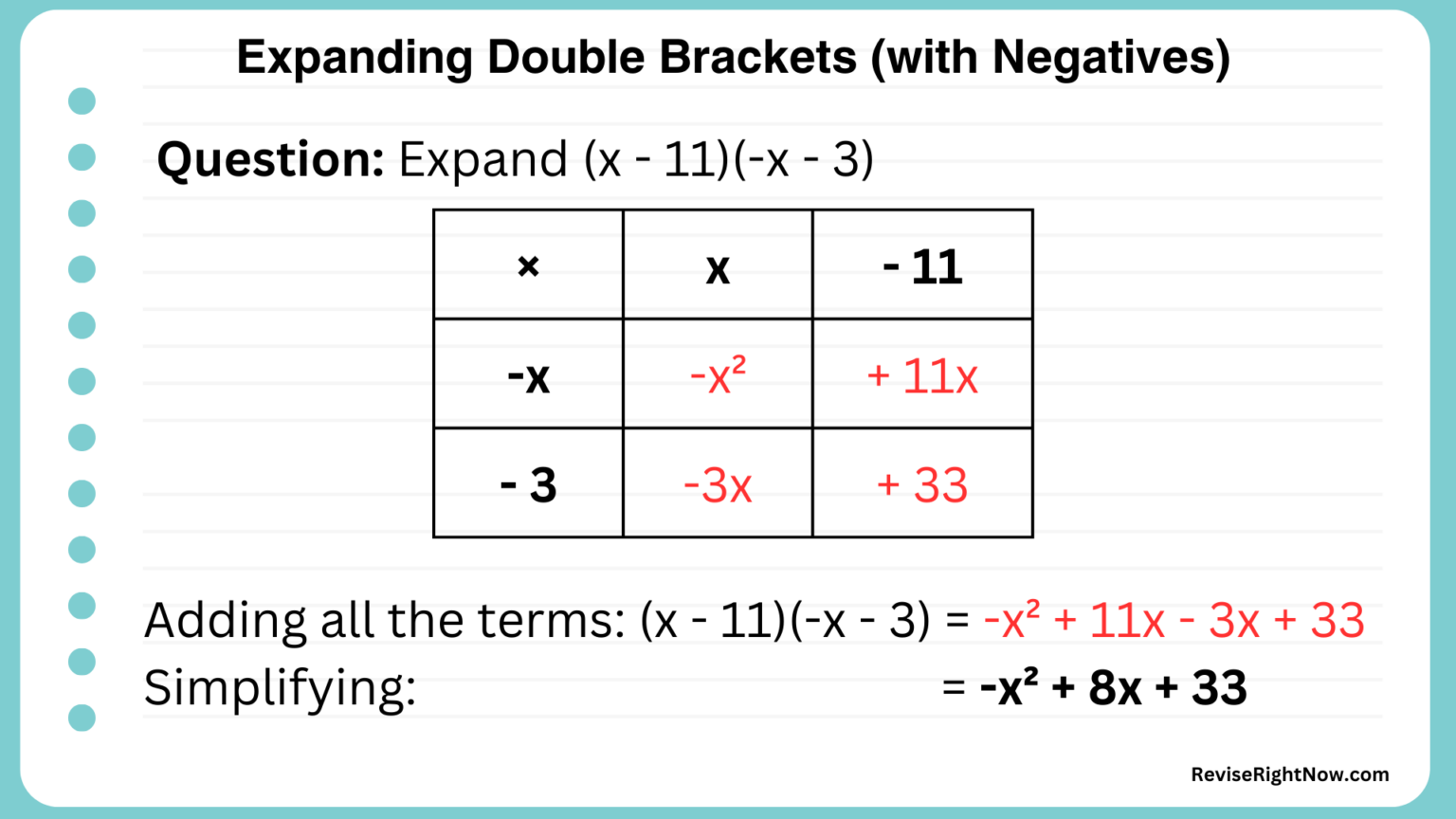
You set up a grid, writing the terms of one bracket along the top and the terms of the other bracket down the side. Then you fill in the grid by multiplying.
How to Expand Double Brackets (FOIL and Grid Method)
This article from IGCSE Maths Tutor introduces the Grid Method as an alternative to FOIL. It's a fantastic tool for ensuring accuracy.
Scroll down to the section titled 'How to Expand Double Brackets using the Grid Method'. Study the setup for (x+3)(x+2) and the two worked examples. Crucially, in Example 6 for (x-7)(x-3), notice how the negative signs are kept with the numbers (-7 and -3) in the grid.
Here is another example of the grid method, this time with several negative terms.
Test your understanding!
Use the Grid Method to expand and simplify the expression (2x - 5)(x - 3).
Show answer
Your grid should look like this:
Now, collect the terms from the grid:
Simplify the middle terms:
4. Handling Coefficients and Avoiding Common Errors
The process remains the same even when the 'x' terms have numbers in front of them (coefficients).
Expanding Double Brackets (Higher & Foundation) | GCSE Maths Tutor
Let's tackle expressions with coefficients, like (2x - 3)(3x + 4). The process is identical, just with slightly more complex multiplication.
Watch from 05:19 to 07:16. Note how the first multiplication, 2x * 3x, becomes 6x². You multiply the numbers (2 × 3) and the variables (x × x) separately.
To solidify your technique, it's useful to explicitly review the most common mistakes students make on these questions.
Expanding Brackets GCSE | Techniques, Tips & Practice
Let's proactively address the typical pitfalls. This article has an excellent section on common mistakes.
Read the section 'Common Mistakes and How to Avoid Them'. This directly covers issues like forgetting to multiply all terms and misplacing negative signs. Being aware of these traps is the first step to avoiding them.
5. Practice Time
The best way to build speed and accuracy is through practice. Let's work through the sets of problems from the video resource. Try solving them on paper first, then watch the solutions to check your work.
Expanding Double Brackets (Higher & Foundation) | GCSE Maths Tutor
First, let's practice with different combinations of positive and negative signs. Pause the video when the questions appear, solve all four, and then play the video to see the worked solutions.
The questions appear at 03:28. Pause the video here to solve them. The solutions are then explained from 03:33 to 05:19. If you get one wrong, listen carefully to the explanation.
Now, try a couple more that include coefficients.
Expanding Double Brackets (Higher & Foundation) | GCSE Maths Tutor
Here are two final practice questions with coefficients. Again, pause the video, solve them, and then review the solutions to confirm your method.
The questions appear at 07:16. Pause and solve (3x - 2)(2x + 3) and (5x - 2)(2x - 1). The worked solutions follow from 07:23 to the end of the video (08:29).
Key Takeaways
- The Golden Rule: To expand double brackets, you must multiply every term in the first bracket by every term in the second.
- Choose Your Method: Both the Arrow/FOIL method and the Grid method work perfectly. The Grid method is often safer for preventing sign errors and ensuring you don't miss any terms.
- Sign Precision: Be extremely careful with negatives. Write down each step of your multiplication before simplifying. Remember:
negative × negative = positive. - Simplify Fully: Always finish by collecting like terms to present your answer in its simplest form (usually ). This final step is worth a mark.
You've now covered a crucial building block of algebra. Mastering this will make the next topics significantly easier.
In our next lesson, we will look at factorising. This is the exact reverse process of what we did today. We'll learn how to take an expression like and work backwards to put it into brackets, as (x+2)(x+3).