Hello! Welcome to your next lesson in the Algebraic Foundations and Quadratics module.
In our previous session, we mastered expanding brackets, turning expressions like (x + 2)(x + 3) into x² + 5x + 6. Today, we're going to reverse that process. This is called factorising.
Our goal for this lesson is to learn how to factorise expressions by identifying common factors, grouping, and using the difference of two squares. Think of factorising as finding the original building blocks of an expression. It's a critical skill in your IGCSE exam, not just for dedicated factorising questions, but for simplifying complex fractions and, as we'll see soon, for solving equations.
You've mentioned that you value knowing which method to choose and when. We will focus on this "method selection" throughout the lesson.
Your Strategic Map for Factorising
Before we dive into the methods, let's look at a flowchart. This is your strategic map for tackling any factorisation problem.

Keep this process in mind:
- ALWAYS look for a Greatest Common Factor (GCF) first.
- Then, count the number of terms.
- Apply the appropriate method based on the term count.
Let's learn the methods one by one.
1. The First Commandment: Highest Common Factor (HCF/GCF)
The most fundamental type of factorising is taking out the highest common factor (sometimes called the greatest common factor, or GCF). This is the reverse of expanding a single bracket. You need to find the largest number and the highest power of each variable that can be divided into every single term of the expression.
This worksheet provides a great step-by-step guide and practice.
Factorising Linear and Quadratic Expressions Worksheet
This resource from Physics and Maths Tutor breaks down how to find and extract the highest common factor (HCF). Pay attention to the two-step process: finding the numerical HCF, then the algebraic HCF.
Read 'Section A'. Study the 'Worked Example' for 3y² + 9y and the 'Guided Example' for 8a³ - 4a². Then, try questions 1(a), 1(d), and 1(g) on paper. The logic in 1(g) is exactly what you need for more complex exam questions.
Examiner Tip: Forgetting to take out the highest common factor is one of the most frequent reasons students lose marks. Always check for it before trying any other method.
2. Factorising by Grouping (Four-Term Expressions)
When you see an expression with four terms, your first thought should be to try factorising by grouping. The flowchart above confirms this. The strategy involves splitting the expression into two pairs and factorising each pair separately.
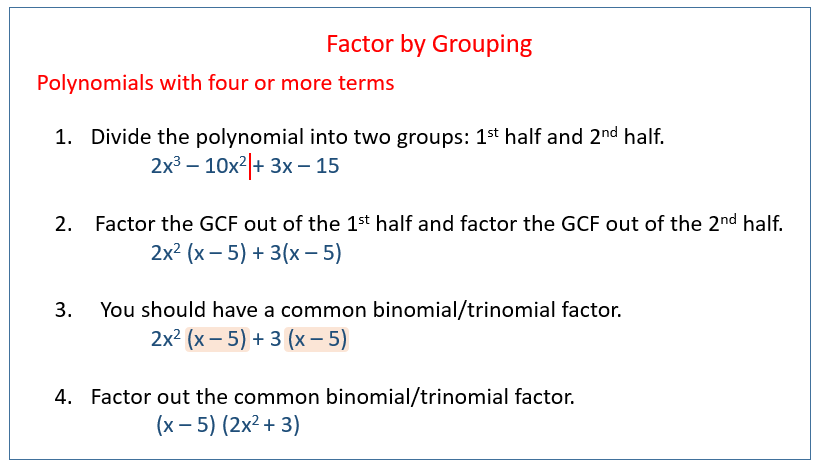
This method can be tricky, especially when negative signs are involved. The following video provides excellent worked examples and highlights a common pitfall.
Gr 9 Factorisation: Grouping Introduction
This video from Kevinmathscience focuses specifically on the grouping method. Pay close attention to how he handles negative signs to make the brackets match.
Watch the first example from the beginning to 01:43. Then, watch the crucial example involving a negative sign from 03:34 to 06:03. This is a common exam trick: sometimes you need to factor out a negative number to make the two brackets identical. This is a key technique to master.
Test your understanding!
Factorise the expression .
Show answer
- Group into pairs:
- Factorise each pair:
- Factor out the common bracket:
3. Difference of Two Squares (DOTS)
When you see a two-term expression (a binomial) with a minus sign between the terms, check if it's a "Difference of Two Squares". This pattern occurs when you have one square number/term subtracted from another.
The rule is:
To use this, you need to be able to spot square numbers (1, 4, 9, 16, 25, 36, ...) and square variables (, etc.).
This video gives a comprehensive overview, from basic examples to the multi-step problems you'll see in exams.
How To Factor Difference of Squares - Algebra
This video from The Organic Chemistry Tutor is a complete guide to DOTS. It covers simple cases and then combines the method with taking out common factors.
Watch the video in stages: The Formula (00:00 - 02:20): Understand the basic pattern a² - b² = (a+b)(a-b). With Coefficients (02:20 - 04:59): See how it works for expressions like 4x² - 25. HCF First! (04:59 - 07:32): This is the most important part for exam success. Watch how for 3x² - 27, you must take out the common factor of 3 first, leaving 3(x² - 9), which you can then factorise using DOTS. This combines the first and third methods of our lesson.
Test your understanding!
Factorise fully:
Show answer
- Check for HCF first: The highest common factor is 2.
- Look at the bracket: It has two terms, a minus sign, and both terms are perfect squares. This is DOTS.
- Apply the DOTS formula:
4. Practice and Strategy Review
You have now learned the three key factorisation techniques for your exam. Let's put it all together with some practice from the worksheet. Remember the strategic flowchart: HCF first, then count the terms.
Factorising Linear and Quadratic Expressions Worksheet
Now it's time to apply these skills. Use the Physics and Maths Tutor worksheet for targeted practice.
Go back to the worksheet and complete the following questions: From 'Section A' (HCF): Try 1(i) and 1(l). From 'Section B' (DOTS): Try all questions from 2(a) to 2(e). For (d) and (e), remember the golden rule: HCF first!
Key Takeaways
- Factorising is the reverse of expanding. You are putting an expression back into its component brackets.
- Your strategy is key: Always start by looking for a Highest Common Factor. Then, count the terms to decide your next move.
- 4 terms? Try Grouping.
- 2 terms? Check for a Difference of Two Squares ().
- Sign errors are costly. When grouping, you may need to factor out a negative to make the brackets match. In DOTS, remember the brackets must have one plus and one minus.
You've added three powerful tools to your algebraic toolkit today. Being able to quickly and accurately factorise will save you time and earn you marks across the exam paper.
In the next lesson, we will move on to solving linear equations. This will involve rearranging expressions, and soon after, we will see how the factorising skills you learned today are essential for solving quadratic equations.