Hello! Welcome back to our Mathematics Mastery Sprint.
In our last lesson, we focused on factorising, which is all about putting expressions into brackets. We learned how to pull out common factors, factorise by grouping, and use the difference of two squares. Today, we're shifting our focus to solving linear equations. This means finding the specific value of a variable (usually ) that makes an equation true.
Our goal is to solve linear equations, including those with algebraic fractions and brackets. This is a fundamental skill for the IGCSE paper. While the questions can look intimidating, the underlying process is very systematic. Mastering this process will help you secure crucial method marks, even if a small calculation error occurs under pressure.
You've mentioned that you sometimes struggle with arithmetic precision and choosing the most efficient method. Today's lesson is designed to give you a reliable, step-by-step strategy to tackle these problems confidently and accurately.
1. The Foundation: Brackets and Variables on Both Sides
Before we tackle fractions, let's solidify the core principles of solving any linear equation. The general game plan is always to isolate the variable ().
- Expand Brackets: If you see brackets, your first step is to multiply them out.
- Collect Terms: Gather all the variable terms (the 's) on one side of the equation and all the constant terms (the numbers) on the other.
- Isolate the Variable: Perform the final division or multiplication to find the value of .
This revision guide from Save My Exams provides a clear and concise summary of this process.
Linear Equations | CIE IGCSE Maths
This guide covers the foundational steps for solving linear equations. Focus on the methods for handling brackets and for equations where 'x' appears on both sides.
Please read the following sections: 'Equations with Brackets & Fractions' (Page 5): Read the first part on 'How do I solve a linear equation that contains brackets?'. Pay attention to the worked example 2(x-1) = 10 - (3+x). 'Unknown on Both Sides' (Page 9): Read this section to review the strategy for collecting 'x' terms. A good tip is to move the 'x' term with the smaller coefficient to avoid dealing with negative 'x' terms.
2. The Main Event: Solving Equations with Algebraic Fractions
Algebraic fractions can make an equation look complicated, but there's a powerful strategy to simplify them right at the start: eliminate the fractions.
The most reliable way to do this is to multiply every single term in the equation by the Least Common Multiple (LCM) of the denominators. This clears all the fractions, leaving you with a straightforward linear equation of the type we just reviewed.
This video provides an excellent, step-by-step guide to this method.
Solving Linear Equations with Fractions in Just Two Steps│Algebra
This GoTutor Math video breaks down solving equations with fractions into two simple steps. It's a fantastic resource for building a reliable method.
Watch the video, focusing on the core techniques: The LCM Method (00:00 - 04:44): Watch the first two examples to understand how to find the LCM and multiply every term to eliminate the fractions. Including Non-Fraction Terms (04:44 - 06:55): This example is crucial. It shows that you must multiply whole numbers by the LCM too, which is a common place to make a mistake. A Shortcut (08:14 - 10:14): Learn about 'cross-multiplication', which is a fast shortcut you can use only when you have a single fraction equal to another single fraction.
Avoiding Common Errors
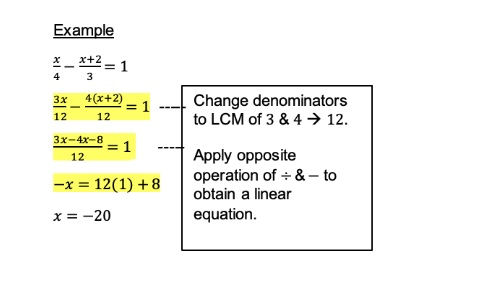
One of the most frequent errors is forgetting to multiply every term by the LCM. Look at this image to see why that's a problem.

Another major tripwire is the negative sign in front of a fraction. When you clear the denominator, that negative applies to the entire numerator.
Test your understanding!
Solve the equation:
Show answer
- Find the LCM: The LCM of 2 and 5 is 10.
- Multiply every term by the LCM:
- Simplify:
Notice the
-2in front of the(x-2)bracket. - Expand the brackets:
A common error is writing
-4instead of+4. Be careful:-2 * -2 = +4. - Collect like terms and solve:
3. Practice and Reinforcement
Now let's consolidate this method with some more examples and practice. Before you try some questions, it's incredibly useful to see the common mistakes other students make. This helps you build a "mental checklist" to avoid them in the exam.
Algebraic Fractions - GCSE Maths
This resource from Third Space Learning has a brilliant section on common errors, followed by clear worked examples. Reading about mistakes first is a great way to prepare for practice.
First, navigate to the section titled 'Common misconceptions'. Read through these five common errors carefully. Think about whether you've ever made any of them. Next, go back up to the section 'Algebraic fractions examples' and study Example 2 and Example 5. These show the method applied to different types of problems you might face.
Now, it's your turn to be the examiner. Use the same resource to work through a typical exam-style problem.
Your Task:
From the "Algebraic Fractions - GCSE Maths" resource, go to the section "Algebraic fractions GCSE questions" and solve Question 1:
"Arron earns £40 per hour. One day, he receives a bonus of £5. He shares this day’s earnings equally with his brother and sister. If he gives away £190, how many hours did Arron work that day?"
First, try to form the equation yourself. Then, solve it step-by-step on paper. The resource provides the answer for you to check.
Hint: "Shares equally with his brother and sister" means his earnings are split between 3 people. "He gives away £190" refers to the shares his brother and sister receive (2 out of the 3 parts).
Key Takeaways
- Systematic Approach: For any linear equation, first expand brackets, then collect terms, and finally isolate the variable.
- Clear the Fractions: When an equation contains fractions, the most reliable first step is to multiply every term by the LCM of the denominators.
- Watch for Negatives: A minus sign before a fraction applies to the entire numerator. Use brackets to avoid sign errors, e.g., becomes .
- Check Your Work: If time permits in the exam, substitute your final answer back into the original equation to verify it is correct.
You've now developed a solid strategy for one of the most common types of algebra questions. This process of clearing fractions will be vital as we move forward.
In our next lesson, we will combine these equation-solving skills with the factorising techniques from our previous lesson to solve quadratic equations, a high-value topic on the IGCSE paper.