Hello! Welcome to your next lesson in the "Graphs of Functions and Transformations" module.
In previous lessons, you've developed key skills in sketching graphs and interpreting them to solve equations and inequalities. Today, we'll build on that foundation by learning how to manipulate entire graphs. Instead of a graph being a static picture, you'll see how to move, stretch, and reflect it in predictable ways just by making small changes to its equation.
Your learning outcome for this lesson is to apply transformations to the graph of y=f(x): translations, reflections, and stretches. This is a frequent topic on both Paper 2 and Paper 4, and mastering the rules will turn these questions into a reliable source of marks, directly addressing your goal of improving on graph-based problems.
The Two Golden Rules of Graph Transformations
At the heart of all graph transformations are two simple, powerful rules that determine how a change to the function's equation affects the graph. Understanding these will allow you to decode any transformation question an examiner throws at you.
The key is to notice where the change is happening in the function notation: is it inside the bracket with the , or outside the bracket?
- Inside the Bracket (Affects X): Any change made inside the function's bracket, directly affecting the variable (e.g., , , ), transforms the graph horizontally. It only changes the x-coordinates. Crucially, the effect is the opposite of what you might expect.
- Outside the Bracket (Affects Y): Any change made outside the function's bracket (e.g., , , ) transforms the graph vertically. It only changes the y-coordinates. This effect is direct and does exactly what you'd expect.
Let's watch a short video clip that introduces these fundamental rules.
Graph Transformations | Grade 7-9 Maths Series | GCSE Maths Tutor
This clip from The GCSE Maths Tutor clearly explains the core principle of 'inside vs. outside' the bracket. Grasping this idea from the start is the key to the whole topic.
Watch from 01:25 to 04:26. Focus on understanding the difference between a change made 'next to the x' (inside the bracket) and 'outside the bracket'. The mnemonic 'Inside bracket, affects X, does the opposite' is extremely useful.
Now, let's break down the specific types of transformations using these two rules.
1. Translations (Shifting the Graph)
A translation simply slides the entire graph without changing its shape or orientation.
-
Vertical Translation:
- The
+ ais outside the bracket. - It affects the y-coordinates as you'd expect.
- If is positive, the graph shifts up by units.
- If is negative, the graph shifts down by units.
- Effect on a point (x, y):
- The
-
Horizontal Translation:
- The
+ ais inside the bracket. - It affects the x-coordinates in the opposite way.
- shifts the graph left by units (opposite of plus).
- shifts the graph right by units (opposite of minus).
- Effect on a point (x, y):
- The
2. Stretches (Scaling the Graph)
A stretch pulls or squashes the graph, changing its shape.
-
Vertical Stretch:
- The multiplier
ais outside the bracket. - It affects the y-coordinates as you'd expect.
- The graph is stretched vertically by a scale factor of . All y-coordinates are multiplied by .
- Effect on a point (x, y):
- The multiplier
-
Horizontal Stretch:
- The multiplier
ais inside the bracket. - It affects the x-coordinates in the opposite way.
- The graph is stretched horizontally by a scale factor of . All x-coordinates are multiplied by (the reciprocal of ).
- Effect on a point (x, y):
- The multiplier
3. Reflections (Flipping the Graph)
A reflection flips the graph across an axis. This is a special case of stretching where the scale factor is -1.
-
Reflection in the x-axis:
- The negative sign is outside the bracket.
- It affects the y-coordinates as you'd expect (multiplies them by -1).
- Effect on a point (x, y):
-
Reflection in the y-axis:
- The negative sign is inside the bracket.
- It affects the x-coordinates. For reflections, the "opposite" rule can be confusing; it's easier to just remember it flips the sign of the x-coordinate.
- Effect on a point (x, y):
This summary table and poster are excellent references to keep handy.
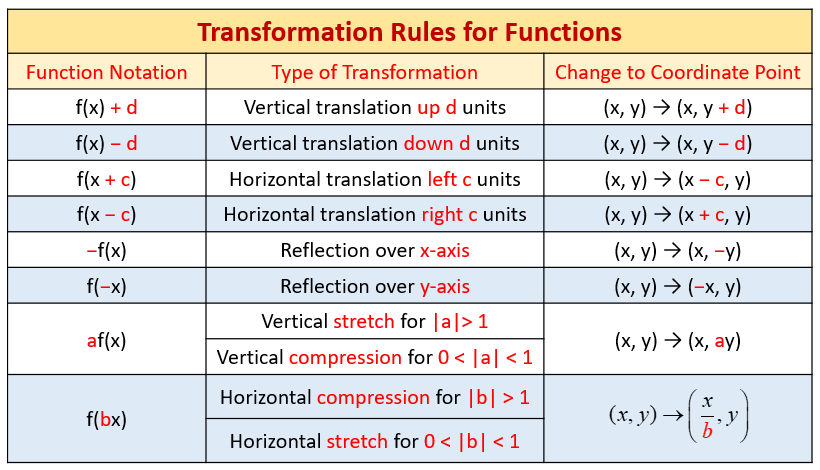
Applying the Rules: From Points to Sketches
In your exam, you'll be asked to do two main things: find the new coordinates of a specific point, or sketch the entire transformed graph.
Let's watch how to apply these rules step-by-step. The video demonstrates how to transform a single maximum/minimum point and then uses that skill to transform an entire curve.
Graph Transformations | Grade 7-9 Maths Series | GCSE Maths Tutor
Let's return to The GCSE Maths Tutor video. It will now demonstrate how to apply these rules to solve typical exam questions involving translations, stretches, reflections, and even combinations of transformations.
Please watch the following sections: Translations (04:26 - 06:01): See how f(x-2) and f(x)-1 are applied to the coordinates of a maximum point. Stretches (06:01 - 07:24): Notice how f(2x) (horizontal stretch, factor 1/2) and 3f(x) (vertical stretch, factor 3) work. Reflections (07:24 - 08:56): Pay close attention to how f(-x) reflects in the y-axis and -f(x) reflects in the x-axis. Combined Transformations (08:56 - 12:44): This is a crucial section. See how multiple transformations like y = f(x-2) + 3 are handled by applying the changes to the x and y coordinates one by one.
Test your understanding!
The graph of has a minimum point at .
Find the coordinates of the minimum point on the graph of .
Show answer
Let's break this down step-by-step, applying the transformations to the point .
-
Look inside the bracket:
- This is a change to , and it does the opposite.
- Instead of multiplying the x-coordinate by 2, we divide it by 2.
- New x-coordinate: .
-
Look outside the bracket:
- This is a change to , and it does what we expect.
- We multiply the y-coordinate by -1.
- New y-coordinate: .
The new minimum point is at .
Sketching Transformed Graphs
The method for sketching a transformed graph is a logical extension of transforming a single point.
- Identify key anchor points on the original graph. These are usually the y-intercept, x-intercepts, and any maximum or minimum points.
- Apply the transformation rules to each of these anchor points to find their new positions.
- Draw a smooth curve through the new anchor points, making sure the shape of the new graph is consistent with the transformation (e.g., stretched, shifted, or reflected).
Graph Transformations | Grade 7-9 Maths Series | GCSE Maths Tutor
This final clip from the same video shows the sketching process in action. It's all about moving key points and redrawing the curve.
Watch these two examples of sketching: Horizontal Translation (14:39 - 16:45): See how the entire graph of f(x) is moved to create f(x-4) by shifting key coordinates 4 units to the right. Vertical Reflection and Translation (19:18 - 23:13): This part shows how to draw both f(x)+2 (shift up 2) and -f(x) (reflect in x-axis). Watch carefully how the key points are moved for each transformation before the new curve is sketched.
Exam Practice
Now it's time to apply these methods, as you would in an exam. This is the core of the "Error-Loop Method" — putting theory into practice.
Exam Questions - Graph transformations
Here are some IGCSE-style questions from ExamSolutions. Try them yourself first, then check your work against the provided solution.
Navigate to the webpage and attempt Question 5 and Question 8. These are excellent examples of typical IGCSE questions on this topic. For Question 5: You are asked to sketch y = f(-x) and y = 2f(x). Identify the transformation type first, then apply it to the key points given on the graph. For Question 8: This involves combined transformations. Use the step-by-step method to find the new coordinates of point P. After attempting each one, click 'View Solution' to check your answer and your method.
Conclusion
Today you've learned a systematic, rule-based approach to graph transformations. By remembering the two golden rules—inside the bracket affects X (opposite), outside affects Y (expected)—you can confidently tackle questions on translations, stretches, and reflections.
Key Takeaways:
- Translations (Shifts): is vertical, is horizontal (in the opposite direction).
- Stretches (Scales): is a vertical stretch by factor , is a horizontal stretch by factor .
- Reflections (Flips): reflects in the x-axis, reflects in the y-axis.
- Method for Exam Questions:
- Identify the transformation(s) from the equation.
- Apply the rules one by one to find the new coordinates of key points.
- If sketching, connect the new points with a smooth curve that respects the transformation.
Preview of the Next Lesson:
In our final lesson of this module, we will apply your graph interpretation skills to a real-world context: kinematics. You will learn how to calculate speed, acceleration, and distance from distance-time and speed-time graphs. This bridges the gap from abstract functions to the practical application of graphs in physics and other sciences.