Hello! Welcome to the final lesson in our "Geometric Transformations and Vectors" module.
In the last lesson, we focused on the essential skill of navigating geometric diagrams by finding vector paths. We established the core rules: creating indirect routes, reversing vector directions, and using the key formula . Today, we will use these exact skills to build logical arguments, a process central to many high-mark exam questions.
This lesson directly targets one of the areas you've found challenging: "show that" questions. Our learning outcome is to construct vector proofs to show that lines are parallel, points are collinear, or to find ratios. By the end of this lesson, you will have a structured, repeatable method for tackling these problems, turning them from a point of uncertainty into an opportunity to score method and accuracy marks reliably.
1. The Two Foundational Principles of Vector Proofs
All vector proofs in your IGCSE course are built on two simple, interconnected ideas. Mastering these is the key.
Principle 1: Proving Lines are Parallel
Two vectors are parallel if one is a simple scalar multiple of the other. This means their directions are identical (or exactly opposite), but their lengths may differ.
If vector is parallel to vector , then you can write:
where is a constant number (a scalar).
- If is positive, they point in the same direction.
- If is negative, they point in opposite directions.
For example, if and , we can see that . Since is a scalar multiple of (with ), the lines AB and CD are parallel.
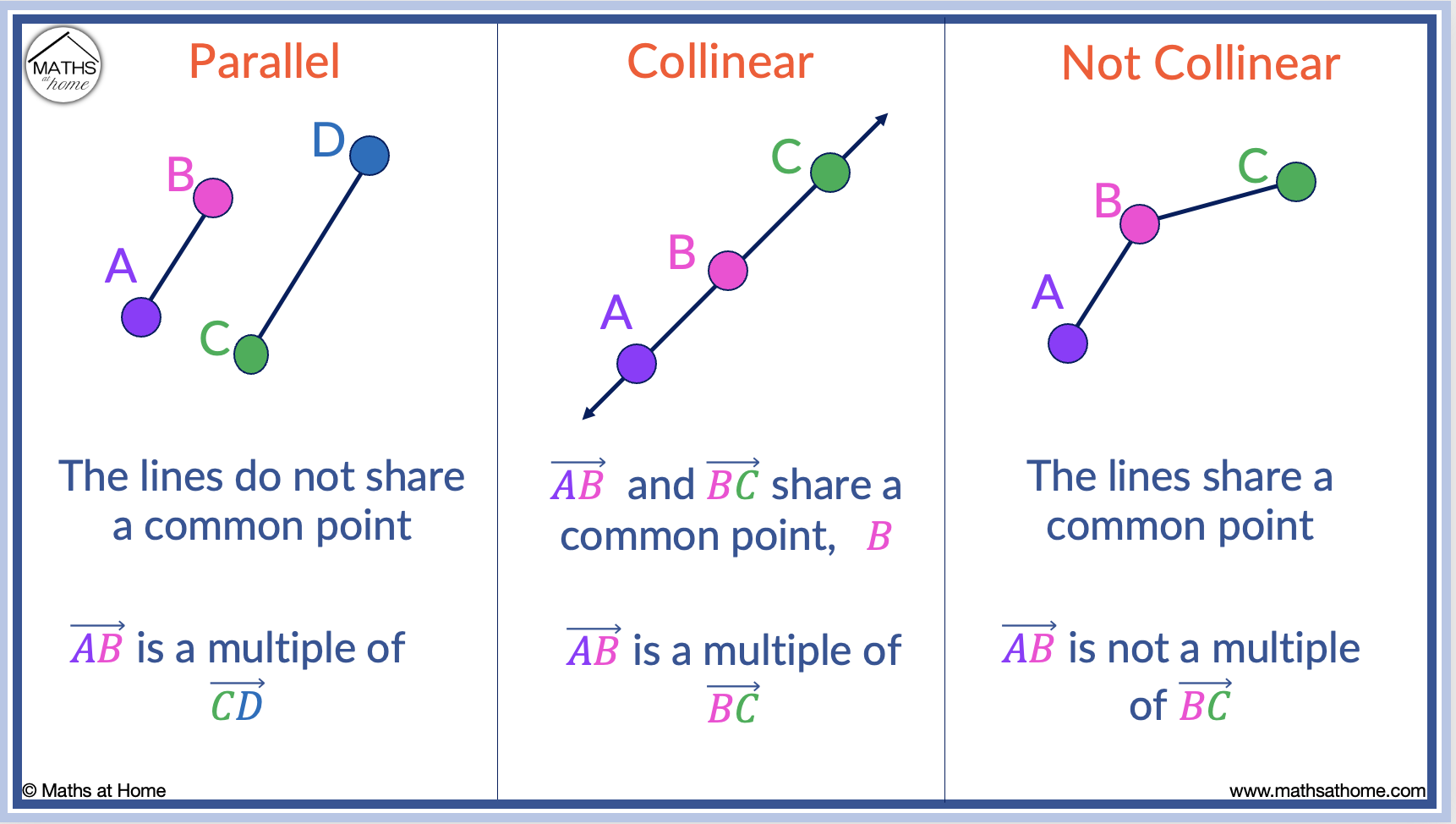
Principle 2: Proving Points are Collinear
"Collinear" simply means the points lie on the same straight line. To prove that three points (say, A, B, and C) are collinear, you must satisfy two conditions:
- The vector from A to B must be parallel to the vector from B to C (i.e., ).
- The two vectors must share a common point (in this case, point B).
The common point is crucial. Without it, the lines would just be parallel and separate. The shared point ensures they connect to form a single straight line.
Vector Geometry - finding "k" and proving lines are straight (GCSE Higher)
To start, watch this short, clear explanation of these two fundamental principles from the channel 'mathonify'. It lays the groundwork for everything that follows.
Watch from the beginning (00:09) to 02:17. Focus on the definitions of parallel vectors as scalar multiples and collinear points as parallel vectors that share a common point.
This next clip makes the distinction between parallel and collinear explicit, which is a common point of confusion.
IGCSE/O LEVEL Maths - Vectors (Past Papers)
This clip from 'Mathlete by Saad' directly addresses what happens when parallel vectors share a point. His explanation will help solidify why both conditions are necessary for a collinearity proof.
Watch from 10:53 to 12:13. Note his emphasis that if there is a common point, the vectors are collinear, not parallel.
To summarise these critical ideas visually:
Test your understanding!
You have worked out the following vectors in a geometry problem:
- Are the lines AB and BC parallel? Are the points A, B, and C collinear? Justify your answer.
- Are the lines AB and DE parallel?
Show answer
-
First, check if is a multiple of .
By factoring out 3 from , we get .
Since , we can state that .- The vectors are parallel because one is a scalar multiple of the other ().
- They share a common point B.
- Therefore, the points A, B, and C are collinear.
-
Now, check if is a multiple of .
By factoring out from , we get .
So, .
Since one vector is a scalar multiple of the other (), the lines AB and DE are parallel. (They are also in opposite directions because k is negative).
2. A Method for Collinearity Proofs
Now let's apply this to a typical IGCSE-style "show that" question. The key is to follow a clear, logical process. This turns a complex problem into a series of manageable steps and ensures you get all the method marks.
The Method:
- Identify your Goal: State which vectors you need to prove are parallel (e.g., to prove P, N, Q are collinear, you could aim to show is a multiple of ).
- Find the Vector Paths: Use the path-finding skills from the last lesson to find expressions for your chosen vectors in terms of the base vectors (e.g., and ). This is where most of the work happens.
- Compare and Factorise: Manipulate one of your vector expressions (usually by factoring out a number or fraction) to show it is a scalar multiple of the other.
- State the Conclusion: Write a concluding statement that covers both conditions:
- "Since , the vectors are parallel."
- "Since they also share a common point N, the points P, N, and Q are collinear."
Let's watch this method in action.
Vector Geometry - finding "k" and proving lines are straight (GCSE Higher)
The following video from 'mathonify' is a perfect demonstration of this method. The problem is to prove that points P, N, and Q lie on a straight line. Pay close attention to how the presenter breaks the problem down, finding each required vector piece by piece before putting it all together.
Watch the example from 07:07 to 14:26. Don't worry about trying to solve it yourself just yet. Focus on the logical structure of the solution and how it matches the 4-step method outlined above. Notice the careful fraction work – a common area for errors!
Here is another worked example, presented in a clear handwritten format. This is a good model for how to lay out your own answers in an exam.

3. Proofs Involving Ratios and Unknowns
The principles of parallelism and collinearity are also used to solve for ratios or unknown values.
Finding Ratios
If you prove that points O, P, and B are collinear by showing , you have also proven something about the ratio in which P divides the line OB.
- The vector is of the total length.
- The remaining part, , must be of the total length.
- Therefore, the ratio , which simplifies to 2:3.
Let's look at a clear written guide that walks through this process.
Vectors | Cambridge (CIE) IGCSE Maths Revision Notes
These notes from Save My Exams provide a concise summary of vector proofs and include an excellent worked example. Pay special attention to part (c).
Read the sections 'Problem Solving with Vectors', 'How do I use ratios in vector paths?', and the full 'Worked Example'. Focus on how the result \vec{OP} = rac{1}{4}\vec{OB} in part (c) is used to prove collinearity and then to determine the ratio OP:PB.
Finding an Unknown Scalar (e.g., 'k')
A common exam variant gives you that three points are collinear and asks you to find an unknown value k. Here, you use the condition of collinearity to form an equation.
The Method:
- Find two different vector paths for the line segment (e.g., find expressions for and ). One of these will involve the unknown
k. - Since the points M, P, N are collinear, you know must be a multiple of .
- Compare the coefficients of your base vectors ( and ). This allows you to find the scalar multiple and then set up an equation to solve for
k.
This technique of comparing coefficients is a powerful strategy.
Vector Geometry - finding "k" and proving lines are straight (GCSE Higher)
This final clip, again from 'mathonify', demonstrates the method of comparing coefficients to solve for an unknown. This is a more advanced technique that is very efficient.
Watch the example from 19:35 to 26:11. The key insight is at the end: by comparing the coefficients of the 'a' vector in the expressions for MP and MN, the presenter can deduce the scalar multiple and solve for k.
Conclusion
Today, we've transformed the abstract rules of vector arithmetic into a powerful tool for constructing geometric proofs. You now have a structured approach for the "show that" questions involving vectors, which will help you write clear, logical answers that secure method marks.
Key Takeaways:
- To prove lines are parallel: Show one vector is a scalar multiple of the other ().
- To prove points are collinear: Show the vectors connecting them are parallel AND they share a common point.
- To find a ratio: The scalar multiple gives you the fraction of the line, which can be converted into a ratio (e.g., if , then ).
- To find an unknown scalar: Use the fact of collinearity to create two vector expressions, then compare coefficients to form an equation and solve.
Preview of the Next Lesson:
This lesson concludes our module on vectors. In the next lesson, we will begin a new topic: Mensuration and Circle Properties. We will start by learning to calculate the area and perimeter of complex 2D shapes, including sectors and segments of circles.