Hello! Welcome to your next lesson in the "Geometric Transformations and Vectors" module.
In our last session, we covered vector arithmetic and learned how to calculate a vector's magnitude using Pythagoras' theorem. You're now equipped with the fundamental tools for manipulating vectors. Today, we'll apply these tools to solve the kind of multi-step geometric problems that carry significant marks in your IGCSE exams.
Today's learning outcome is to use vectors to describe translations and solve geometric problems involving position and displacement. This is all about finding your way around a geometric diagram by following vector paths. Mastering this is crucial for tackling complex questions efficiently and is a key step towards improving your exam grade.
1. The Core Skill: Finding Vector Paths
The fundamental principle of solving geometric problems with vectors is that the path you take doesn't matter, as long as you follow the vectors correctly. To get from a point A to a point C, you don't have to go directly. You can take an indirect route, for example, by going from A to B, and then from B to C.
This is expressed as:
A crucial part of this is understanding what happens when you travel along a vector in the opposite direction. If the vector from O to X is , then travelling from X back to O is simply .
Let's watch a short video that clearly explains this core concept.
This video from 1st Class Maths introduces the notation for vectors and explains the two most important rules: reversing a vector's direction makes it negative, and you can find a vector between two points by taking an indirect path.
Watch from the beginning to 03:50. Pay close attention to how the vector from X to Y is found by going via the origin O.
This idea of finding an alternative path is the key to almost every vector problem you will encounter. If you don't know the direct vector, find another way to make the journey using vectors you do know.
2. Position Vectors vs. Displacement Vectors
To solve problems effectively, we need to be precise about two types of vectors.
-
Position Vector: This is a vector that starts from a fixed point called the origin (O). The position vector of a point A is written as or simply as a lowercase bold letter, . A key fact is that the coordinates of point A, let's say , are the same as the components of its position vector, .
-
Displacement Vector: This is the vector between any two points. It represents the displacement, or journey, from one point to another. For example, is the displacement vector from A to B.
There is a powerful and time-saving formula that connects these two concepts. To find the displacement vector from A to B, you can use their position vectors:
Why does this work? It's just an application of the path-finding rule from Part 1. The journey from A to B can be made by going from A to the origin O () and then from the origin O to B ().
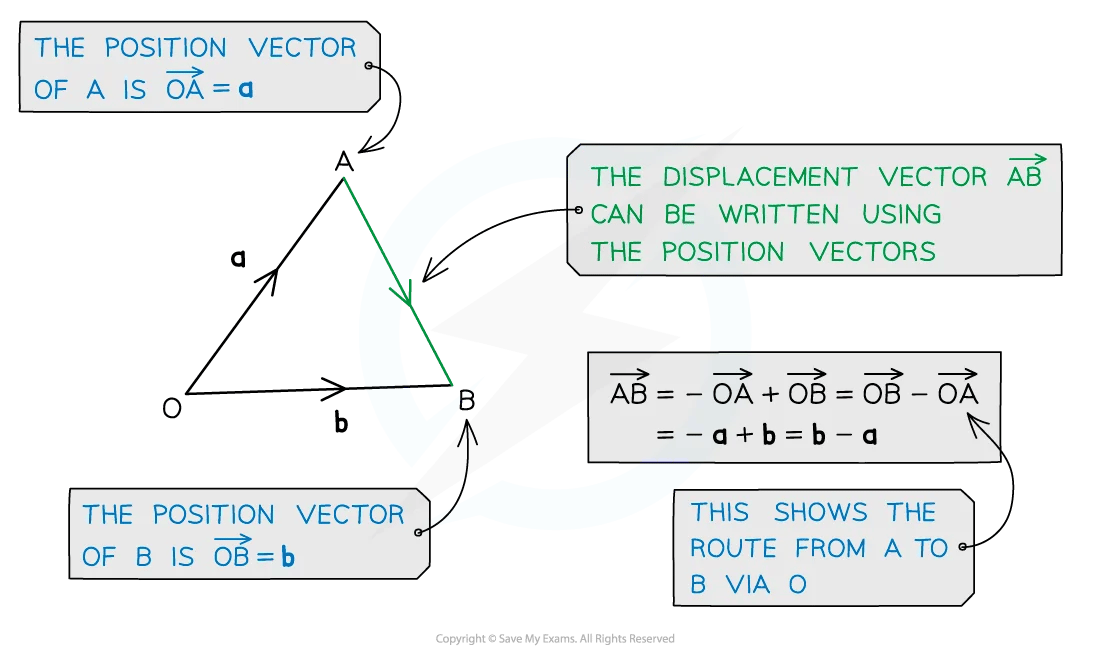
Let's solidify this concept with a concise written explanation.
Position & Displacement Vectors
This document from Save My Exams provides a clear definition of position and displacement vectors and presents the crucial formula \vec{AB} = \mathbf{b} - \mathbf{a}.
Read the page titled 'Position & Displacement Vectors'. Focus on the definitions and the formula for finding the displacement vector from two position vectors. Study the worked example.
Test your understanding!
Point P has coordinates and point Q has coordinates .
- Write down the position vectors and as column vectors.
- Find the displacement vector .
Show answer
-
The position vectors have the same components as the coordinates:
-
Using the formula :
Be careful with the double negative! This is a common place for arithmetic errors.
3. Application: Solving Geometric Problems
Now, let's apply these principles to typical IGCSE exam questions. These problems usually provide a diagram with some known vectors and ask you to find unknown vector paths. Remember the strategies: look for indirect routes and use information about the geometry of the shape (e.g., midpoints, ratios, parallel sides).
The following video is an excellent, in-depth walkthrough of several past-paper questions. We'll watch it in sections to focus on specific skills.
First, let's see how to approach a typical Paper 4 question involving a triangle with points dividing lines. This requires careful application of the path-finding rules.
Everything you need to know about IGCSE Vectors in 43 minutes
This segment from the 'Ginger Mathematician' video tackles a classic IGCSE question. Notice how he finds each required vector by constructing a path from known vectors and how the answer to one part is used in the next. This is a key strategy for multi-step problems.
Watch the section from 03:56 to 10:35.
From Vectors back to Coordinates
A common final part of a vector problem is to find the coordinates of a point. You do this by:
- Finding the position vector of that point (the vector from the origin O to the point).
- The components of this position vector will be the coordinates of the point.
Let's watch another segment from the same video that demonstrates this process perfectly.
Everything you need to know about IGCSE Vectors in 43 minutes
This next segment demonstrates how to use position vectors to find coordinates. The problem involves finding the vector \vec{ON} first, and then substituting in the column vectors for \mathbf{a} and \mathbf{b} to find the final coordinates of N.
Watch from 13:51 to 20:13. This is a fantastic example of combining algebraic vectors with column vectors to solve a problem.
This last example is a great illustration of method selection. You first solved the problem geometrically using paths (), then simplified the algebraic expression, and finally performed the arithmetic with column vectors.
4. Practice Problem
Let's tackle a problem involving finding a starting point, which requires you to reverse your thinking.
Problem:
Point Q has coordinates . The displacement vector is . Find the coordinates of point P.
Strategy:
- You want the coordinates of P, so you need its position vector, .
- You know (from the coordinates of Q) and .
- Construct a path to get from O to P. A good path is .
- Be careful! You are given , so what is ?
Show solution walkthrough
Let's follow the strategy.
- The position vector of Q is .
- The vector from P to Q is .
- To go from Q to P, we must reverse the direction, so .
- Now, find the position vector by following the path from O to Q, then Q to P:
- Since the position vector of P is , the coordinates of P are .
This exact problem is worked through in the "Ginger Mathematician" video from 24:40 to 27:58 if you'd like to see it explained on video.
Conclusion
Today you've moved from the basic mechanics of vectors into their primary application in IGCSE maths: solving geometric problems. By mastering path-finding, you can deconstruct complex shapes and find solutions efficiently.
Key Takeaways:
- To find an unknown vector, create a path using vectors you already know.
- Travelling against a vector's direction reverses its sign (e.g., ).
- A position vector goes from the origin O to a point P ( or ), and its components are the point's coordinates.
- A displacement vector goes between two points A and B. It can be found with the crucial formula: .
- To find the coordinates of a point, first find its position vector.
Preview of the Next Lesson:
In our next lesson, we will build directly on these skills to construct vector proofs. We will use the path-finding techniques you learned today to formally prove that lines are parallel, that points are collinear (lie on the same straight line), and to solve problems involving ratios. This will directly address your weakness with "show that" questions in a vector context.