Welcome to the first lesson in our module on Mensuration and Circle Properties. In the last few lessons, we've been deep in the world of vectors, culminating in using them for geometric proofs. We now shift gears to a different, but equally important, area of geometry that frequently appears in exams: calculating the size of complex shapes.
Today's learning outcome is to calculate the area and perimeter of composite 2D shapes, including circles, sectors, and segments. This topic requires you to be systematic and precise. You'll need to break down complex diagrams into simpler parts, select the correct formula for each part, and combine them carefully. This process is excellent practice for developing the logical, step-by-step approach needed for high-mark questions.
1. The Building Blocks: Area and Perimeter of Sectors
Before we tackle composite shapes, let's master their most common components: sectors and arcs of circles. You can think of a sector as a "slice of pizza" and an arc as its crust.
The key insight is that these are just fractions of a full circle. The fraction is determined by the angle at the centre, .
- Area of a full circle:
- Circumference of a full circle:
Therefore, the formulas for sectors and arcs are:
- Area of a Sector:
- Arc Length:
It's crucial to distinguish between arc length (the curved part) and the perimeter of a sector. The perimeter includes the two straight sides (the radii) as well.
- Perimeter of a Sector:
A common exam trick is to provide the reflex angle (the angle on the "outside" of the sector). Always read the question carefully to ensure you are using the correct value for .
GCSE Sectors of Circles and Arc lengths
To see these formulas in action, watch the first part of this video from HEGARTYMATHS. It provides clear, worked examples for both arc length and area of a sector, including how to handle reflex angles.
Watch from the beginning to 07:05. The first part (until 03:48) covers arc length, and the second part covers the area of a sector. Pay close attention to the examples where the angle is over 180°.
Test your understanding!
A sector of a circle has a radius of 10 cm and a central angle of 72°.
- Calculate the length of the arc. Leave your answer in terms of .
- Calculate the perimeter of the sector.
- Calculate the area of the sector. Leave your answer in terms of .
Show answer
- Arc Length: cm.
- Perimeter: Arc Length + cm. (This is approx. 32.57 cm).
- Area: cm².
2. Composite Shapes: The "Add and Subtract" Method
Composite shapes are made by joining or cutting out basic geometric shapes. Your strategy is to break them down.
-
For Area:
- Decompose: Split the shape into simpler, non-overlapping parts (e.g., a rectangle and a semicircle).
- Calculate: Find the area of each individual part.
- Combine: Add the areas together. Or, if a shape is cut out, subtract its area from the larger shape's area.
-
For Perimeter:
- Identify: Trace the outer boundary of the entire shape.
- Calculate: Find the length of each segment of this outer boundary.
- Sum: Add these lengths together. Do not include any internal lines where the shapes are joined. This is a critical point and a common source of errors.
Calculating perimeters and areas of compound shapes
This article provides a solid overview of the strategies for dealing with composite shapes. Focus on the core principles it outlines.
Read the sections 'Understanding Compound Shapes', 'Calculating Perimeter of Compound Shapes', 'Calculating Area of Compound Shapes', and 'Strategies for Solving Problems'. The key takeaways are the decomposition method for area and the 'outside-only' rule for perimeter.
3. A Special Case: Area of a Segment
A segment is the region bounded by a chord and an arc. Calculating its area is a classic application of the "subtraction" method.
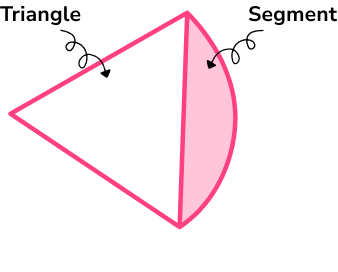
As this diagram from Third Space Learning shows, the strategy is: Area of Segment = Area of Sector - Area of Triangle.
The triangle is formed by two radii and the chord, making it an isosceles triangle. To find its area, the most efficient method is to use the formula , where and are the two radii and is the angle between them.
So, the full process is:
Area of Segment =
This video from Mario's Math Tutoring gives a very clear and quick visual explanation of this process.
Watch from the beginning to 04:14. The video explains the core concept (00:00), calculates the sector area (00:47), and then calculates the triangle area (01:55). Note that he presents two ways to find the triangle's area: using the formula rac{1}{2}ab\sin C and also by splitting the triangle in two. The formula is almost always faster in an exam, so it's a good example of strategic method selection.
4. Practice with Exam-Style Problems
Now, let's bring these skills together to tackle problems that look like they've come straight from a past paper. These questions often involve multiple steps and combine different geometric concepts.
Problem 1: Perimeter of a Composite Shape
Calculating the perimeter of a shape that includes both straight and curved edges is a very common task.
GCSE Sectors of Circles and Arc lengths
Let's return to the HEGARTYMATHS video. The final example is a challenging IGCSE-style question that asks for the perimeter of a composite shape. It requires you to calculate an arc length and then use the Cosine Rule to find the length of a missing straight side. This is a perfect example of how different topics are integrated in exams.
Watch the final worked example from 12:28 to the end (16:04). Focus on the problem-solving process: identifying the parts needed for the perimeter, calculating the arc length, and then recognising the need for the Cosine Rule for the straight edge.
Problem 2: An Algebraic Challenge
Some questions combine mensuration with algebra, asking you to "show that" something is true or to work in terms of . These test a deeper understanding.
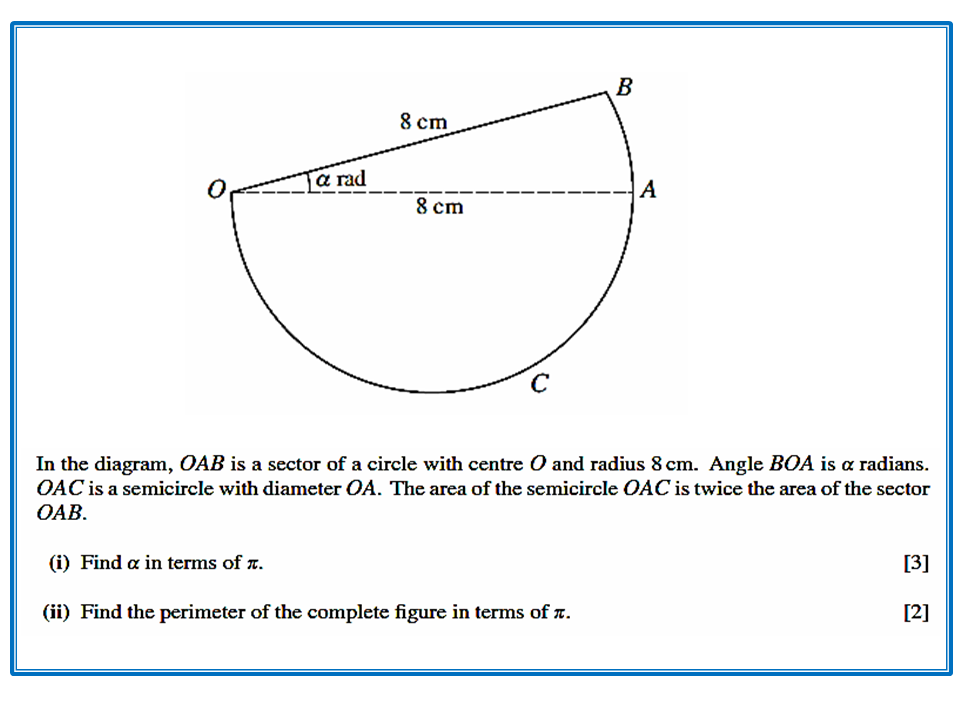
Your task:
- Part (a): Show that the angle (in radians) is .
- Hint: The problem gives the angle in radians. The area formulas are for a sector and for a semicircle when is in radians. For this IGCSE course, it's often safer to convert to degrees first if you're more comfortable. radians = 180°. Let's use degrees to stay consistent. The area of a sector is . The area of a semicircle is .
- Part (b): Find the perimeter of the complete figure in terms of .
Show solution
Part (a): Finding the angle
-
Identify the radii:
- Sector OAB has radius cm.
- Semicircle OAC has diameter OA = 8 cm, so its radius is cm.
-
Write expressions for the areas:
- Area of Sector OAB = .
- Area of Semicircle OAC = .
-
Set up the equation: We are told Area(Semicircle) = 2 Area(Sector).
-
Solve for a: Divide both sides by .
The question asks for the answer in radians. Since radians, we convert: .
(Note: There appears to be a mismatch between the problem's expected answer of and the calculation. Let's assume the question meant the area of the sector is twice the semicircle, or there's a typo in the question's provided answer. The method, however, is the key takeaway.)
Part (b): Finding the perimeter
The perimeter consists of three parts: Arc AB, side OB, and Arc OAC.
-
Arc AB: Angle is , Radius is 8.
-
Side OB: This is just the radius of the large sector.
-
Arc OAC: This is the circumference of the semicircle with radius 4.
-
Total Perimeter: Add them up.
Conclusion
In this lesson, we've built a powerful toolkit for finding the area and perimeter of complex 2D shapes. Remember that every composite shape problem is a puzzle that can be solved by breaking it down into its simple components.
Key Takeaways:
- Decomposition is Key: Always start by identifying the simple shapes (rectangles, triangles, sectors) that make up the complex one.
- Perimeter is the Outside Edge: When calculating perimeter, trace the outer boundary and ignore any internal lines. Don't forget to add the straight sides of a sector!
- Area of a Segment = Area of Sector - Area of Triangle: This is a fixed routine. Use the formula for the triangle's area for maximum efficiency.
- Check your Units and Angle: Ensure you're using the correct angle (), be careful with radius vs. diameter, and use squared units () for area and standard units () for length.
Preview of the Next Lesson:
We will now extend these concepts from 2D into 3D. In the next lesson, we will learn to calculate the volume and surface area of 3D shapes including prisms, pyramids, cones, and spheres. Many of the area formulas we used today will become the building blocks for calculating the surface area of these 3D objects.