Hello! Welcome to your next lesson.
In our previous session, we wrapped up our work on functions by learning how to find and evaluate inverse functions, f⁻¹(x). You learned the crucial four-step algebraic method for finding the inverse and a useful shortcut for evaluating it at a specific point.
Today, we transition from the "Functions" part of this module to the "Sequences" part. This lesson focuses on a specific type of sequence that, like functions, follows a predictable mathematical rule. Your learning outcome is to recognize and find the nth term for simple geometric sequences. This skill is a reliable source of marks on your IGCSE papers, so mastering the method is an excellent investment of your study time.
1. What is a Geometric Sequence?
You've likely encountered arithmetic sequences before, where you add or subtract a constant difference to get from one term to the next. A geometric sequence (or geometric progression) is different: you multiply by a constant value to get from one term to the next.
- The first term is denoted by a.
- The constant value you multiply by is called the common ratio, denoted by r.
To find the common ratio, you can divide any term by the term that came before it.
For example, in the sequence 2, 6, 18, 54, ...
- The first term is .
- The common ratio is . You can check this: .
For a more formal definition and to see how different values of r affect the sequence, take a few minutes to read the following resource.
This brief note from Save My Exams clearly defines a geometric progression and its key components. It also shows how the sequence can be increasing, decreasing, or alternating depending on the common ratio.
Read the section titled 'What is a geometric progression?'. Pay attention to the examples given for an increasing sequence (r > 1), a decreasing sequence (0 < r < 1), and an alternating sequence (r < 0).
2. The Formula for the nth Term
Just like with arithmetic sequences, there's a formula to find any term in a geometric sequence without having to list them all out. The formula for the nth term () is:
Where:
- is the first term
- is the common ratio
- is the position of the term you want to find
This formula is usually provided on the IGCSE formula sheet, so you don't need to memorize it, but you absolutely must know how to use it fluently.
The image below gives a perfect summary of how to apply this formula.
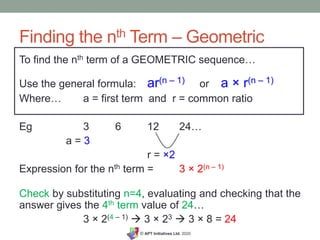
Let's follow the logic in the image:
- Identify
aandr:- First term, .
- Common ratio, .
- Substitute into the formula:
- . This is the expression for the nth term.
- Check your work: This is a critical step to avoid arithmetic errors. Let's check if the formula gives us the 4th term, which we know is 24.
- For , .
- It matches! This gives you confidence that your formula is correct.
Test your understanding!
Find the formula for the nth term of the sequence: 80, 40, 20, 10, ...
Show answer
- Identify
aandr:- The first term is .
- The common ratio is (or ).
- Substitute into the formula:
- .
- Check with n=3:
- . It works.
3. Worked Examples: From Basics to Exam Style
Your exam questions will range from straightforward applications to more complex problems. Let's work through some examples to build your strategy.
Example 1: A simple application
Watch this short video clip to see the method applied to another basic sequence.
The Maths Prof: Sequences nth Term EXAM QUESTIONS (extended/higher version)
The Maths Prof provides a very clear, step-by-step walkthrough for finding the nth term of a simple geometric sequence.
Watch from 04:02 to 05:43. Notice how the presenter first identifies the sequence type, then finds 'a' and 'r', and finally substitutes them into the formula.
Example 2: Fractional sequences
A common way to make these problems more challenging is to involve fractions. You might find a geometric sequence as the numerator or denominator of a larger sequence. The strategy is to handle the numerator and denominator separately.
Problem: Find the nth term of the sequence
Method Selection: The key here is to not be intimidated by the fractions. Treat the top and bottom as two separate, simpler sequence problems.
-
Numerator: 7, 8, 9, 10, ...
- This is an arithmetic sequence.
- First term is 7, common difference is 1.
- The nth term is , or simply .
-
Denominator: 8, 16, 32, 64, ...
- This is a geometric sequence.
- First term, .
- Common ratio, .
- The nth term is .
Simplifying the denominator: You can often simplify the geometric part using index laws, which makes the final answer look neater. Since :
Combining the parts: Now, put the nth term of the numerator over the nth term of the denominator.
The final nth term for the entire sequence is:
To see this exact problem worked through with narration, watch the following clip.
The Maths Prof: Sequences nth Term EXAM QUESTIONS (extended/higher version)
This clip from the same video by The Maths Prof demonstrates the strategy for tackling fractional sequences. It's a perfect example of a multi-step problem you might see on Paper 4.
Watch from 09:09 to 10:59. Pay close attention to how the denominator is simplified using index laws, as this is a key skill.
4. Practice Question
Now, let's try a full practice question from start to finish. This resource provides a worked example and then some practice questions. Try Question 1 and Question 2 yourself.
This resource from Mathspace first shows a worked example and then provides some practice questions. This is a great way to solidify your understanding.
First, review 'Example 1' under 'Worked examples'. Then, attempt 'Question 1' and 'Question 2' under 'Practice questions'. Click 'Reveal Solution' on the webpage to check your work.
Conclusion
Excellent work. You have now covered the essentials of geometric sequences for your IGCSE exam. You know how to identify them, how to use the formula for the nth term, and how to tackle more complex fractional problems.
Key Takeaways:
- A sequence is geometric if you multiply by a constant common ratio (r) to get to the next term.
- The formula for the nth term is . It's on your formula sheet, but you must know how to apply it.
- Always check your resulting formula by substituting a value of
n(like n=3 or n=4) to see if it produces the correct term. This helps catch small errors. - For fractional sequences, handle the numerator and denominator as separate problems and combine the results at the end. Look for opportunities to simplify using index laws.
Preview of the Next Lesson:
This lesson concludes the "Functions and Sequences" module. We will now move on to a new, high-weightage topic: Coordinate Geometry. In the next lesson, you will learn how to calculate the midpoint, length, and gradient of a line segment from its coordinates, which is a foundational skill for all other topics in coordinate geometry.