Hello! Welcome to your first lesson in the Coordinate Geometry module.
In the previous lesson, we concluded our study of sequences by mastering how to find the nth term of a geometric sequence. You are now equipped to handle a variety of sequence-based problems on your exam papers.
Today, we're diving into Coordinate Geometry, a topic you've mentioned can be challenging. This first lesson is crucial as it lays the groundwork for the entire module. Our goal is to ensure you can confidently and accurately calculate the midpoint, length, and gradient of a line segment from coordinates. Mastering these three fundamental calculations will provide a solid base for the more complex problems to come and help build your confidence in this area.
Let's get started.
1. Gradient: Measuring the Steepness of a Line
The gradient of a line is simply a number that tells us how steep it is.
- A positive gradient means the line slopes upwards from left to right.
- A negative gradient means it slopes downwards.
- A gradient of zero means the line is horizontal.
To see a quick visual of this, watch the first part of the video below.
CSEC Maths - Gradient, midpoint, equation and length of a line
This clip from CSEC Mathematics visually introduces the concept of gradient before diving into the calculation.
Watch from 00:14 to 02:07. Focus on understanding how the sign (positive/negative) and magnitude of the gradient relate to the visual appearance of the line.
The Formula for Gradient
To calculate the gradient () between two points, and , we use the formula:
Crucial Tip for Accuracy: To avoid the small arithmetic errors you've mentioned, always label your points before you start. For points A() and B(), write the labels directly above the numbers in the question. It makes substituting into the formula much safer. It doesn't matter which point is 1 and which is 2, as long as you are consistent in the numerator and denominator.
Let's see this formula in action.
Everything you need to know about IGCSE Coordinate Geometry in 53 minutes
This video from Ginger Mathematician provides a clear, concise example of calculating a gradient from two points.
Watch from 09:38 to 11:33. Note how the presenter identifies the coordinates, substitutes them into the formula, and simplifies the resulting fraction.
Test your understanding!
Calculate the gradient of the line segment joining the points P(–2, 7) and Q(4, –5).
Show answer
-
Label the points:
- Let P be = (–2, 7)
- Let Q be = (4, –5)
-
Substitute into the formula:
-
Calculate carefully:
The gradient is -2.
2. Midpoint: Finding the Exact Centre
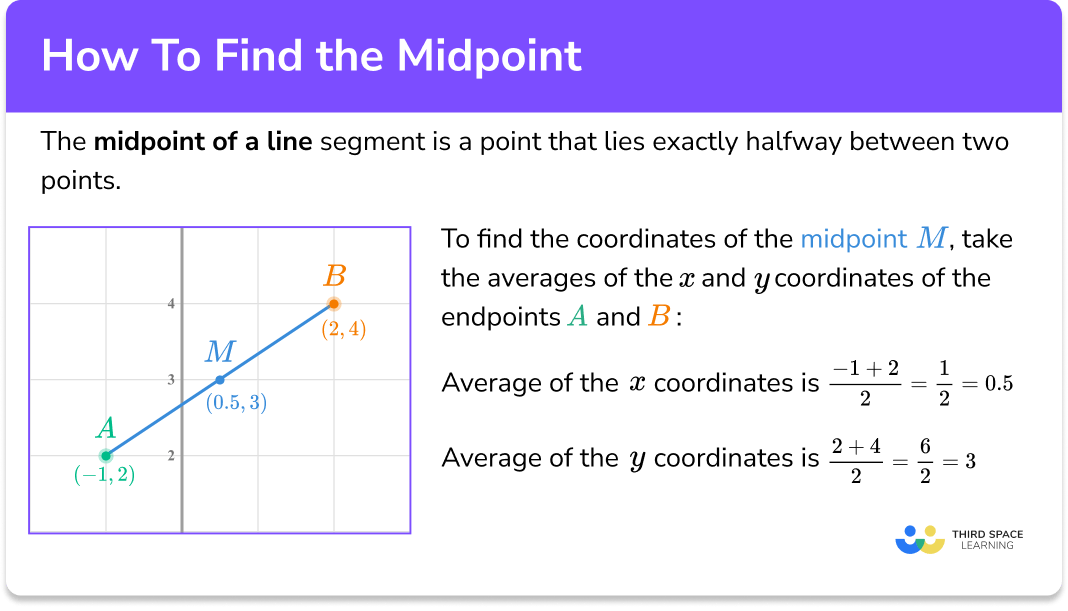
The midpoint of a line segment is the point that lies exactly halfway between the two endpoints. The easiest way to think about this is that you are finding the average of the x-coordinates and the average of the y-coordinates.
The Formula for Midpoint
The formula for the midpoint () of a line segment joining and is:
Notice that the final answer is a coordinate pair .
Now, let's watch a quick worked example.
Everything you need to know about IGCSE Coordinate Geometry in 53 minutes
This clip from Ginger Mathematician demonstrates a straightforward application of the midpoint formula, showing the working for a typical 2-mark question.
Watch from 00:21 to 01:55. Pay attention to how the x-coordinates and y-coordinates are handled separately and then combined into the final coordinate answer.
Test your understanding!
Find the coordinates of the midpoint of the line segment with endpoints A(3, –4) and B(–5, 8).
Show answer
-
Label the points:
- = (3, –4)
- = (–5, 8)
-
Substitute into the formula:
-
Calculate:
The midpoint is (–1, 2).
3. Length: Calculating the Distance Between Two Points
Finding the length of a line segment is a direct application of a familiar concept from your physics and maths background: Pythagoras's Theorem.
If you imagine a right-angled triangle where the line segment is the hypotenuse, the other two sides are simply the "change in x" and the "change in y".

The Formula for Length
The formula for the length (, for distance) of a line segment between and is derived directly from Pythagoras's theorem :
This formula might look complex, but it's just .
Let's watch a video that demonstrates this visual link and then applies the formula.
Everything you need to know about IGCSE Coordinate Geometry in 53 minutes
This explanation from Ginger Mathematician first shows how to derive the length from a sketch using Pythagoras, reinforcing the concept before using the formula.
Watch from 26:00 to 29:02. Notice how drawing a quick sketch helps to visualize the problem. This is a great strategy if you ever feel stuck.
Test your understanding!
Calculate the length of the line segment joining C(5, 1) and D(–3, –5). Give your answer to 3 significant figures.
Show answer
-
Label the points:
- = (5, 1)
- = (–3, –5)
-
Substitute into the formula:
-
Calculate carefully:
The length is exactly 10 units. (No rounding needed here, but always check if the question asks for it).
4. Application and Practice
Now it's time to put it all together and practice, which is key to your "Error-Loop Method". First, let's watch one comprehensive past paper question being solved, covering all three skills.
CSEC Maths - Gradient, midpoint, equation and length of a line
This CSEC Mathematics video is excellent because it runs through a full past paper question that asks for the gradient, midpoint, AND length of the same line segment. This is a perfect summary of today's lesson.
Watch the segment from 20:32 to 27:15. Notice the presenter's advice to label the points x1, y1, x2, y2 on the exam paper itself—this is a fantastic habit to adopt.
Now it's your turn. Use the following resource to access past paper questions. Your task is to apply the methods we've just covered.
IGCSE Extended Mathematics Revision by Topic – The Maths Mann
The Maths Mann provides an excellent collection of past paper questions sorted by topic. We'll use this for targeted practice.
Click on the link and find the heading 'COORDINATE GEOMETRY/STRAIGHT LINE GRAPHS'. Download the 'Question Paper – Paper 2 and 4' document. Complete the first 3-4 questions, which should focus on gradient, midpoint, and length. Then, use the 'Mark Scheme' document to check your work meticulously. Identify any errors in your method or calculation.
Conclusion
Great job today. You have established a solid foundation in coordinate geometry, a topic that carries significant marks and builds throughout the syllabus. By mastering these three core calculations, you are in a much stronger position.
Key Takeaways:
- Gradient: Steepness, calculated with .
- Midpoint: The average of the points, calculated with .
- Length: Distance, calculated using Pythagoras's theorem: .
- Technique: To improve accuracy, always label your coordinates and before substituting them into any formula.
Preview of the Next Lesson:
In our next lesson, we will build directly on today's work. You will learn how to find the equation of a straight line (). You already know how to find the gradient, 'm'—the next step is to use that to find the full equation.