Hello! Welcome back to your second lesson in the Coordinate Geometry module.
In our last lesson, you built a strong foundation by mastering the calculation of a line segment's gradient, midpoint, and length. We particularly focused on the gradient formula, , and the importance of careful substitution to ensure accuracy.
Today, we'll put that skill to immediate use. Our goal is to find the equation of a straight line given sufficient information. This is one of the most fundamental and frequently tested skills in coordinate geometry. We will focus on the two most common scenarios you'll face in an exam: being given two points, or being given one point and the gradient.
Let's begin.
1. The Anatomy of a Line Equation: y = mx + c
Every straight line on a coordinate grid can be described by the equation:
You are already very familiar with the first part of this equation:
- is the gradient of the line, which you learned to calculate in the last lesson. It tells us the steepness of the line.
- is the y-intercept. This is the y-coordinate of the point where the line crosses the vertical y-axis.
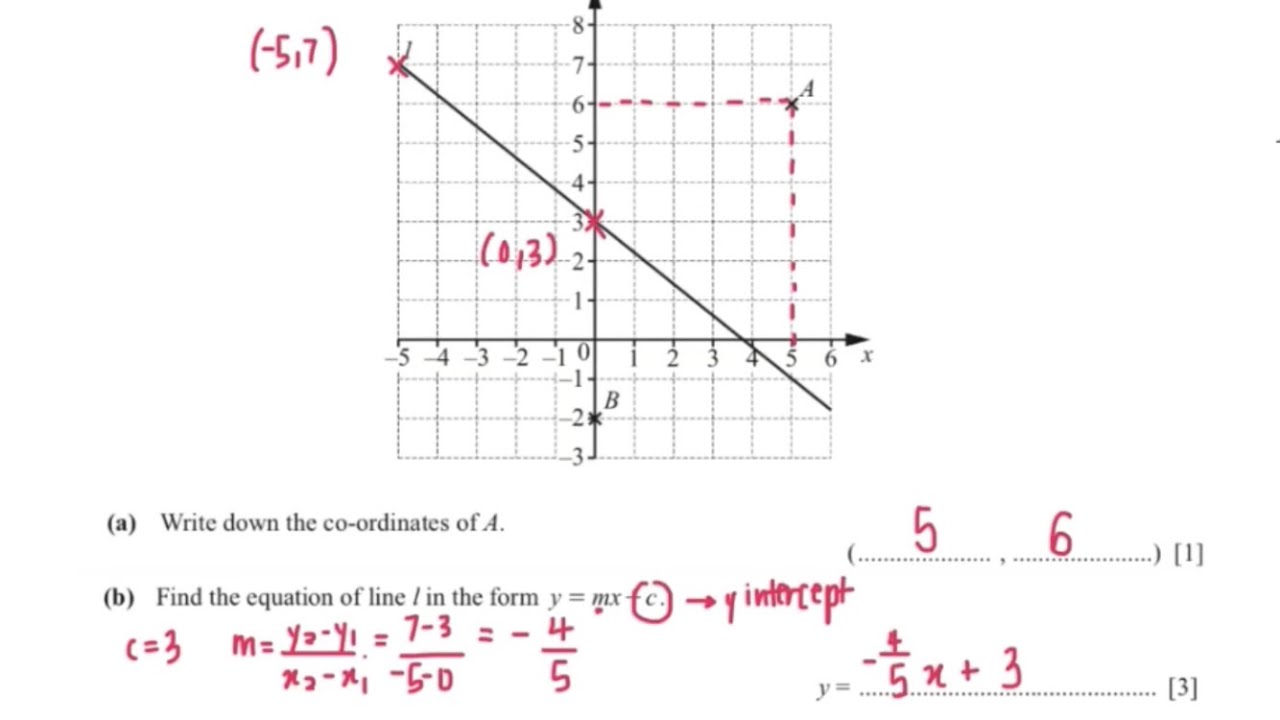
To define a unique straight line, we need to find the specific values of and . Our job today is to learn the systematic process for doing this.
2. The Core Method: Finding the Equation from Two Points
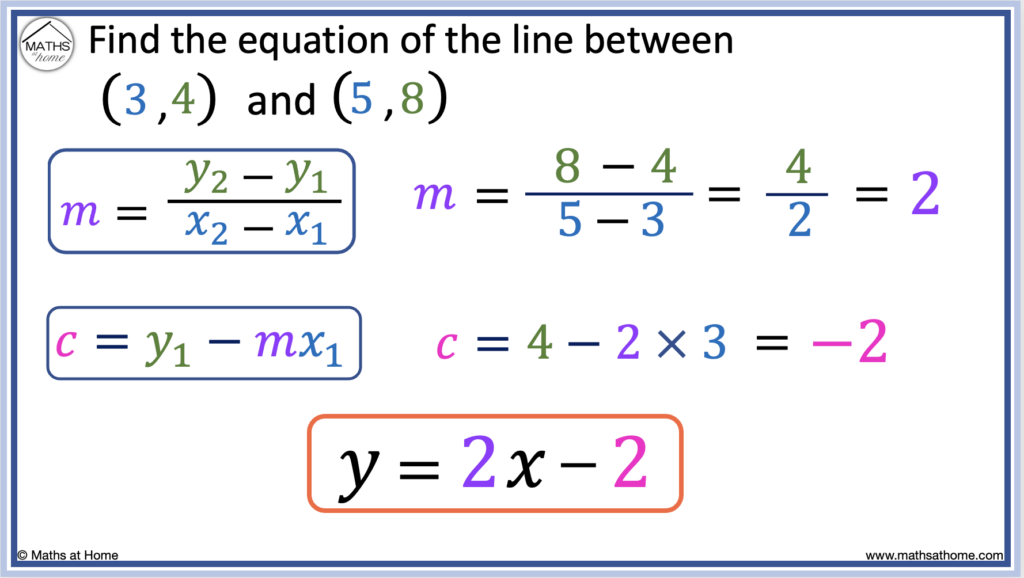
This is the most common type of question. If you are given any two points on a line, say and , you can find its equation using a clear, two-step process.
The Two-Step Process:
- Find the gradient (): Use the formula .
- Find the y-intercept (): Substitute the gradient () you just found, and the coordinates of one of the points ( and ), into the equation . Then, solve the resulting simple linear equation to find .
To avoid the small arithmetic errors you've noted as a challenge, it's often wise to pick the point with simpler coordinates (e.g., positive numbers, smaller numbers, or zeros) for the substitution in Step 2.
The following video provides an excellent, clear walkthrough of this exact process.
GCSE Maths - Finding the Equation of a Straight Line From 2 Sets of Coordinates (2026/27 exams)
This video from Cognito breaks down the problem into a clear, memorable method. It's a perfect demonstration of the two-step process we just discussed.
Watch from the beginning to 04:06. Pay close attention to the three-step framework the presenter outlines (we are calling it a two-step process, but the logic is identical). Notice how carefully they handle subtracting a negative number in the first example – a key area to focus on for accuracy.
Test your understanding!
Find the equation of the straight line that passes through the points A(–1, 8) and B(3, –4).
Show answer
-
Step 1: Find the gradient (m)
Let A be and B be . -
Step 2: Find the y-intercept (c)
Use the gradient and point A(–1, 8). Substitute and into . -
Write the final equation:
3. The Simpler Case: Given Gradient and One Point
Sometimes, the examiner makes your life easier by giving you the gradient directly. In this case, you can skip Step 1 and go straight to Step 2.
Method:
- Take the given gradient .
- Substitute and the coordinates of the given point into .
- Solve for and write the final equation.
This is a more direct application of the same principle. Let's look at a quick written example to solidify this.
IGCSE Equation of a Line: Complete Guide
The 'IGCSE Equation of a Line: Complete Guide' from Tutopiya provides a very concise worked example for this exact scenario. Reviewing it will confirm your understanding.
Read the section titled 'Finding Equation from Gradient and One Point'. Notice how it's just the second half of the process we learned above.
Test your understanding!
A straight line has a gradient of and passes through the point (6, –1). Find the equation of the line.
Show answer
-
We are given:
- Gradient
- Point
-
Substitute into :
-
Write the final equation:
4. Practice: The Error-Loop Method
You've learned the method; now it's time to apply it under exam-like conditions. This is where you'll sharpen your skills, improve your speed, and catch any recurring errors in your process.
IGCSE Questions by Topic - Straight Line Graphs
Your goal is to become fluent and accurate with this process. We will use the 'Past Paper Penguin' topic-based question bank for targeted practice.
On the webpage, locate and download two PDFs: 'Straight Line Graphs' (the questions) and 'Straight Line Graphs ANS' (the solutions). Work through the first 4-5 questions in the question PDF. Most will involve finding the equation of a line. For each question, compare your final answer and your working steps meticulously against the solutions document. If there's a discrepancy, pinpoint the exact source of the error—was it a sign mistake, an algebraic slip, or a miscalculation of the gradient? This is the core of the Error-Loop Method.
Conclusion
Excellent work today. You have mastered a crucial algebraic skill that is central to the entire coordinate geometry topic. By internalizing the two-step process for finding a line's equation, you have a reliable strategy for a wide range of exam questions.
Key Takeaways:
- The equation of a straight line is always in the form .
- The core method is a two-step process: 1. Find the gradient , 2. Substitute a point to find the y-intercept .
- If the gradient is given, you only need to perform the second step.
- Methodical working and careful checking are the best ways to avoid simple arithmetic errors, especially with negative numbers.
Preview of the Next Lesson:
We will now extend this skill to solve problems involving parallel and perpendicular lines. In the next lesson, you will learn the simple but powerful rules connecting their gradients:
- Parallel lines have equal gradients.
- The gradients of perpendicular lines multiply to give -1.
This will unlock another set of common and high-value exam questions.