Hello! Welcome to the third lesson in our Coordinate Geometry module.
In the last lesson, we mastered the core skill of finding the equation of a straight line in the form , which is the bedrock of this topic. You practiced the essential two-step method: first finding the gradient , and then substituting a point to find the y-intercept .
Today, we will build directly on that foundation to tackle one of the most common and important question types in this topic. Our learning outcome is to use gradient relationships to identify and find the equations of parallel and perpendicular lines. By mastering the simple rules that govern these lines, you will unlock a large number of potential marks on your exam papers and gain confidence in a topic you've previously found challenging.
1. Parallel Lines: The Same Gradient
Let's start with the more intuitive of the two concepts.
Parallel lines are lines that have the same steepness and never intersect. For this to be true, they must have the exact same gradient.
Key Rule for Parallel Lines:
If two lines are parallel, their gradients are equal.
This simple rule makes finding the equation of a parallel line a very straightforward process that reuses the skills from our last lesson.
Method to find the equation of a parallel line:
- Identify the gradient () of the given line. Remember, you may need to rearrange the equation into the form first. This is a crucial step where marks can be lost, so be careful.
- Use this same gradient for your new line's equation, .
- Substitute the coordinates of the point the new line passes through to solve for , the new y-intercept.
Let's see this in action.
Parallel and Perpendicular Lines
The following clip from the Maths Genie YouTube channel provides a concise worked example of finding the equation of a line parallel to another. Notice that it's the exact same method as last lesson, but your first step is simply to identify the gradient from the given line.
Watch the segment from 06:12 to 07:33. The example demonstrates finding the equation of a line parallel to y = 2x + 1 that passes through a specific point.
Test your understanding!
Find the equation of the line that is parallel to the line and passes through the point .
Show answer
- The given line is . Its gradient is .
- The parallel line must also have a gradient of . Its equation is .
- Substitute the point into the equation:
- The final equation is .
2. Perpendicular Lines: The Negative Reciprocal
Perpendicular lines are lines that intersect at a perfect right angle (90°). The relationship between their gradients is not as obvious, but it is just as precise.
Key Rule for Perpendicular Lines:
The gradients of two perpendicular lines, and , multiply to give -1.
This means the gradient of one line is the negative reciprocal of the other.
The term "negative reciprocal" means two things: flip the fraction and change the sign.
- If , the perpendicular gradient is .
- If , the perpendicular gradient is .
- If , the perpendicular gradient is .
The following video explains where this rule comes from and gives you plenty of practice with finding the negative reciprocal.
Perpendicular Lines - GCSE Higher Maths
To really understand this rule, watch this first section from the '1st Class Maths' video. It clearly explains the concept of perpendicular gradients and then drills down into the practical skill of calculating the negative reciprocal for integers, fractions, and decimals.
Watch from 00:43 to 06:36. The first part explains the 'why,' and the second part gives you the practical 'how' for finding the perpendicular gradient.
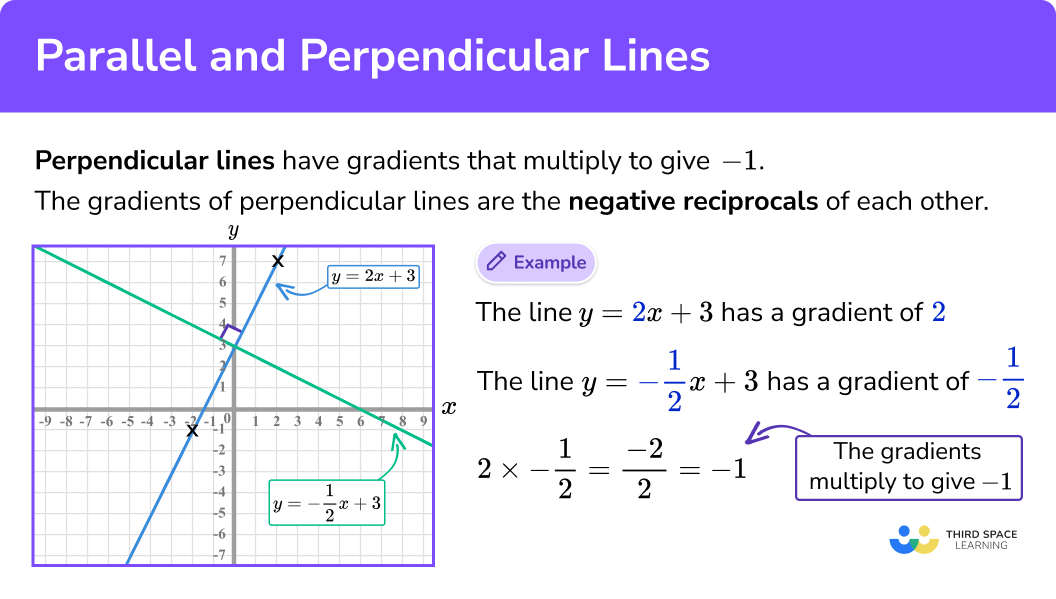
3. Finding the Equation of a Perpendicular Line
Now we can combine our new rule with our established method.
Method to find the equation of a perpendicular line:
- Find the gradient () of the given line (rearranging to if needed).
- Calculate the perpendicular gradient () using the negative reciprocal rule: .
- Use and the given point to substitute into and solve for the new y-intercept, .
The process is robust. Let's watch a clear, worked example.
Perpendicular Lines - GCSE Higher Maths
Let's continue with the '1st Class Maths' video. This next section applies the method we've just outlined to a typical exam-style question.
Watch from 08:59 to 12:11. The presenter walks through two examples of finding the equation of a line perpendicular to a given line and passing through a specific point. Pay close attention to how they handle the fractional gradient.
Test your understanding!
Line A has the equation . Find the equation of Line B, which is perpendicular to Line A and passes through the point .
Show answer
- The gradient of Line A is .
- The gradient of Line B is the negative reciprocal: .
- The equation for Line B is .
- Substitute the point :
- The final equation for Line B is .
4. Application: "Show That" and Multi-Step Problems
These gradient rules are essential for two common, higher-mark question types. This is a great chance to practice your "show that" question technique and your ability to break down problems.
"Show That" Questions
To prove two lines are perpendicular, you use the rule.
Method:
- Find the gradient of the first line, .
- Find the gradient of the second line, .
- Multiply them: .
- State your conclusion: "Since the product of the gradients is -1, the lines are perpendicular."
This structured approach is exactly what examiners look for.
Multi-Step Problems
A classic question asks you to find the equation of a line perpendicular to a segment AB that passes through a point C. This combines skills from the last two lessons.
Method:
- Calculate the gradient of the line segment AB using the two points A and B.
- Find the negative reciprocal of this gradient. This is the gradient of your new line.
- Use this new gradient and the coordinates of point C to find the equation of the line.
The following video demonstrates both of these problem types.
Perpendicular Lines - GCSE Higher Maths
This final clip from '1st Class Maths' puts everything together. It first shows you how to structure a 'show that' proof and then tackles a multi-step problem that combines finding a gradient from two points with the perpendicular rule. This is a perfect model for your own work.
Watch the video in two parts: 06:36 to 08:59: Focus on the 'show that' question. Notice how the equations must be rearranged into y=mx+c form first. 12:11 to 16:05: Watch the multi-step problem. This is a great example of combining skills from different lessons to solve a complex problem.
5. Practice and Error-Checking
You now have all the knowledge. It's time to make it fluent and accurate using the Error-Loop Method. Before you start, it's wise to review the most common pitfalls.
Parallel & Perpendicular Lines - GCSE Maths
To help you avoid simple mistakes, read this section on common misconceptions. Being aware of these traps is the first step to not falling into them.
On the webpage from Third Space Learning, scroll down to the heading 'Common misconceptions' and read the three bullet points carefully. Do any of these sound familiar?
Now, let's practice with some exam-style questions.
Parallel & Perpendicular Lines - GCSE Maths
This resource provides a set of questions that perfectly match the difficulty and style of your IGCSE exam. Apply your methods, work carefully, and use the solutions to analyze any mistakes.
Scroll to the section 'Parallel and perpendicular lines GCSE questions'. Attempt questions 1, 2, and 3. After each attempt, click 'Show answer' to compare your working and final answer. If you made a mistake, identify exactly where it occurred: was it in rearranging the equation, calculating the gradient, finding the negative reciprocal, or substituting the point? This analysis is key to improving.
Conclusion
Fantastic work. You have now added two powerful rules to your coordinate geometry toolkit and seen how they apply to a variety of exam questions. You've also practiced a structured approach to "show that" questions, a key area for your development.
Key Takeaways:
- Parallel lines: Gradients are equal ().
- Perpendicular lines: Gradients are negative reciprocals. They multiply to give -1 ().
- Method selection: The core method for finding a line's equation is unchanged. First, find the correct gradient using the rules above. Second, substitute a point to find .
- Accuracy: Always ensure an equation is in the form before you identify its gradient.
Preview of the Next Lesson:
In our next lesson, we will learn how to solve geometric problems involving points of intersection. This involves finding the exact coordinate where two lines cross by setting up and solving their equations simultaneously—a technique that will bring together your algebra and coordinate geometry skills.