Hello! Welcome to your fourth lesson in the Coordinate Geometry module.
In our last session, you mastered finding the equations of parallel and perpendicular lines by using the two key gradient rules: for parallel lines, and for perpendicular lines.
Today, we'll connect this skill directly with your algebra knowledge. The learning outcome is to solve geometric problems involving points of intersection by setting up and solving simultaneous equations. In essence, we are going to find the exact coordinates where two lines cross. This is a fundamental skill that frequently appears in multi-step, higher-mark exam questions.
1. The Point of Intersection: Where Geometry Meets Algebra
When two lines intersect on a graph, they share a single, common point. The coordinates of this point, , must satisfy the equation of the first line and the equation of the second line. This is the exact definition of the solution to a pair of simultaneous equations.

While you can estimate this point from a graph, the algebraic method gives you the precise coordinates, which is essential for exam accuracy.
This article from Third Space Learning clearly explains the link between intersecting lines and simultaneous equations. It also highlights why using algebra is often better than drawing a graph.
Read the sections 'What are intersecting lines?' and 'Finding the point of intersection algebraically'. Focus on the key idea: the point of intersection (x, y) is the single solution that works for both equations.
2. Solving for the Intersection: Method Selection
Since finding the point of intersection means solving simultaneous equations, you can use the two main algebraic methods you've learned previously: elimination and substitution. A key part of exam strategy, and an area you wanted to focus on, is choosing the most efficient method for the problem at hand.
Method 1: The Elimination Method
This method is usually most efficient when both equations are in the general form . The goal is to manipulate the equations so that either the or terms have the same coefficient, allowing them to be eliminated by adding or subtracting the equations.
Solving Simultaneous Equations | Cambridge (CIE) IGCSE ...
Let's review the elimination method with a worked example from Save My Exams.
Study the 'Worked Example' which solves a pair of equations using the elimination method. Pay close attention to how they multiply the equations to make the coefficients of 'y' equal (but with opposite signs) before adding. This is a classic and reliable technique.
Method 2: The Substitution Method
This method is incredibly powerful and often the quickest in coordinate geometry. It's the best choice when one of the equations is already written in the form or can be easily rearranged to it.
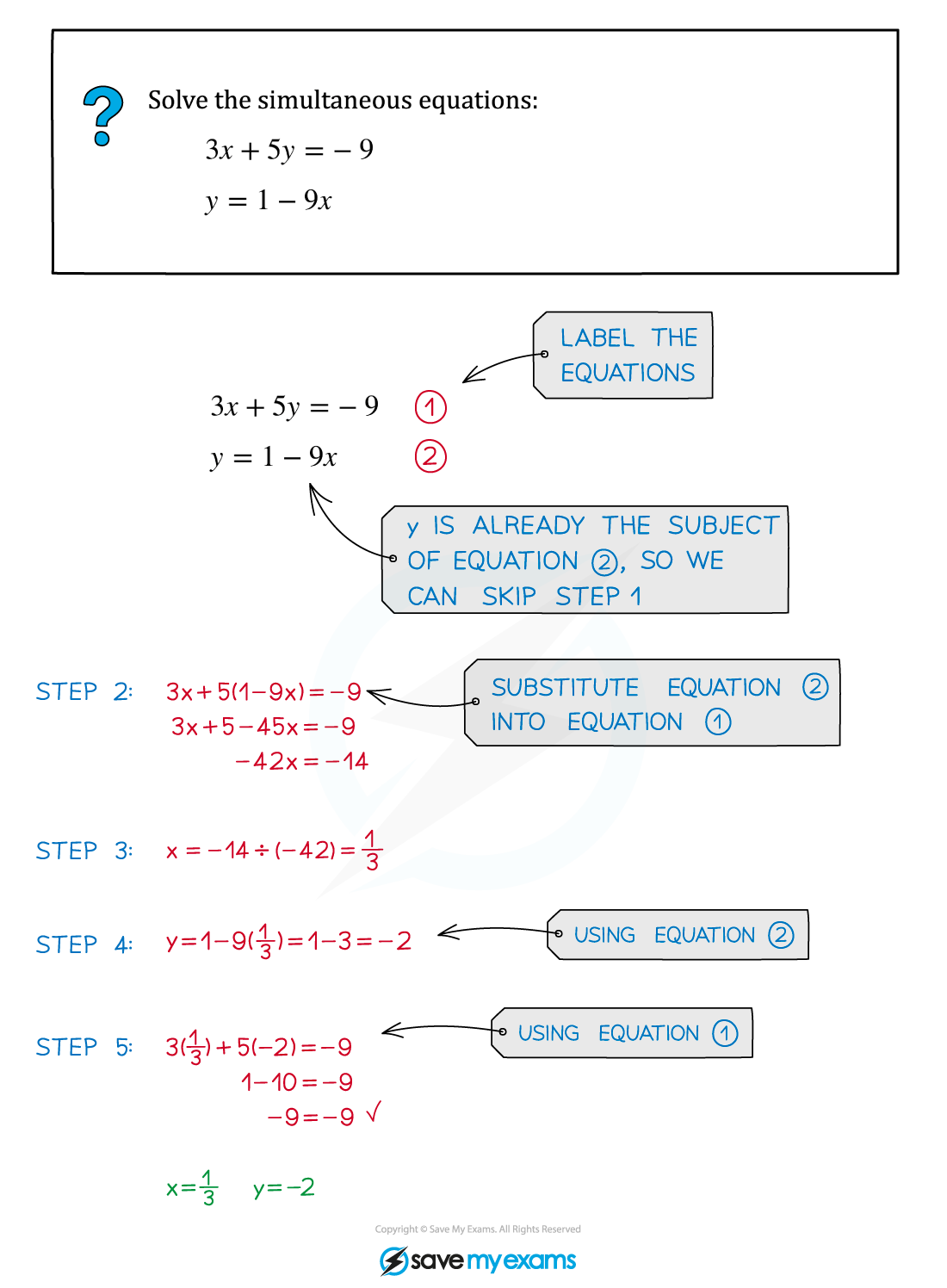
Test your understanding!
For each pair of equations, which method (elimination or substitution) would be more efficient, and why?
3x + 2y = 7and5x - 4y = 8y = 5x - 1and2x + 3y = 11
Show answer
- Elimination. Both equations are in the form . It would be straightforward to multiply the first equation by 2 to get
6x + 4y = 14, which would allow the4yterms to be eliminated easily by adding the equations. - Substitution. The first equation is already in the form . It is very efficient to substitute
(5x - 1)foryin the second equation to get2x + 3(5x - 1) = 11.
3. A Multi-Step Geometric Problem
In an exam, you're unlikely to just be given two equations. Instead, you'll need to use your geometry skills to find the equations of the intersecting lines first.
Let's walk through a typical high-mark question.
Problem:
Line passes through points A and B.
Line is perpendicular to and passes through point C.
Find the coordinates of the point of intersection of and .
Our Strategy:
- Find the equation of Line . (Skill from two lessons ago)
- Find the equation of Line . (Skill from last lesson)
- Solve the two equations simultaneously. (Skill from this lesson)
Step 1: Equation of
- Gradient .
- Using : .
- Substitute point B: .
- So, ** **
Step 2: Equation of
- has gradient .
- Since is perpendicular, its gradient is the negative reciprocal: .
- Using : .
- Substitute point C: .
- So, ** **
Step 3: Find the Intersection
We need to solve the simultaneous equations:
Since both are in the form y = ..., we can set them equal to each other (which is a form of substitution).
To eliminate the fraction, let's multiply the entire equation by 2:
Now solve for :
Now substitute this value back into either equation to find . Let's use :
The point of intersection is or .
This example shows how several topics are layered together to form one larger problem. Breaking it down into steps is the key to success.
4. Application: Intersection of Lines and Curves
The principle of solving simultaneous equations extends beyond just lines. It's also the method used to find where a line intersects a curve (like a quadratic or a circle). This is a topic in Module 4, but seeing the connection now will strengthen your understanding.
Non-Linear Simultaneous Equations - GCSE Higher Maths
The same principle of solving simultaneous equations applies when finding where a line intersects a curve. This is a common exam topic that combines coordinate geometry with more advanced algebra.
Watch the video 'Non-Linear Simultaneous Equations' from 00:00 to 07:24. Pay attention to: The graphical interpretation: a line can intersect a curve in 0, 1 (tangent), or 2 places. The method: it's almost always substitution. Rearrange the linear equation to make x or y the subject, and substitute it into the non-linear equation. This will always result in a quadratic equation to solve.
5. Exam-Style Practice
Now it's time to practice applying these methods. Remember to use the Error-Loop method: attempt each question fully, then check your working against the solution to find any points of error. This will help you identify and fix your logic gaps.
Intersecting Lines - GCSE Maths - Steps, Examples & ...
This resource from Third Space Learning contains a set of GCSE questions that are perfect for practice. The final question is a 'show that' problem, which is excellent for working on a skill you've identified as a weakness.
Scroll down to the 'Intersecting lines GCSE questions' section. Work through questions 1, 2, and 3. Question 1 is a good check of your graphical understanding. Question 2 is a standard algebraic problem. For Question 3, focus on the algebraic 'Alternative solution' provided for part (a). This structured proof is exactly what you should aim for in 'show that' questions.
Conclusion
Excellent work today. You have successfully bridged your algebra and coordinate geometry skills to solve a very common and important type of problem.
Key Takeaways:
- The point where two lines intersect is the single coordinate pair that is the solution to their simultaneous equations.
- Method selection is key: Use substitution when one equation is in the form . Use elimination when both are in the form .
- In geometric problems, you often need to find the equations of the lines first using skills from previous lessons before you can solve for their intersection.
Preview of the Next Lesson:
In our final coordinate geometry lesson, we will combine all the skills from this module to tackle a specific exam favorite: finding the equation of a perpendicular bisector. This will involve finding a midpoint, a perpendicular gradient, and the equation of a line, providing a perfect summary of the topic.