Hello! Welcome to your next lesson in the "Functions and Sequences" module.
In our last lesson, we explored composite functions, learning how to combine functions like fg(x) by applying one after another. We saw that fg(x) means applying g first, then applying f to the result.
Today, we're going to look at the reverse process. Instead of combining functions, we'll learn how to "undo" a single function. This brings us to your learning outcome for this lesson: to find the inverse of a one-to-one function, f⁻¹(x), and evaluate it for specific values. Mastering this is crucial, as it combines conceptual understanding with precise algebraic manipulation—a key skill for your IGCSE exam.
1. What is an Inverse Function?
An inverse function does the exact opposite of the original function. If a function f turns an input of 3 into an output of 10, then its inverse, written as f⁻¹(x), will turn an input of 10 back into the original 3.
It's like reversing a function machine. If the original machine multiplies by 7 and then adds 2, the inverse machine will first subtract 2 and then divide by 7—the inverse operations in the reverse order.
Important Note on Notation: The notation f⁻¹(x) means "the inverse of function f". The -1 is not an exponent. It does not mean . This is a very common point of confusion, so be mindful of it.
To see this concept visualised clearly with the function machine analogy, watch the beginning of the following video.
Inverse Functions - GCSE Higher Maths
This video from 1st Class Maths provides an excellent conceptual start by using function machines to show how an inverse function reverses a process.
Watch from the beginning to 02:05. Focus on how the inverse function is constructed by performing the inverse operations in the reverse order.
2. The Method for Finding an Inverse Function
While the function machine is great for understanding the concept, you need a reliable algebraic method for your exam. There is a standard four-step process that works for all the inverse function questions you will encounter.
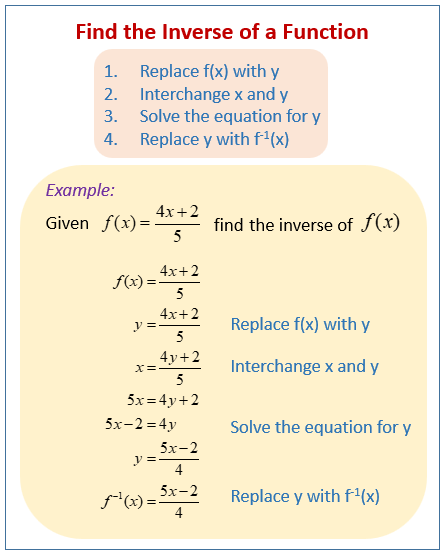
Here are the steps in detail:
- Replace
f(x)withy: Rewrite the function as an equation, e.g., if , write . - Swap
xandy: Replace everyxwith ayand everyywith anx. This is the key step that represents the "inverting" of inputs and outputs. The equation becomes . - Make
ythe subject: Rearrange the new equation to isolatey. This is where your algebraic skills are tested. - Replace
ywithf⁻¹(x): Rewrite the final expression in proper inverse function notation: .
This method is reliable and will earn you method marks in the exam, even if you make a small slip in the final rearrangement.
To see this method applied in a clear, narrated format, the same video provides a great walkthrough.
Inverse Functions - GCSE Higher Maths
The presenter now demonstrates the four-step algebraic method we just discussed with two clear examples.
Watch from 02:05 to 05:06. Observe how the four steps are applied first to a simple linear function and then to one involving a fraction.
Test your understanding!
Given the function . Find .
Show answer
Let's follow the four-step method:
Step 1: Replace g(x) with y
Step 2: Swap x and y
Step 3: Make y the subject
Step 4: Replace y with g⁻¹(x)
You can also write this as . Both forms are correct.
3. Handling More Complex Rearrangements
The difficulty in inverse function questions often comes from Step 3: rearranging the equation. You've mentioned that choosing the most efficient method and avoiding errors in multi-step problems is an area you want to improve. Let's look at two common, more challenging scenarios.
Case 1: The subject appears twice (Rational Functions)
Consider a function like . When you swap x and y, you get . To make y the subject, you need to collect all y terms and factorize. This is a crucial technique.
The following video from The Organic Chemistry Tutor demonstrates this process very effectively. While the video covers some advanced concepts, the segment on this specific type of problem is perfectly relevant and clear.
Inverse Functions - Domain & range- With Fractions, Square Roots, & Graphs
This video shows how to handle the algebraic rearrangement when the variable you are solving for appears in both the numerator and the denominator.
Watch from 01:39 to 04:03. Focus on the strategy: cross-multiply, gather all 'y' terms on one side, factor out 'y', and then divide.
Case 2: Functions with Powers and Roots
If your function involves squares or square roots, your rearrangement will involve the inverse operations: square rooting or squaring.
For a function like where , the process would be:
Note: An unrestricted parabola is not a "one-to-one" function (it fails the horizontal line test), so it doesn't have a true inverse function. That's why exam questions will specify a domain like to make it one-to-one. For IGCSE, you typically only need to consider the positive root unless told otherwise.
The 1st Class Maths video also has a good, concise example of this.
Inverse Functions - GCSE Higher Maths
This segment shows how to find the inverse of a simple quadratic function and explains why we only need to consider the positive square root.
Watch from 05:06 to 06:38. Pay attention to the rearrangement steps of isolating the squared term before taking the square root.
4. Evaluating an Inverse Function
Often, a question will ask you to find a value like f⁻¹(5). There are two ways to approach this, and choosing the right one can save you time.
Method 1: Find the inverse function first (The Standard Method)
- Find the expression for using the four-step method.
- Substitute the given value into your inverse function. For example, if , then .
This method is robust and always works. The video below demonstrates this approach with a more complex example.
Inverse Functions - GCSE Higher Maths
This final segment from the 1st Class Maths video shows the standard method for evaluating an inverse function at a specific point.
Watch from 06:38 to 08:44. Notice how the inverse function is found first, and only then is the value x=2 substituted in.
Method 2: The Efficiency Shortcut
Remember that if f(x) = y, then f⁻¹(y) = x.
To find f⁻¹(5), we are looking for the input x that makes the original function output 5.
So, you can solve the equation f(x) = 5.
Let's use our earlier example, . To find f⁻¹(5):
Set :
So, f⁻¹(5) = 2. This gives the same answer as Method 1, but can be much faster if the question only asks for the value and not the expression for f⁻¹(x). Knowing both methods gives you a strategic advantage.
Test your understanding! (Exam Practice)
Given the function .
(a) Find . (2 marks)
(b) Find the value of . (1 mark)
Show answer and mark scheme
(a) Find h⁻¹(x)
- Step 1 & 2: Let , then swap: .
- Step 3: Rearrange to make
ythe subject. (1 mark for correct rearrangement to isolate y) - Step 4: Rewrite in correct notation.
(1 mark for the final correct expression)
(b) Find h⁻¹(5)
-
Method 1: Using the inverse function
Substitutex=5into the expression from part (a):
(1 mark for the correct answer) -
Method 2: Using the shortcut (for checking or if part (a) wasn't asked)
Set :This confirms
h⁻¹(5) = 6.
Conclusion
Well done. You have now covered the entire process for finding and using inverse functions, from the basic concept to the algebraic methods required for exam success.
Key Takeaways:
- An inverse function
f⁻¹(x)reverses the action of the original functionf(x). - The notation
f⁻¹(x)does not mean . - The most reliable method is the four-step process: (1) Write y=f(x), (2) Swap x and y, (3) Rearrange for y, (4) Write as f⁻¹(x).
- For evaluating
f⁻¹(a), you can either findf⁻¹(x)first and substitutex=a, or solve the equationf(x) = a.
Preview of the Next Lesson:
We have now concluded our main work on functions. In the next lesson, we will shift our focus to the other part of this module's title: sequences. We will begin by looking at a specific type of sequence known as a geometric sequence, learning how to recognize them and find their nth term.