Hello! Welcome to your third lesson in the Functions and Sequences module.
In our last lesson, you mastered function notation, learning how to evaluate functions like for both numerical inputs (e.g., ) and algebraic inputs (e.g., ). Today, we'll build directly on that skill.
This lesson is about composite functions, which are what you get when you combine two or more functions. Your learning outcome is to find and evaluate composite functions such as fg(x). This is a common topic in IGCSE exams, and questions often combine numerical evaluation with algebraic simplification, so it's a great area to practice precision and method.
1. What is a Composite Function?
A composite function is essentially a "function of a function". The notation fg(x) means you first apply the function g to your input x, and then you apply the function f to the result of that.
It's crucial to read the order correctly: from right to left.fg(x) means f(g(x)). Apply g first, then f.
Think back to the function machine analogy. A composite function is like linking two machines together. The output of the first machine becomes the input for the second.

One of the most common mistakes is to read the order from left to right, or to think fg(x) means f(x) * g(x). It does not. It is a sequence of operations.
To get a solid grasp of the core concept and notation, please review the following short text.
Functions | CIE IGCSE Maths: Extended Revision Notes 2025
The revision notes from Save My Exams give a concise and clear definition of composite functions and how the notation works. This will set a solid foundation.
On page 12 of the PDF, read the section titled 'Composite Functions' down to (but not including) the 'Worked example'. Focus on the explanation of fg(x) versus gf(x) and the two-step process described.
2. Evaluating Composite Functions with Numerical Inputs
This is the most straightforward type of composite function problem. It breaks down into a two-step process that you are already familiar with.
Let's say we have and , and we need to find fg(3).
-
Work from the inside out. First, calculate
g(3).
. -
Use that output as the new input. Now, take the result (9) and put it into
f(x).
.
So, fg(3) = 19.
The following video demonstrates this process with clear, step-by-step examples. Notice how the presenter works through gf(4) and fg(3) and highlights that the order matters.
Composite Functions | Grade 7-9 Maths Series | GCSE Maths Tutor
This video by The GCSE Maths Tutor clearly illustrates the two-step method for evaluating composite functions with numbers.
Watch the video from 00:28 to 03:10. Pay close attention to how the inner function is calculated first in both examples (gf(4) and fg(3)).
Test your understanding!
Given and , find the value of gf(4).
Show answer
We need to calculate gf(4), which means g(f(4)).
Step 1: Find f(4)
Step 2: Use the result as the input for g
Now we calculate g(12).
Therefore, gf(4) = 7.
3. Finding an Algebraic Expression for a Composite Function
This is where your skill in substituting algebraic expressions from the last lesson comes directly into play. To find fg(x), you substitute the entire expression for g(x) into f(x).
Let's use and .
To find fg(x):
- Identify the outer function (
f) and the inner function (g). - Substitute the expression for
g(x)intof(x).
Replaceg(x)with its expression, using brackets to maintain correctness:
- Simplify. This is a critical step where precision is key to avoid errors.
To find gf(x):
- Identify the outer function (
g) and the inner function (f). - Substitute the expression for
f(x)intog(x).
Replacef(x)with its expression, again using brackets:
- Simplify. Remember to expand brackets carefully.
Notice that fg(x) ≠ gf(x). This is usually the case.
The following video from The GCSE Maths Tutor provides another clear demonstration of this process. It also includes examples where a function is composed with itself, such as ff(x), which is a common exam question.
Composite Functions | Grade 7-9 Maths Series | GCSE Maths Tutor
Watch these segments to see how to form and simplify algebraic composite functions.
Watch from 06:02 to 09:56. The video covers finding expressions for fg(x) and gf(x) and then provides two practice questions with worked solutions. This is excellent practice for your algebraic manipulation skills.
4. Exam-Style Practice
Now let's apply these methods to a typical IGCSE exam question. Remember the course strategy: focus on the mark scheme to understand where marks are awarded. Method marks are given for correct substitution, even if you make a calculation error later.
This worked example shows exactly what an examiner is looking for.
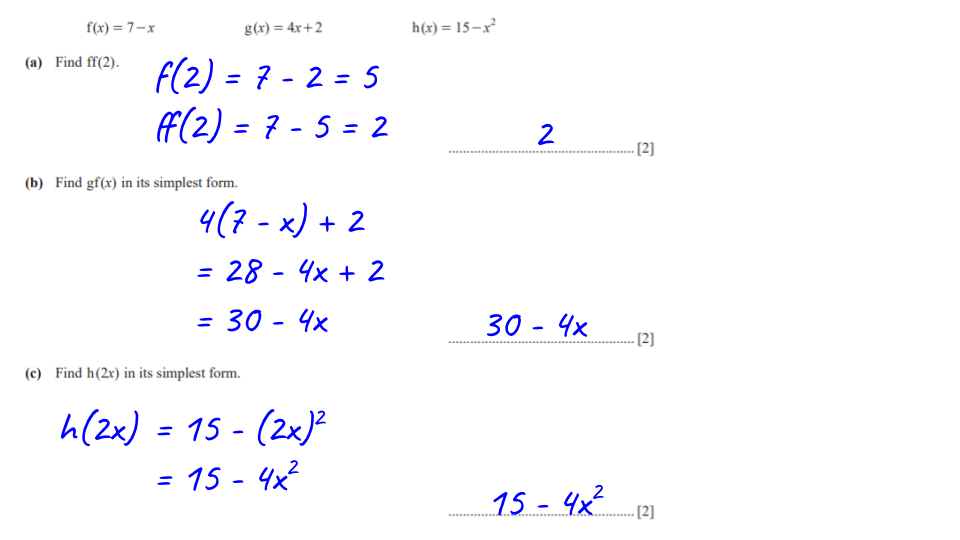
Now it's your turn.
Test your understanding! (Exam Practice)
This question is taken from a resource based on past exam papers. Try to solve it, showing your working clearly as if you were in an exam.
Question:
Given the functions and .
(a) Find the value of gf(-2). (2 marks)
(b) Find an expression for fg(x) in its simplest form. (2 marks)
Show answer and mark scheme
This question is adapted from the Third Space Learning resource. Here is how the marks are awarded.
(a) Find gf(-2)
-
Step 1: Find f(-2)
(1 mark awarded for correctly evaluating the inner function) -
Step 2: Find g(-5)
(1 mark awarded for the final correct answer)Final Answer:
gf(-2) = 27
(b) Find fg(x)
-
Step 1: Substitute g(x) into f(x)
(1 mark awarded for correct substitution, showing the expression for g(x) inside f(x)) -
Step 2: Simplify the expression
(1 mark awarded for the correct, fully simplified expression)Final Answer:
fg(x) = 3x^2 + 7
Conclusion
Excellent work. You have now learned how to combine functions, which is a powerful tool in algebra. By mastering the process of substitution and simplification, you are well-prepared for these types of questions in your exam.
Key Takeaways:
- Order is critical: The composite function
fg(x)meansf(g(x)). You apply the functiongfirst, then applyfto the result. - Numerical evaluation is a two-step process: First, evaluate the inner function for the given number. Second, use that result as the input for the outer function.
- Algebraic evaluation is a substitution process: Substitute the entire expression of the inner function into the variable of the outer function, then expand and simplify carefully.
- In general,
fg(x)andgf(x)produce different results.
Preview of the Next Lesson:
We've seen how to combine functions. The next logical step is to see how we can "undo" a function. In the next lesson, we will explore inverse functions, denoted as f⁻¹(x). You will learn the method for finding the expression for an inverse function, which essentially reverses the process of the original function machine.