Hello! Welcome to your next lesson in the Trigonometry module.
In our last session, we focused on the Sine and Cosine rules to find missing sides and angles in non-right-angled triangles. We paid special attention to the strategy of choosing the right rule for the job. Today, we complete your non-right-angled triangle toolkit.
The learning outcome for this lesson is to calculate the area of any triangle using the formula ½ab sin C. This formula is a frequent and valuable source of marks on your IGCSE papers, and mastering its use—including in multi-step problems—is essential for exam success.
1. The Challenge: Finding Area Without Perpendicular Height
You already know the classic formula for a triangle's area: . The problem is that in many non-right-angled triangles, you aren't given the perpendicular height.
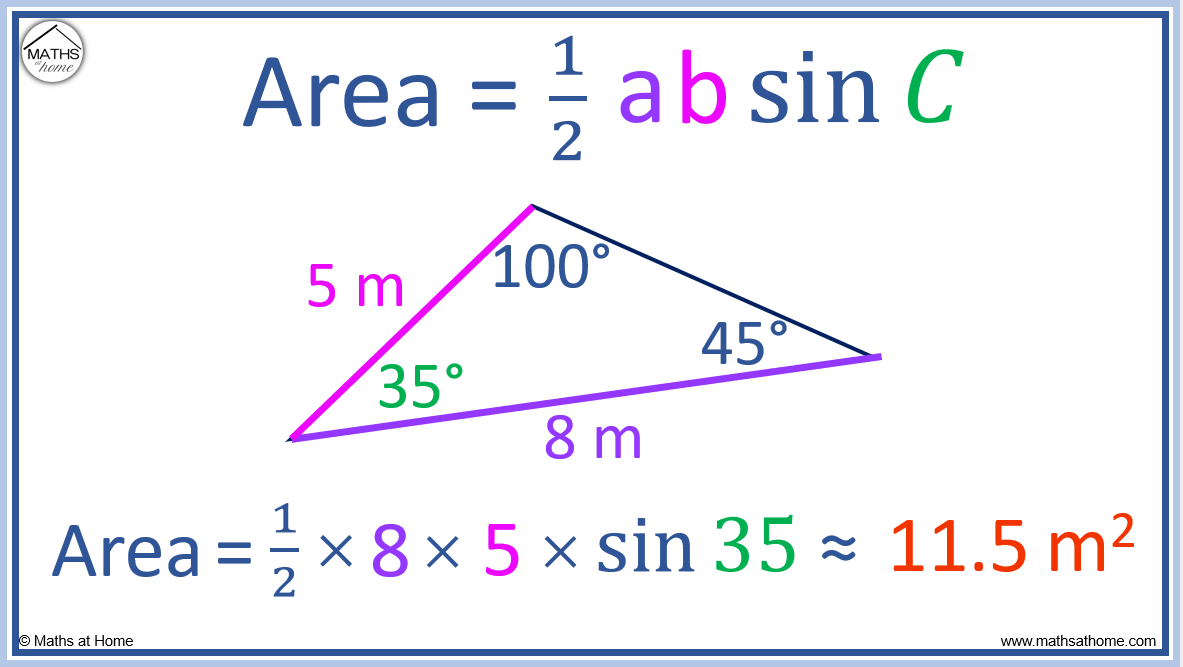
This is where our new formula comes in.
2. The Area Formula: Two Sides and the Included Angle
The area of any triangle can be found using the formula:
The most critical part is understanding what a, b, and C represent.
aandbare the lengths of any two sides.Cis the included angle—the angle that is between those two sides.
This condition is the key to knowing when to apply this formula. Making sure you have two sides and the angle sandwiched between them is a crucial check before you start calculating.
Let's read a quick, exam-focused summary of this rule.
IGCSE Area Rule: Complete Guide
This guide from Tutopiya concisely explains the area rule and when to use it. It also highlights common examiner traps, which is excellent for your exam preparation.
Read the sections titled 'Understanding Area Rule', 'When to Use Area Rule', and 'Common Examiner Traps'. This will take less than 5 minutes but will solidify the core concept.
Now, let's see this formula applied in a series of worked examples.
Area of any Triangle using Sine | Grade 7 Maths Series | GCSE Maths Tutor
This video from The GCSE Maths Tutor provides clear, step-by-step examples of how to apply the area formula.
Watch from the beginning to 05:12. The presenter will walk through the formula and two examples. Notice how they identify the two sides and the included angle in each case.
3. Deriving the Formula (Why it Works)
Given your interest in mathematics and physics, you might find it helpful to see why this formula works. It's not magic; it's a clever combination of the old area formula and SOHCAHTOA. Understanding the derivation can make the formula easier to remember and apply.
Area of a Triangle - 1/2 absin(C) - GCSE Higher Maths
This video from 1st Class Maths provides a brilliant, visual derivation of the formula. It shows how trigonometry is used to find a triangle's perpendicular height, which is then substituted into the standard area formula.
Watch from 01:13 to 04:33. Focus on how finding the height 'h' using sin(C) = h/b leads directly to the ½ab sin C formula.
4. Practice: Direct Application
Now it's your turn. The following video segment contains two practice questions. Pause the video as instructed and work through them, paying close attention to units and rounding.
Area of any Triangle using Sine | Grade 7 Maths Series | GCSE Maths Tutor
Time to put the formula into practice. Have a pen and your calculator ready.
Watch from 05:12 to 07:14. Follow the instructions to pause and attempt the two questions before the solutions are revealed. Note the comment about sin(30) in the second question—this is a preview of using exact trig values, which we'll cover soon.
5. Working Backwards: Finding a Missing Side or Angle
In more challenging exam questions, you might be given the area and asked to find a missing side or angle. This requires you to rearrange the formula—a key algebraic skill.
Let's see how this is done.
Area of any Triangle using Sine | Grade 7 Maths Series | GCSE Maths Tutor
The same video will now show you how to tackle these 'reverse' problems. Pay close attention to the algebraic steps.
Watch from 07:14 to 14:01. The first part covers finding a missing side, and the second covers finding a missing angle. Notice that when finding an angle, you'll need to use the inverse sine function (sin⁻¹) at the end.
An Important Exam Trap: The Obtuse Angle
Just like with the Sine Rule from our last lesson, when you use inverse sine to find an angle, your calculator gives you the acute answer (). However, since , there could be an obtuse angle solution.
If an exam question asks for an obtuse angle, you must calculate . Always check the diagram and the question wording for clues.
Test your understanding!
A triangle has an area of 50 cm². Two of its sides are 10 cm and 13 cm.
- Calculate the acute angle between these two sides.
- What would the obtuse angle be?
Show answer
- Start with the formula:
- Substitute the known values:
- Simplify:
- Isolate :
- Find the angle: (This is the acute angle).
- To find the obtuse angle: .
6. Multi-Step Problems: Combining Your Skills
The highest-mark questions often require you to combine multiple rules. You might need to use the Sine or Cosine Rule first to find a necessary side or angle before you can use the area formula. This tests your strategic thinking.
Let's tackle an exam-style problem.
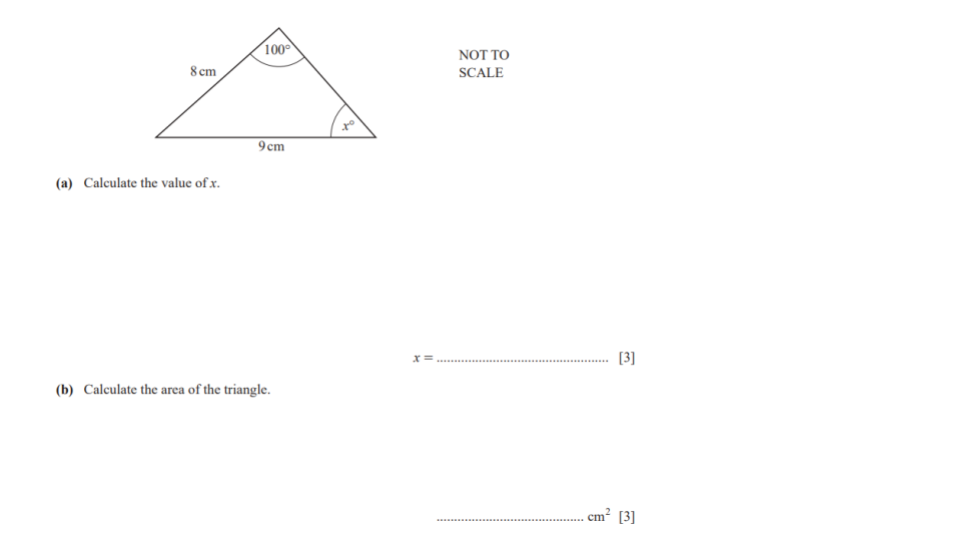
Your Task:
Before revealing the solution, think about your method.
- Part (a): Calculate the value of x. What information are you given? Which rule connects this information to the unknown angle x? (Hint: Look for "matching pairs").
- Part (b): Calculate the area of the triangle. To use
½ab sin C, you need two sides and the included angle. You have sides 8 cm and 9 cm. What is the angle between them? How can you find it once you know x?
Solution Walkthrough
Part (a): Finding x
- Strategy: We have a side (9 cm) and its opposite angle (100°), forming a "matching pair". We also have another side (8 cm) and its opposite angle (x). This is a classic Sine Rule problem.
- Execution:
Part (b): Finding the Area
- Strategy: To find the area, we need the angle between the 8 cm and 9 cm sides. Let's call this angle . The angles in a triangle sum to 180°.
- Execution:
- First, find angle :
- Now, apply the area formula with sides
a=8,b=9and included angleC=Y=29.1°:
- First, find angle :
This problem demonstrates perfectly how the skills from previous lessons are prerequisites for solving more complex questions.
Conclusion
You have now completed your essential toolkit for non-right-angled triangles. You can find any side, any angle, and the area, provided you have sufficient information. The key, as always, is selecting the right tool for the job.
Key Takeaways:
- The formula for the area of any triangle is .
- The crucial condition is that you must know two sides and the included angle.
- The formula can be rearranged to find a missing side or angle if the area is known.
- When finding an angle using this rule, be mindful of the potential obtuse angle solution.
- High-value exam questions often require you to first use the Sine or Cosine Rule to find a piece of information needed for the area formula.
Preview of the Next Lesson:
We will now take our 2D trigonometry skills into the third dimension. The next lesson will focus on solving 3D problems by identifying and analysing the 2D triangles hidden within 3D shapes. We will also cover the exact trigonometric values for key angles (0°, 30°, 45°, 60°, 90°), which are essential for non-calculator exam questions.