Hello! Welcome to your next lesson in the Trigonometry module.
In our last session, we mastered SOHCAHTOA, your toolkit for solving problems in right-angled triangles. Today, we expand our arsenal to tackle any triangle, whether it has a right angle or not.
The learning outcome for this lesson is to strategically select and apply the Sine Rule and Cosine Rule in non-right-angled triangles. This is a critical skill for your IGCSE exams, especially on Paper 4, where these questions are common and carry significant marks. A key focus will be on developing your "method selection" strategy—knowing which rule to use and when—which is a specific area you've wanted to improve.
1. Recap and The Standard Triangle Labelling
First, let's establish a consistent way to label any triangle. This is crucial for applying the formulas correctly.
- Angles are labelled with uppercase letters (e.g., ).
- Sides are labelled with the corresponding lowercase letter of the angle opposite them (e.g., side is opposite angle ).
Standard labelling for a non-right-angled triangle. Side 'a' is opposite angle 'A', 'b' is opposite 'B', and 'c' is opposite 'C'.
This convention is the foundation for both the Sine and Cosine rules.
2. The Sine Rule: For "Matching Pairs"
The Sine Rule establishes a relationship between a side and the sine of its opposite angle. It states that the ratio of a side's length to the sine of its opposite angle is the same for all three side-angle pairs.
Formulas:
- To find a side:
- To find an angle:
Using the "angle" version when you need to find an angle makes the algebra simpler and reduces the chance of errors.
The following video walks through how to apply the Sine Rule.
The Sine Rule - GCSE Higher Maths
Watch this video from 1st Class Maths to see clear, worked examples of the Sine Rule in action.
Watch from 01:14 to 09:22. The first part covers finding a missing side, and the second part covers finding a missing angle. Notice how the formula is flipped for finding an angle to make the rearrangement easier.
3. The Cosine Rule: For "SAS" and "SSS"
The Cosine Rule connects all three sides with one angle. It's your go-to tool when the Sine Rule doesn't fit.
Formulas:
- To find a side (when you know two sides and the included angle):
- To find an angle (when you know all three sides):
The second formula is a rearrangement of the first. Being able to perform this rearrangement is a valuable skill, especially for "show that" questions.
The Cosine Rule - GCSE Higher Maths
This next video demonstrates the Cosine Rule. Pay close attention to how the presenter rearranges the formula to find an angle—this is a great example of the algebraic manipulation needed for 'show that' questions.
Watch from 01:00 to 07:44. The video covers finding a side first, then shows the rearrangement and application for finding an angle.
4. The Core Strategy: When to Use Which Rule
This is the most important part of the lesson and directly addresses your goal of improving method selection. Choosing the wrong rule is a common source of wasted time and lost marks. The decision depends entirely on what information you are given.
The following video provides an excellent summary of the decision-making process.
The Cosine Rule - GCSE Higher Maths
This is the most crucial video for this lesson. It explicitly lays out the conditions for using the Sine Rule versus the Cosine Rule. This is your 'method selection' playbook.
Watch carefully from 07:44 to 10:25. Focus on the visual patterns for each rule.
Here is a summary of that strategy, reinforced with a clear flowchart.
| Your Situation | The Rule to Use | The Logic |
|---|---|---|
| You know 2 sides and the angle between them (SAS) | Cosine Rule | To find the third, opposite side. |
| You know all 3 sides (SSS) | Cosine Rule | To find any angle. |
| You know 2 sides and an angle not between them | Sine Rule | You have a "matching pair" and half of another. |
| You know 2 angles and 1 side | Sine Rule | You have a "matching pair" and can find the third angle to make another pair. |
This flowchart from Third Space Learning is an excellent tool. Follow its logic to make the correct choice every time.
5. Application and Exam Technique
Let's apply these rules to exam-style questions. Remember to always write down the formula you are using and show your substitution—these are essential steps for securing method marks (M marks).
Worked Example: Past Paper Question
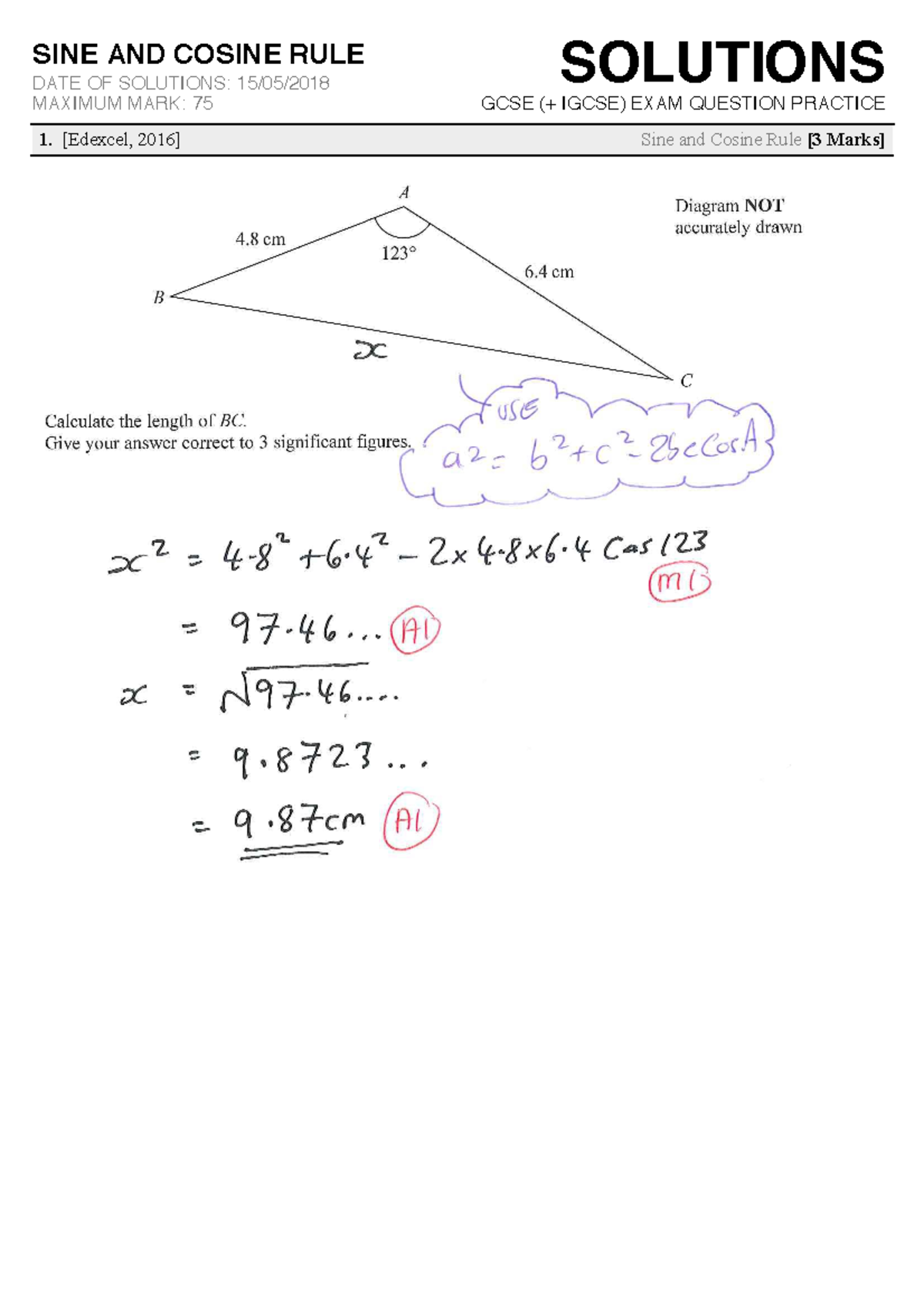
Analysis:
- Identify Information: We are given two sides (6.4 cm and 4.8 cm) and the angle between them (123°).
- Select Rule: This is a classic "Side-Angle-Side" (SAS) scenario. Following our strategy, we must use the Cosine Rule.
- Apply: The solution correctly applies the formula , substitutes the values, and calculates the result. The final answer is given to 3 significant figures, a standard requirement in IGCSE unless otherwise specified.
Test your understanding!
For the triangle below, which rule would you use to find the angle ?
A triangle with sides 5cm, 7cm, and 8cm. The angle opposite the 7cm side is labelled θ.
A triangle with three known sides.
Show answer
You would use the Cosine Rule. You are given all three sides (SSS) and need to find an angle. The Sine Rule would not work as you don't have any known angles to form a "matching pair".
The formula would be: .
The Ambiguous Case of the Sine Rule
When using the Sine Rule to find a missing angle, there's a potential trap. Because , your calculator will always give you the acute angle answer, but there might be an obtuse angle solution as well.
Exam questions will guide you. If a diagram clearly shows an obtuse angle, or the question states "angle X is obtuse," you must subtract your calculator's answer from 180°.
The Sine Rule - GCSE Higher Maths
This short clip explains the 'ambiguous case' visually. Understanding this is a hallmark of a high-achieving student.
Watch from 09:22 to 13:32. Focus on why two possible angles can exist and how an exam question would provide the necessary clue.
6. "Show That" Practice
Let's address your weakness with "show that" questions by applying it to these rules.
Trigonometry Formula - GCSE Maths - Steps & Examples
This resource contains GCSE-style questions that are perfect for our focus. We will tackle questions 3 and 4.
Scroll down to the 'Trigonometry formulas GCSE questions' section. We will focus on questions 3 and 4.
Question 3a: Show that the formula rearranges to make .
- Step 1: Start with the formula:
- Step 2: We want , so let's cross-multiply:
- Step 3: Isolate by dividing by :
- Step 4: To find , take the inverse sine of both sides: . (Shown)
Now, attempt Question 3b and Question 4 (both parts) from the resource on your own.
Check your work for Q3b and Q4
Question 3b:
- Information: You have two sides (10.1, 8.2) and an angle not between them (43°). This is a Sine Rule case.
- Application: Using the rearranged formula from 3a, .
- Answer: (2 d.p.)
Question 4a: Show that rearranges to .
- Step 1:
- Step 2: Isolate the term with . Add to both sides and subtract :
- Step 3: Divide by :
- Step 4: Take the inverse cosine: . (Shown)
Question 4b:
- Information: You know all three sides (SSS). This is a Cosine Rule case.
- Application: Using the formula from 4a, .
- Answer: (2 d.p.)
Conclusion
You have now learned the two essential rules for non-right-angled triangles and, most importantly, the strategy for deciding between them. Mastering this logic is key to solving these problems efficiently and accurately in your exam.
Key Takeaways:
- Strategic Choice: The information you have (SAS, SSS, or matching pairs) determines whether you use the Cosine Rule or the Sine Rule.
- Cosine Rule: Use for Side-Angle-Side (SAS) to find the third side, or Side-Side-Side (SSS) to find an angle.
- Sine Rule: Use when you have or can find a "matching pair" of a side and its opposite angle.
- Exam Technique: Always write the formula and substitution for method marks. Be alert for the ambiguous case of the Sine Rule when finding an angle.
Preview of the Next Lesson:
We will continue to build on these skills. The next lesson covers how to calculate the area of any triangle using the formula and how to apply all these trigonometric rules to solve complex 3D problems.