Hello! Welcome to your next lesson in the Trigonometry module.
In our last few lessons, we've built a powerful 2D toolkit: SOHCAHTOA, the Sine and Cosine rules for any triangle, and the area formula ½ab sin(C). Today, we'll apply this entire toolkit in a new context: three-dimensional space. These questions are a common feature of the IGCSE Extended paper and are an excellent way to consolidate your skills.
The learning outcome for this lesson is to solve 3D problems by identifying and analysing relevant 2D triangles within the 3D shape. The key insight is that there are no "new" 3D trigonometry rules to learn. The entire strategy revolves around one skill: spotting and extracting the right 2D triangles from a 3D diagram.
1. The Core Strategy: From 3D to 2D
A 3D object on a 2D exam paper can be disorienting. The secret to every 3D trigonometry problem is to break it down into a series of manageable 2D problems. Your process will almost always be:
- Identify the target: What angle or length are you ultimately trying to find? This will be part of a specific triangle.
- Extract the target triangle: Sketch this triangle in 2D, labelling the vertices.
- Assess the target triangle: What information do you have? What do you need?
- Hunt for more information: Find other 2D triangles within the 3D shape that you can solve to find the missing lengths or angles needed for your target triangle.
- Solve and conquer: Use the information you've found to solve your target triangle.
This process of breaking down a complex system into simpler, solvable components is a fundamental problem-solving technique in both mathematics and physics.
2. Defining the "Angle Between a Line and a Plane"
One of the most common questions asks for the angle between a line and a plane (e.g., the angle between a diagonal of a cuboid and its base). Let's be precise about what this means.
3D Trigonometry - IGCSE Maths Revision Notes
This revision note from Save My Exams provides a clear definition and visualisation for finding the angle between a line and a plane. It's a crucial concept to master.
Read the sections 'How do I find the angle between a line and a plane?' and 'How do I apply 3D Pythagoras and trigonometry to more complicated problems?'. The 'fishing rod' analogy is a particularly helpful way to visualise this.
The key idea is that the angle is formed by the line itself and its "shadow" projected directly onto the plane. This always creates a right-angled triangle.
Let's see this in practice with an exam-style solution.
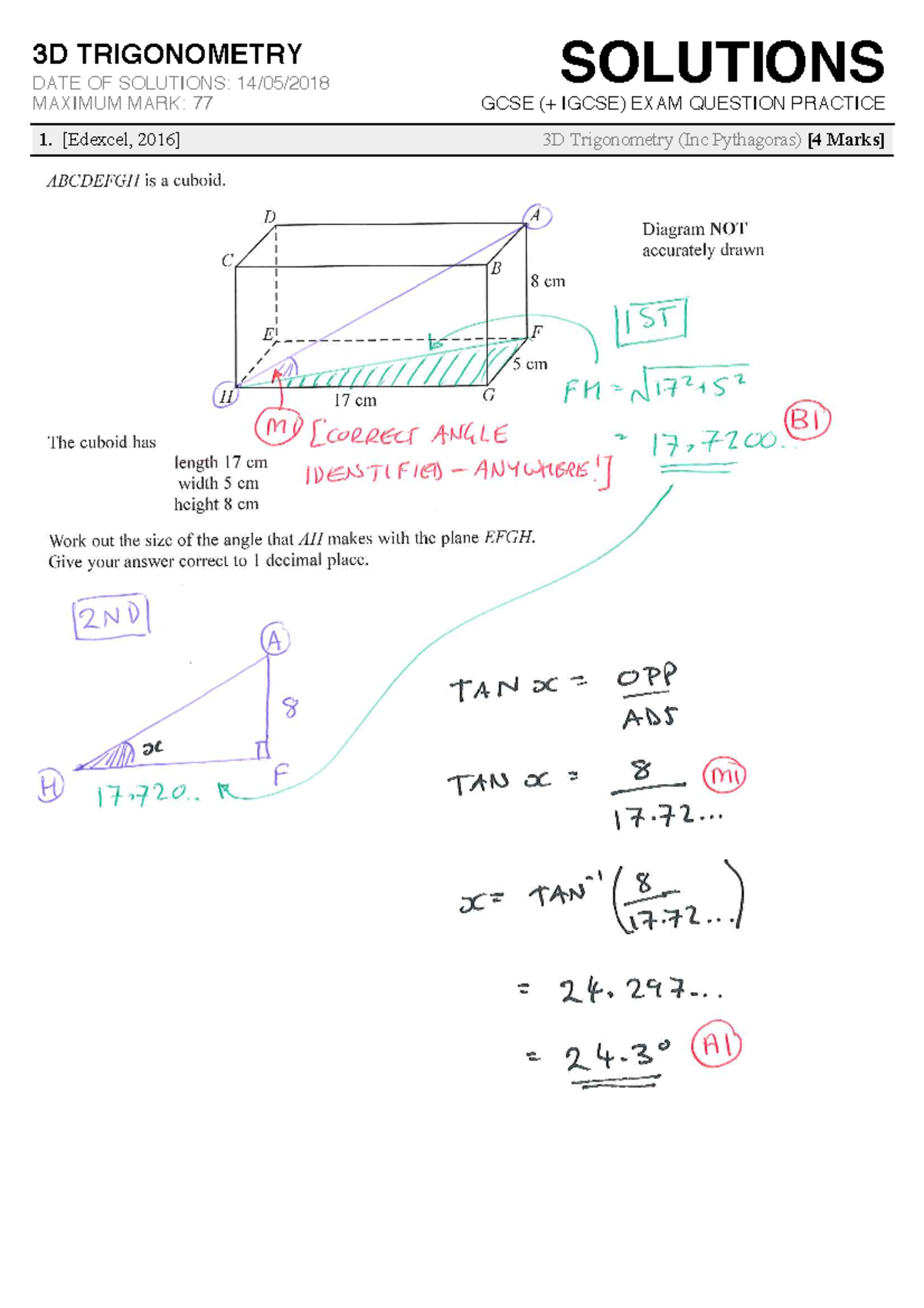
Look closely at the logic in this solution:
- The Goal: Find the angle between the line AH and the plane EFGH. The triangle is AFH. The angle is .
- The Triangle: This is a right-angled triangle with the right angle at F. The height is AF = 6 cm. We need the base length, FH.
- The Hunt: To find FH, we look at the base of the cuboid. This forms another right-angled triangle, EFH (or FGH). The sides are 9 cm and 5 cm.
- The First Solve (Pythagoras): On the base triangle EFH, . This gives . This gets a method mark (M1) and a correct value mark (B1).
- The Final Solve (SOHCAHTOA): Now, in our target triangle AFH, we have the opposite side (AF = 6) and the adjacent side (FH = ). We use
tan.
This earns the final method and accuracy marks.
This two-step process—using Pythagoras on a flat plane to find a length, then using that length in a vertical triangle with SOHCAHTOA—is the most common pattern in these questions.
3. Worked Examples: From Simple to Complex
The best way to master this topic is by seeing the pattern applied repeatedly across different shapes and scenarios. Let's work through some video examples. A key strategy, as you'll see, is to always redraw the 2D triangles separately to avoid confusion.
The 5 Hardest 3D Trigonometry Questions (+1 Extra) | Grade 7-9 Maths Series | GCSE Maths Tutor
This video from The GCSE Maths Tutor tackles a series of challenging 3D trigonometry questions. We'll watch the first two problems to see the core strategies in action.
Watch from 01:26 to 18:35. First Question (Cuboid, 01:26 - 08:40): Notice how a single goal (finding angle AHD) is broken down into two sub-problems: finding length AD and finding length HD, each by solving a different right-angled triangle. Second Question (Tetrahedron, 08:40 - 18:35): This is a fantastic example of a more advanced problem. The target triangle (BDC) is not right-angled. The strategy is to find the lengths of all three of its sides (BC, DC, DB) by applying Pythagoras to three different right-angled triangles first. Then, with all three sides known, the Cosine Rule is used to find the final angle. This is a perfect illustration of combining multiple skills.
Test your understanding!
Let's apply this method to a new problem.

Your task is to outline the steps needed to find . You don't have to do the full calculation, just describe the plan.
- What are the knowns and unknowns in the target triangle EOC?
- What length do you need to find first?
- Which 2D triangle do you need to analyse to find this missing length, and what rule would you use?
- Once you have all the necessary information for triangle EOC, which trigonometric ratio (sin, cos, or tan) would you use to find ?
Show answer
- Target Triangle EOC: We know the opposite side (the height OE = 9 cm). We need to find the angle . The adjacent side is OC.
- Missing Length: We need to find the length of OC.
- The Hunt: OC is half the length of the diagonal of the square base, AC. So, we first need to find the length of AC. We can do this by looking at the right-angled triangle ABC on the base. Using Pythagoras' Theorem: . So, . Therefore, .
- Final Solve: In triangle EOC, we now have the opposite side (9 cm) and the adjacent side ( cm). We would use the tangent ratio: .
4. Tackling Multi-Layered Problems
The most difficult questions layer multiple concepts together. They might involve ratios, area, or other parts of the syllabus before you can even start the trigonometry. Success here comes down to methodical, step-by-step thinking.
Let's watch one more example that introduces a ratio, and then a truly challenging "beast" of a question that synthesises many topics.
The 5 Hardest 3D Trigonometry Questions (+1 Extra) | Grade 7-9 Maths Series | GCSE Maths Tutor
First, let's see how a ratio can be incorporated. Watch the third problem from the same video.
Watch from 19:08 to 26:26. Note how the first step is to use the given ratio to calculate the lengths on the side of the prism before any trigonometry begins.
Now for a tougher challenge. This next video includes a problem that the presenter calls a "double flashing siren" tricky question. It requires you to use the area formula and the sine rule (including the obtuse angle case) just to find the side lengths needed for the 3D part.
#53 3D Trigonometry - Edexcel IGCSE Exam Questions
This is an A*-level problem that tests your ability to select and combine multiple rules strategically. It's a great test of your overall trigonometric fluency.
Watch the section from 06:30 to 12:16. Don't worry if it seems overwhelming at first. Pause the video and trace each step. The key is to see how a complex goal is achieved by a sequence of simpler calculations, each using a rule you already know.
Conclusion
3D Trigonometry is a topic that beautifully ties together many different parts of geometry and trigonometry. It is less about learning a new skill and more about creatively applying the skills you already have.
Key Takeaways:
- The master strategy for all 3D trigonometry problems is to identify and extract 2D triangles.
- Always redraw the 2D triangles flat on your page to avoid confusion. Label them clearly.
- The most common pattern is a two-step process:
- Use Pythagoras' Theorem on a horizontal triangle (like the base).
- Use SOHCAHTOA on a vertical triangle using the length you just found.
- Be prepared for more complex problems that require the Sine or Cosine Rule because the target triangle is not right-angled.
- If you're stuck, try to find any length or angle you can. It might be a necessary intermediate step and could earn you method marks.
Preview of the Next Lesson:
In our next lesson, we will shift focus slightly. We will learn to recall and apply the exact trigonometric values for special angles (0°, 30°, 45°, 60°, and 90°), a skill vital for non-calculator questions. Following that, we will learn how to solve trigonometric equations.