Hello! Welcome to the twelfth module of our Mathematics Mastery Sprint.
In our last lesson, we wrapped up our study of Calculus by mastering definite integration to find the area under a curve. This was a significant achievement, covering one of the most challenging topics on the IGCSE syllabus.
Today, we pivot to a new module: Probability and Statistics. We will start with the fundamentals, focusing on how to calculate the probability of single outcomes and how to combine these to find the probability of more complex sequences of events. This is a topic that frequently appears on both Paper 2 and Paper 4, so building a solid foundation is essential for scoring well.
By the end of this lesson, you will be able to confidently calculate probabilities of single and combined events.
1. The Core Principle of Probability
At its heart, probability is a way of measuring the likelihood of an event happening. It's always a value between 0 (impossible) and 1 (certain). For your exams, you'll almost always express probabilities as fractions.
The fundamental formula is:
A crucial related idea is the probability of an event not happening. Since the total probability of all possible outcomes must be 1, we can say:
Let's watch a very quick example that puts these two simple ideas into the context of an IGCSE question.
All of iGCSE Maths Probability 2025 Edition!
This short clip from the Ginger Mathematician's "All of iGCSE Maths Probability" video shows how to calculate the probability of a single event and its complement (the 'not' event).
Watch from 0:15 to 1:52. Notice how the probability is first written with the total number given, and then simplified. Also, pay attention to the use of the 1 - P(A) rule.
Expected Frequency
A common application of single event probability is calculating the expected frequency (or expected number of outcomes). If you know the probability of an event and the number of times you're going to run the experiment (the number of trials), you can predict how many times you expect that outcome to occur.
The formula is straightforward:
Expected Frequency = Probability of the event × Number of trials
This next clip from the same video provides a clear, worked example.
All of iGCSE Maths Probability 2025 Edition!
This part of the video demonstrates how to calculate the expected number of times an event will occur.
Watch from 13:46 to 15:34. The key is multiplying the probability of the single event by the number of trials.
2. Combined Events: The 'AND' and 'OR' Rules
Most exam questions involve more than one event happening in sequence. These are called combined events. To solve these, you need to understand two key rules: the 'AND' rule and the 'OR' rule.
First, we must distinguish between two types of combined events:
- Independent Events: The outcome of the first event does not affect the probability of the second. A classic example is picking an item and then replacing it.
- Dependent Events: The outcome of the first event does affect the probability of the second. This happens when you pick an item without replacement.
The 'AND' Rule (Multiplication)
When you want to find the probability of event A and then event B happening, you multiply their probabilities.
- For independent events, is its standard probability.
- For dependent events, is the new probability, after event A has already occurred.
The 'OR' Rule (Addition)
When you want to find the probability of event A or event B happening (where A and B cannot happen at the same time), you add their probabilities.
This is most often used when a question asks for a final outcome that can be achieved in multiple ways. For example, "picking two balls of the same colour" could mean (Red and Red) OR (Blue and Blue).
Let's watch a video that works through examples of these rules for both independent (with replacement) and dependent (without replacement) events.
All of iGCSE Maths Probability 2025 Edition!
The following two clips from the Ginger Mathematician's video demonstrate the 'AND' and 'OR' rules in practice. Pay close attention to how the denominators change in the 'without replacement' scenario.
First, watch the section on dependent events (without replacement) from 1:52 to 3:39. Then, watch the section on independent events (with replacement), which also uses the 'OR' rule, from 7:48 to 10:17.
To solidify your understanding, take a few minutes to read through this summary page.
Combined Events Probability - GCSE Maths
This article from Third Space Learning provides a concise written explanation of combined events, covering both independent and dependent scenarios with clear examples.
Read through the sections 'What are combined events in probability?', 'Independent Combined Events', and 'Dependent combined events'. Then, look at the worked examples, especially Example 1, 2, and 5, to see how the AND and OR rules are applied.
3. Structuring Your Work: Tree Diagrams
Tree diagrams are an invaluable tool for organising your thoughts in probability questions. They provide a clear visual map of all possible outcomes and their probabilities, which is essential for avoiding the small arithmetic errors you've mentioned can be a problem.
The rules for using a tree diagram are a direct application of the AND/OR rules:
- Multiply along the branches to find the probability of a specific sequence of outcomes (the 'AND' rule).
- Add the results at the end for the different outcome paths that satisfy the question (the 'OR' rule).
This revision note gives a quick, effective overview of how to set up and use a tree diagram.
This revision note from Save My Exams clearly explains the core principles of constructing and interpreting tree diagrams for both independent and conditional probability.
Read through the sections 'How do I draw a tree diagram?', 'How do I find probabilities from tree diagrams?', and 'How do I use tree diagrams with conditional probability?'. Focus on the logic of multiplying along branches and adding between cases.
Test your understanding!
The image below shows a probability problem. Before looking at the solution in the image, try to solve it yourself.
Question: Anna has a bag with 2 red and 3 yellow sweets. Ben has a bag with 4 red and 1 yellow sweet. Anna takes a sweet, then Ben takes a sweet. Calculate the probability they both take a red sweet.
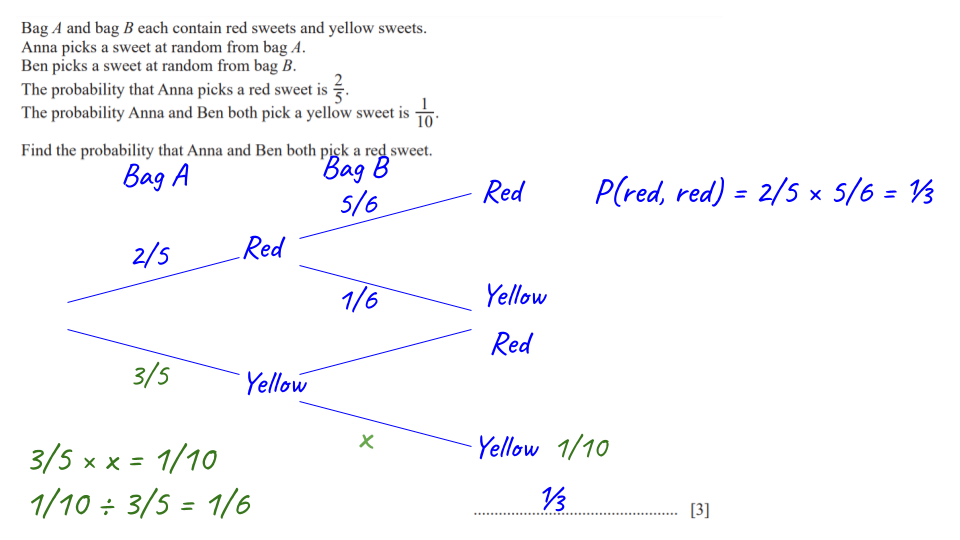
Show answer
This is a case of two independent events, as the contents of Ben's bag are not affected by Anna's choice.
-
Probability of Anna picking red:
(2 red out of 5 total) -
Probability of Ben picking red:
(4 red out of 5 total) -
Apply the 'AND' Rule:
We need Anna to pick red AND Ben to pick red.
As you can see in the image, this matches the result found using the tree diagram.
4. Key Exam Strategies and Scenarios
To move from a B to an A grade, you need to master not just the basics, but also the common traps and efficient methods that save time in an exam.
Strategy 1: The "At Least One" Shortcut
If a question asks for the probability of "at least one" of something, it's often much faster to calculate the probability of "none" and subtract it from 1.
For example, is the same as . This saves you from calculating etc.
Watch this video to see a side-by-side comparison of the long method versus this shortcut.
IGCSE/O level Maths - Probability (Concepts and Past Papers)
This clip from Mathlete by Saad demonstrates the efficiency of the '1 - P(none)' method for 'at least one' questions.
Watch from 52:04 to 55:52. Notice how much simpler the calculation is when using the alternative method.
Strategy 2: Dealing with Unspecified Order
A common exam pitfall is when the question asks for a combination of outcomes but doesn't specify the order. For example, "find the probability of picking one red and one blue sweet".
Many students only calculate P(Red then Blue) and forget that P(Blue then Red) also satisfies the condition. You must calculate the probability for all possible permutations and add them together.
The video below works through a problem of picking 3 pens (2 blue, 1 red) without replacement. The presenter clearly shows the three possible permutations and a clever shortcut.
All of iGCSE Maths Probability 2025 Edition!
This video segment addresses the common mistake of forgetting permutations when the order of events is not specified.
Watch from 10:17 to 13:26. Pay close attention to how the presenter lists the three possible outcomes (BBR, RBB, BRB) and then uses multiplication as a shortcut, since each permutation has the same probability.
Strategy 3: Tackling Probability "Show That" Questions
You've identified "show that" questions as a weakness. In probability, these often involve forming an algebraic expression for a probability and showing it simplifies to a given quadratic equation.
The key is to stay calm and build the probability expression step-by-step. Don't panic if your algebra doesn't immediately match the target; instead, use the target expression to help find your mistake.
This final video is an advanced, high-mark exam question that brings all these ideas together. It is an excellent test of your understanding.
All of iGCSE Maths Probability 2025 Edition!
This is a challenging IGCSE problem where you must use conditional probability (without replacement) to form a quadratic equation. This is a perfect example of a 'show that' question in a probability context.
Watch carefully from 27:45 to 35:53. Note how the presenter sets up the probability of 'Black and Black'. A brilliant part is where he makes a mistake in the cross-multiplication (31:00) but then uses the 'show that' target to realise his error and correct it. This is a vital exam skill.
Conclusion
Excellent work today. We've moved from the basic definition of probability right up to the complex, multi-step problems you're likely to see at the top end of your exam papers.
Key Takeaways:
- Single Events: Probability is the ratio of favorable outcomes to total outcomes. Expected frequency is this probability multiplied by the number of trials.
- Combined Events: Use the 'AND' rule (multiply) for events in sequence and the 'OR' rule (add) for mutually exclusive options.
- Dependent vs. Independent: Always check if events are with replacement (independent) or without replacement (dependent), as this changes the probabilities for subsequent events.
- Exam Strategy: Use tree diagrams to structure your work, use the shortcut for "at least one" problems, and always account for all permutations when the order is not specified.
Preview of the Next Lesson:
In the next lesson, we will continue our work on probability by learning how to use Venn diagrams. This is another visual tool that helps solve problems involving overlapping sets and introduces the important concept of conditional probability in a different context.