Hello! Welcome to the final lesson in our Introduction to Calculus module.
In our last session, we mastered indefinite integration, learning how to reverse the process of differentiation to find the general equation of a curve, . We also practiced finding the specific value of the constant c using a known point on the curve.
Today, we will build directly on that foundation to learn about definite integration. This powerful tool allows us to calculate a specific numerical value which, graphically, represents the area enclosed between a curve and the x-axis. Given your focus on exam technique, mastering this topic is crucial as it's a frequent source of high-mark questions on Paper 4.
By the end of this lesson, you will be able to evaluate definite integrals to calculate the area between a curve and the x-axis.
1. Definite Integration: Finding Area Above the x-axis
The fundamental idea is that the area of a region bounded by a curve , the x-axis, and the vertical lines and can be found by calculating a definite integral.
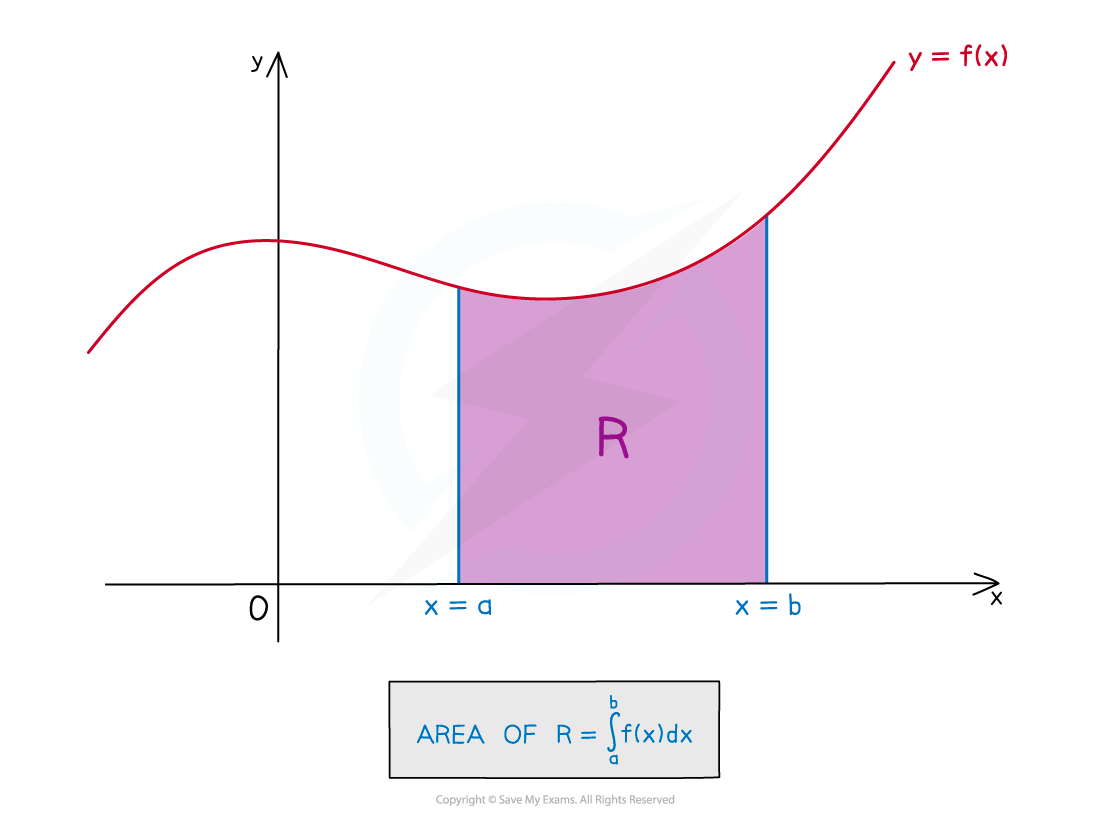
The process to calculate this is:
- Integrate the function to find the indefinite integral, which we'll call . You can ignore the
+ cfor definite integrals. - Evaluate the integrated function at the upper limit () and the lower limit ().
- Subtract the results: Area = .
This is typically written using the notation:
You might wonder why we can forget about the + c. If we included it, the calculation would be . As you can see, the c terms would cancel each other out, so we can omit it from the start to save a step.
Let's watch a quick worked example to see this process in action.
Area under and between Curves by Integration | ExamSolutions
This clip from ExamSolutions provides a clear, concise review of how to set up and evaluate a definite integral to find the area under a curve that is entirely above the x-axis.
Watch the first 3 minutes of this video. The presenter will walk through calculating the area under the curve y = x² + 1 between x = -1 and x = 3.
2. The Critical Point: Areas Below the x-axis
This is where many students lose marks. What happens if the area you need to find is below the x-axis?
When a region is below the x-axis, the definite integral for that region will produce a negative value. Since area cannot be negative, the actual area is the positive (or absolute) value of the integral's result.
This leads to a crucial strategic point for exams:
- Never integrate in one go across a section where the curve crosses the x-axis.
If you try to calculate where part of the curve is above the axis and part is below, the negative area will cancel out some of the positive area, giving you an incorrect final answer.
To understand this concept clearly, let's turn to a short reading.
These notes from mathcentre.ac.uk explain the theory behind why areas below the x-axis produce a negative integral and the pitfall of integrating across the x-axis without splitting the calculation.
Read pages 2 and 3 of the document, starting from Section 2, 'The area between a curve and the x-axis'. Pay close attention to the example of y = x(x-1)(x-2) and how integrating from 0 to 2 gives an answer of 0, which is clearly not the total area.
The key takeaway is that you must always sketch the curve first to see which parts are above and below the x-axis.
This image provides a perfect summary of this concept.

3. The Full Method for Finding Total Area
Here is a reliable, multi-step method that you can apply to any question asking for the area between a curve and the x-axis.
- Find the roots: Set to find where the curve crosses the x-axis.
- Sketch the curve: Draw a quick sketch to visualise which regions are above and which are below the axis.
- Split the Integral: Set up a separate definite integral for each region.
- Calculate and Sum: Evaluate each integral. Take the positive value of any negative results, and add all the areas together.
Let's watch a video where this exact method is applied to an exam-style question.
Area under and between Curves by Integration | ExamSolutions
This segment from the same ExamSolutions video demonstrates the full method for a curve with regions both above and below the x-axis.
Watch from 10:50 to 14:25. The example finds the total area for the curve y = 2x - x² between x = -1 and x = 2. Notice how the presenter first finds the roots (0 and 2), then calculates the area from -1 to 0 (below the axis) and the area from 0 to 2 (above the axis) separately before adding them.
This methodical approach is exactly what examiners are looking for and will help you avoid the common traps.
Test your understanding!
A curve has the equation . Find the area enclosed by the curve, the x-axis, and the lines and .
Show answer
Step 1: Find the roots.
Set . The curve crosses the x-axis at and .
Step 2: Sketch the curve.
It's a standard U-shaped parabola. Between our limits of and , the curve crosses the axis at .
- From to , the area is below the x-axis.
- From to , the area is above the x-axis.
Step 3: Split the Integral.
We need to calculate two separate areas.
Area 1 (below):
Area 2 (above):
Step 4: Calculate and Sum.
-
Area 1:
The integral is negative, as expected. The area is . -
Area 2:
-
Total Area:
Conclusion
Well done on completing the final lesson on calculus! You now have a complete framework for tackling one of the most significant topics in the IGCSE syllabus.
Key Takeaways:
- A definite integral, , is calculated as , where is the integral of .
- This value represents the area between the curve and the x-axis.
- Crucially, if the area is below the x-axis, the integral will be negative. The area is the positive value of this result.
- To find the total area for a curve that is partly above and partly below the x-axis, you must split the integral at the roots and sum the positive values of each resulting area. Always sketch the graph to plan your strategy.
Preview of the Next Module:
We have now concluded our intensive review of Calculus. This is a huge achievement and covers a major part of the higher-tier papers. In our next lesson, we will pivot to a new module: Probability and Statistics. We'll begin by looking at the fundamentals of calculating probabilities for single and combined events, another key area for your exams.