Hello! Welcome to the fourth lesson in our Introduction to Calculus module.
In our last few lessons, we've focused on differentiation, the process of finding the gradient function, , of a curve. We used this to find the gradient at a specific point, the equation of a tangent, and the coordinates of turning points.
Today, we will explore the reverse process: integration. If you're given the gradient function , how can you work backwards to find the equation of the original curve, ? This skill is fundamental to calculus and is a prerequisite for finding the area under a curve, a common high-mark exam topic.
By the end of this lesson, you will be able to integrate polynomial functions, including finding the constant of integration from given information.
1. Reversing Differentiation: The Constant of Integration
Integration is the inverse operation of differentiation. While differentiation takes a function and finds its gradient, integration takes a gradient and finds the original function.
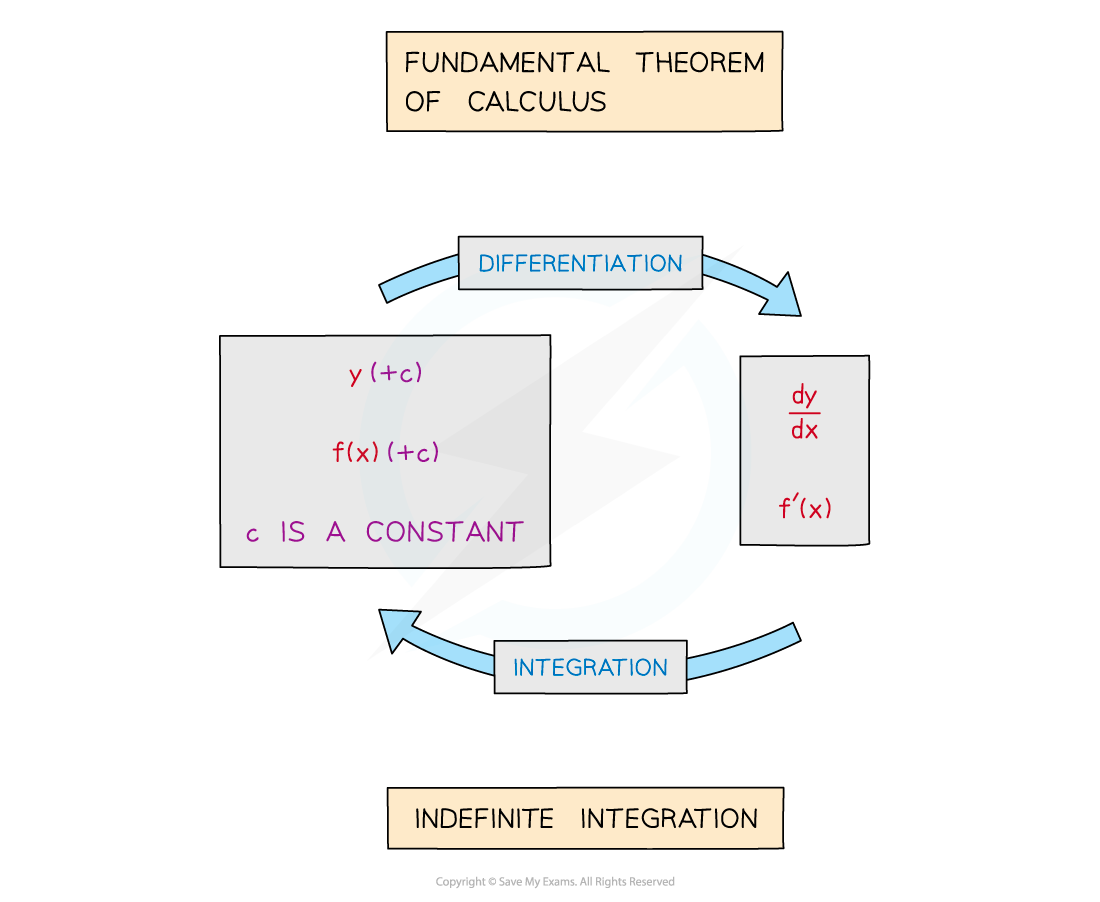
This leads to a key question. Consider these three functions:
If you differentiate all of them, the constant term disappears, and you get the same derivative for all three: .
So, if we start with and want to integrate to find , which function should we arrive at? We don't have enough information to know the original constant. To account for this unknown constant, we always add a constant of integration, written as + c, whenever we perform an indefinite integral.
Let's watch a short video that explains this idea clearly.
Integration finding the c value
This clip from Joel Speranza Math clearly explains why the constant of integration, 'c', is necessary. It shows how multiple different functions can have the same derivative.
Watch the first 1 minute and 12 seconds of the video. Focus on understanding the core idea: differentiation loses the constant term, so integration must include a generic '+ c' to represent it.
2. The Rule for Integrating Polynomials
Just as there is a rule for differentiating powers of , there is a simple rule for integrating them.
To integrate a term of the form , you increase the power by one and then divide by the new power.
The rule is:
(Note: This rule doesn't work for n = -1, as that would mean dividing by zero, but you won't need to worry about that for polynomial integration in your IGCSE exam.)
To integrate a full polynomial, you simply apply this rule to each term individually.
For a thorough explanation of the rules and notation, please read the following sections from the Save My Exams revision notes.
CIE IGCSE Additional Maths Revision Notes 2025
These notes provide a structured overview of the integration process, including the notation and the rule for integrating powers of x.
Please read the first two sections, 'Introduction to Integration' and 'Integrating Powers of x'. Pay close attention to: The formal notation for an integral: ∫f(x)dx. The general formula for integrating powers of x. The example of how a polynomial with multiple terms is integrated term-by-term.
Example:
Find the integral of .
We write this as . Now, we integrate term by term:
- For : Increase power to 4, divide by 4.
- For (or ): Increase power to 2, divide by 2.
- For (or ): Increase power to 1, divide by 1.
Putting it all together and adding the constant of integration:
Test your understanding!
Given that , find a general expression for .
Show answer
We need to find .
Integrate term by term:
Combine them and add the constant of integration:
3. Finding the Specific Value of 'c'
In many exam questions, you won't just be asked for the general solution with + c. You will be given extra information that allows you to find the exact value of c. This information is usually a point (x, y) that the curve passes through.
The procedure is a reliable three-step process that you should memorize. It's a great way to secure method marks.
- Integrate: Integrate the given gradient function to find the general equation of the curve, including
+ c. - Substitute: Substitute the known and coordinates from the given point into your general equation. This will create an equation where
cis the only unknown. - Solve: Solve the equation to find the value of
cand write down the final, specific equation of the curve.
This video from Eddie Woo provides an excellent, clear walkthrough of this exact process.
Evaluating Constant of Integration (1 of 2: Indefinite integral)
In this video, Eddie Woo breaks down the process of finding the constant of integration into clear, manageable steps. This aligns perfectly with the efficient, methodical approach you need for your exam.
Watch from 02:32 to 06:19. Pay attention to his three distinct steps, which he calls 'Integrate', 'Evaluate' (our 'Substitute' step), and 'Substitute' (our final 'Solve and write' step).
Worked Example
Let's apply this method to an exam-style problem.
Question: A curve has a gradient function . The curve passes through the point . Find the equation of the curve.
Step 1: Integrate
First, integrate the gradient function to get the general equation for .
Step 2: Substitute
We know the curve passes through , so we can substitute and into our general equation.
Step 3: Solve
Now, solve the equation for c. Remember to be careful with your arithmetic here.
Finally, write the complete equation for the curve by substituting the value of c back into the general equation.
Final Answer:
Exam-Style Practice Question
A curve is such that . Given that the curve passes through the point , find the equation of the curve .
Show solution
Step 1: Integrate
We are given . We find by integrating.
Step 2: Substitute
The curve passes through , so we substitute and .
Step 3: Solve
Final Answer: Substitute back into the general equation.
Conclusion
Great job today! You have learned the inverse process of differentiation and how to apply it to a common type of exam question. Mastering this procedure is key to unlocking more advanced calculus topics.
Key Takeaways:
- Integration is the reverse of differentiation.
- The rule for integrating a power of is: increase the power by one, then divide by the new power.
- When finding an indefinite integral, you must always add the constant of integration,
+ c. - To find the specific value of
c, you can use a known point(x, y)on the curve by following a three-step process: Integrate, Substitute, Solve.
Preview of the Next Lesson:
In this lesson, we found the general equation of a curve. In our next and final lesson on calculus, we will learn about definite integration. This involves integrating between two specific limits to find a single numerical value. You'll discover that this value represents the area under the curve between those limits—a very powerful and frequently tested application. We'll also see why the + c is no longer needed for those calculations.