Hello! Welcome to the third lesson in our Introduction to Calculus module.
In the last lesson, we saw how to find the equation of a tangent and a normal to a curve at a specific point. This involved using differentiation, , to find the gradient at that single point.
Today, we're going to use differentiation to answer a different but related question: how do we find the "peaks" and "troughs" of a curve? These are known as turning points or stationary points, and they are locations where the curve momentarily stops rising or falling. This is another classic, high-mark topic in your exam.
By the end of this lesson, you will be able to locate the coordinates of turning points on a curve and determine their nature (maximum or minimum).
1. What are Stationary Points?
A stationary point is a point on a curve where the gradient is zero. At these points, the tangent to the curve is a horizontal line. These are also called turning points because they are where the curve changes direction from increasing to decreasing, or vice versa.
There are two main types you need to know for your exam:
- Maximum point: The "peak" of a section of the curve.
- Minimum point: The "trough" of a section of the curve.
Let's watch a short video that introduces this concept visually.
IGCSE Math Differentiation (Part 2) Stationary Points, Maxima & Minima #igcsemath #differentiation
This video from 'IGCSE on fingertips' clearly defines stationary points and explains why the gradient is zero at these locations. It then introduces the idea of maximum and minimum points.
Watch from 00:32 to 03:34. Focus on: The definition of a stationary (or turning) point. The key condition: the gradient, rac{dy}{dx}, must be zero. The visual difference between a maximum and a minimum point.
2. The Method: Finding and Classifying Stationary Points
To solve these problems efficiently in an exam, you can follow a reliable, five-step process. This process first locates the points and then determines their nature.
The 5-Step Strategy
- Find the Gradient Function: Differentiate the curve's equation to find .
- Find Stationary x-coordinates: Set the gradient function to zero () and solve the resulting equation for . This often involves solving a linear or quadratic equation.
- Find Full Coordinates: Substitute the -values you found back into the original equation to find the corresponding -coordinates.
- Find the Second Derivative: Differentiate the gradient function () to get the second derivative, .
- Classify the Points: Substitute each stationary -coordinate into the second derivative, , and check the sign of the result.
- If (negative), the point is a Maximum.
- If (positive), the point is a Minimum.
Let's walk through this process.
Steps 1-3: Locating the Coordinates
The first part of the process is finding where the stationary points are.
Differentiation (Maxima and Minima)
The following clip from '1st Class Maths' provides a perfect worked example of the first three steps. It shows how to find the derivative, set it to zero, solve the resulting quadratic, and find the full coordinates.
Watch from 01:09 to 03:23. Pay close attention to how the x-coordinates are found by solving rac{dy}{dx}=0, and then how these are substituted back into the original curve equation to find the y-coordinates.
Test your understanding!
Find the coordinates of the stationary points of the curve .
Show answer
-
Find :
-
Solve :
-
Find y-coordinates:
- For : . Point is .
- For : . Point is .
The stationary points are at and .
Steps 4-5: Classifying the Points with the Second Derivative
Now that we have the coordinates, we need to determine if they are maximums or minimums. For exam purposes, the most efficient way is the Second Derivative Test.
The second derivative, , tells us about the rate of change of the gradient.
- At a maximum point, the gradient is decreasing (it goes from positive, to zero, to negative). A decreasing gradient means is negative.
- At a minimum point, the gradient is increasing (it goes from negative, to zero, to positive). An increasing gradient means is positive.
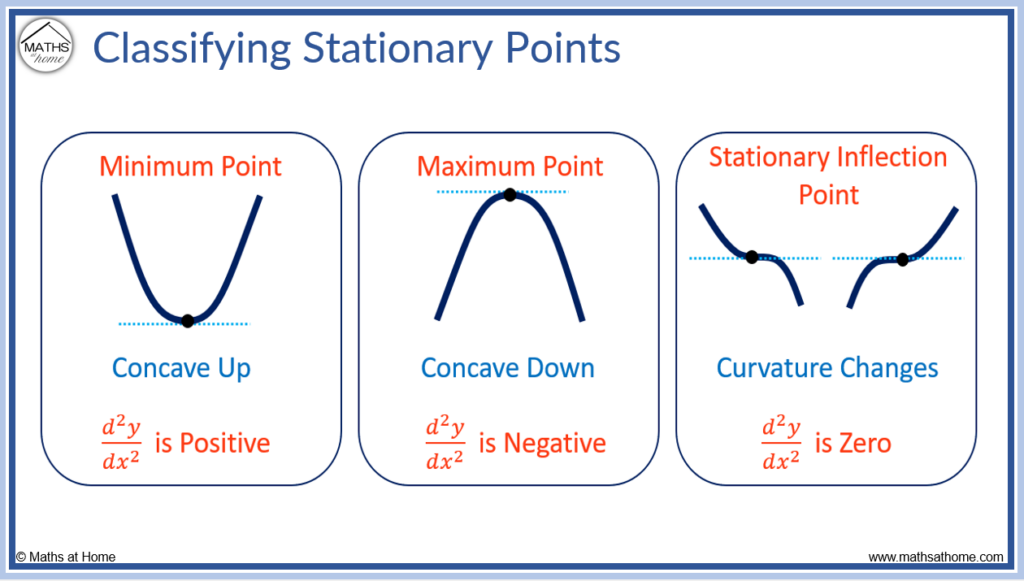
Let's watch a video that explains this test and applies it.
IGCSE Math Differentiation (Part 2) Stationary Points, Maxima & Minima #igcsemath #differentiation
This video from 'IGCSE on fingertips' demonstrates how to use the second derivative test. It's a clear, procedural walkthrough that aligns perfectly with our 5-step strategy.
Watch from 04:11 to 11:42. You can follow the whole example, but pay special attention to these parts: 04:11 - 06:08: The explanation of the second derivative test rules. 09:47 - 11:42: Finding the second derivative and substituting the x-values to determine the nature (maxima or minima) of the points.
3. Consolidation and Practice
Let's solidify this method with a concise written summary and a full worked example. The "second derivative test" is the method you should prioritize for exams as it is generally quicker and less prone to the small arithmetic errors you're working on eliminating.
The following guide from Save My Exams provides a clear written summary of the methods. Focus on the section explaining the second derivative test, as this is your most efficient tool.
Read the sections 'How do I classify turning points using the second derivative?' and the 'Worked Example'. Notice how the worked example uses the second derivative (Method 3) to classify the points at x = -2 and x = 1. This is the exact procedure to follow in an exam.
Now, try a full question yourself, applying the 5-step strategy.
Exam-Style Practice Question
A curve has the equation .
Find the coordinates of the turning points and determine their nature.
Show solution
Step 1: Find
Step 2: Solve
Factorize:
This gives two solutions: and .
Step 3: Find Full Coordinates
- When : . Point is .
- When : . Point is .
Step 4: Find
Differentiate :
Step 5: Classify the Points
- At : . Since this is negative, the point is a maximum.
- At : . Since this is positive, the point is a minimum.
Final Answer: The curve has a maximum point at and a minimum point at .
Conclusion
Excellent work. You have now learned one of the most powerful applications of differentiation. Being able to find and classify turning points is a skill that is tested frequently and carries significant marks.
Key Takeaways:
- Stationary (or turning) points occur where the gradient of the curve is zero, i.e., .
- To find the coordinates, solve for , then substitute these -values back into the original equation to find .
- To determine the nature of a stationary point, use the second derivative test:
- Find .
- Substitute the -coordinate of the stationary point.
- If the result is positive, it's a minimum.
- If the result is negative, it's a maximum.
Preview of the Next Lesson:
We have spent the last few lessons on differentiation—the process of finding a rate of change. Now, we will explore the reverse process: integration. In the next lesson, we will learn how to integrate polynomial functions. This will open the door to another major application of calculus: finding the area under a curve.