Hello! Welcome back to our Calculus module.
In our last lesson, we mastered the core skill of differentiation: finding the gradient function, , for a polynomial. This gave us an equation for the gradient at any point on a curve.
Today, we will apply that skill to a classic and very common type of exam question. We'll focus on a single point on a curve and find the equations of two specific lines related to it: the tangent and the normal. This lesson will also be a great opportunity to reinforce some key concepts from coordinate geometry, a topic you've mentioned can be tricky.
By the end of this 60-minute lesson, you will be able to find the equation of the tangent and the normal to a curve at a specific point.
1. Defining Tangents and Normals
Before we start calculating, let's be clear on what we're trying to find.
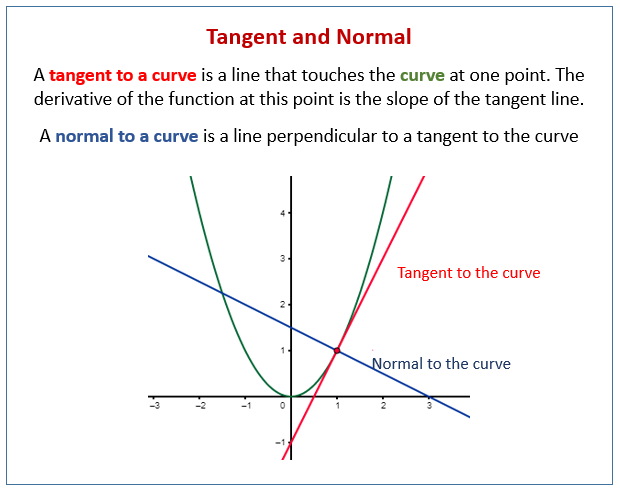
- A tangent is a straight line that just touches a curve at a single point and has the same gradient as the curve at that point.
- A normal is a straight line that passes through the same point but is perpendicular to the tangent.
To find the equation of any straight line, we need two things:
- A point on the line ().
- The gradient of the line ().
Once we have these, we can use the formula: .
2. Finding the Equation of a Tangent
Let's break down the process of finding the tangent's equation into a reliable, repeatable method.
The 3-Step Method for Tangents
Given a curve and a point with x-coordinate :
-
Find the Gradient (m):
- First, differentiate the equation of the curve to find the gradient function, .
- Then, substitute the given -coordinate () into to calculate the numerical gradient of the tangent, .
-
Find the Point ((x₁, y₁)):
- You have the x-coordinate, .
- To find the y-coordinate, , substitute into the original equation of the curve, . Be careful not to use the derivative here!
-
Find the Equation:
- Substitute the gradient and the point into the straight-line equation .
- Rearrange the equation into the form required by the question (usually or ).
Let's watch a video that works through this exact process.
Differentiation - Equation of Tangent and Normal (O Level | IGCSE) Part - 11
This video from 'Mathlete by Saad' demonstrates the 3-step method to find the equation of a tangent for a standard polynomial. Notice how he finds the gradient first, then the y-coordinate, and finally constructs the equation.
Watch the section from 00:00 to 01:27. Follow the example for the curve y = x² + 3x + 2 at x = -2.
Test your understanding!
Find the equation of the tangent to the curve at the point where .
Show answer
-
Find the Gradient:
- Differentiate: .
- Substitute : .
-
Find the Point:
- Substitute into the original equation: .
- The point is .
-
Find the Equation:
- Using :
3. Finding the Equation of a Normal
The process for finding the normal is nearly identical, with one extra but crucial step. Since the normal is perpendicular to the tangent, their gradients are related.
Key Rule for Perpendicular Gradients:
If the tangent has gradient , the normal has a gradient which is the negative reciprocal:
The 4-Step Method for Normals
- Find the Tangent Gradient: Differentiate and substitute the -coordinate to find .
- Find the Normal Gradient: Calculate .
- Find the Point ((x₁, y₁)): Substitute the -coordinate into the original equation to find the -coordinate.
- Find the Equation: Use the point and the normal's gradient, , in the equation .
The following video is an excellent worked example, as it also demonstrates a situation where you are only given the x-coordinate, forcing you to complete Step 3 yourself.
Differentiation (Gradients, Tangents and Normals) Exam Question Solutions
This video from '1st Class Maths' walks through finding the equation of a normal. It clearly shows the negative reciprocal step and the need to find the y-coordinate.
Watch the clip from 11:42 to 13:46. Pay close attention to these key moments: Finding the tangent gradient (1/2). Calculating the normal gradient (-2). Substituting x=1 into the original equation to find y=2. Assembling the final equation.
4. Reading and Practice
Now that you've seen the methods in action, let's consolidate your understanding and put it into practice. The following resource provides a clear, written summary of everything we've covered and is an excellent reference for revision.
Differentiation | CIE IGCSE Additional Maths Revision Notes 2025
This guide from Save My Exams provides a concise summary of the definitions and methods for finding the equations of both tangents and normals. It's a perfect resource to bookmark for your revision.
Read the section titled 'Tangents & Normals' (pages 41-46). Focus on the clear, step-by-step instructions for finding the equation of a tangent and a normal. The worked examples are very similar to what you'll face in an exam.
After reviewing the methods, it's time to apply them. The best way to secure this skill is through practice.
The following resource from Radford Mathematics breaks down the method and provides practice questions with worked solutions, which is ideal for applying the Error-Loop Method.
Read through the page. Then, attempt 'Exercise 1' (for tangents) and 'Exercise 2' (for normals). After attempting each question, check your working against the provided solutions to identify and correct any errors.
Conclusion
Well done. You've now connected your new differentiation skills to a very practical application in coordinate geometry. This type of multi-step problem, combining different areas of maths, is exactly what you need to master for a high grade.
Key Takeaways:
- The equation of a straight line is found using a point and a gradient.
- To find the tangent's gradient, differentiate the curve's equation and substitute the -coordinate.
- To find the normal's gradient, calculate the negative reciprocal of the tangent's gradient ().
- To find the y-coordinate of the point, always substitute the -coordinate into the original equation of the curve.
- The formula is your most direct tool for building the final equation.
Preview of the Next Lesson:
Today we looked at the gradient at a specific point. But what about points where the gradient is special, for example, where it is exactly zero? These are called turning points (maximums or minimums). In the next lesson, we will use differentiation to locate the coordinates of turning points on a curve and determine their nature. This is another major application of calculus and a high-value skill for your exam.