Hello! Welcome to your ninth lesson in the Mathematics Mastery Sprint.
In our last session, we mastered solving simultaneous equations where one was linear and the other non-linear. This reinforced your skills in algebraic substitution and solving quadratics, which are essential for tackling complex problems.
Today, we shift our focus to another key area of algebra: linear inequalities. While the process is very similar to solving linear equations, there is one crucial rule change that you must master. These questions are a staple of both Paper 2 and Paper 4, so getting this right is key to building your score.
Learning Outcome: Solve linear inequalities, including compound inequalities, and represent solution sets on a number line.
The Two Golden Rules of Inequalities
Solving a linear inequality like 2x - 5 ≤ 21 feels almost identical to solving the equation 2x - 5 = 21. You use the same inverse operations (add, subtract, multiply, divide) to isolate the variable. However, there's a critical difference.
Let's establish the two golden rules for solving any linear inequality. The first is familiar, but the second is new and extremely important.
Inequalities - IGCSE Maths Revision Notes
The revision notes from Save My Exams clearly explain the process of solving linear inequalities. We will focus on the section that details the rules.
Read the section titled 'How do I solve linear inequalities?'. This will introduce the two key principles. Pay very close attention to the second rule about multiplying or dividing by a negative number—it is the single most common place to lose marks on these questions.
To summarise:
- Rule 1: Treat it like an equation. Use inverse operations to isolate the variable, just as you would for a standard linear equation.
- Rule 2: Flip the inequality sign if you multiply or divide by a negative number.
Let's see this in action. The first video walks through a standard problem where the variable term is positive, and the second shows what to do when it's negative.
Solving Inequalities & Drawing Solutions on a Number Line | Higher & Foundation | GCSE Maths Tutor
This first clip from The GCSE Maths Tutor solves an inequality with variables on both sides, demonstrating how to collect terms just like in an equation.
Watch from 03:58 to 06:09. Notice how the process of moving terms across the inequality mirrors solving equations.
Now for the crucial second rule. This example from Save My Exams shows what to do when you have a negative coefficient for x.
Inequalities - IGCSE Maths Revision Notes
Now, let's look at a written example that demonstrates the sign-flip rule.
Study the second 'Worked Example' which solves the inequality 5 − 2x ≤ 21. Track the steps carefully and see how they deal with the -2x term by dividing by -2 and flipping the ≤ to ≥.
Visualising Solutions: The Number Line
Once you've solved an inequality, you need to be able to represent your solution on a number line. This is a visual way to show the range of all possible values that satisfy the inequality.
The conventions are simple but strict:
- Use a solid (filled-in) circle for ≤ and ≥. This shows the endpoint is included in the solution.
- Use an open (empty) circle for < and >. This shows the endpoint is not included.
A good way to remember this, as suggested in the next video, is the "extra ink" rule: if the symbol has extra ink (the line underneath), the circle gets extra ink (it's filled in).
Solving Inequalities & Drawing Solutions on a Number Line | Higher & Foundation | GCSE Maths Tutor
This video introduces the concept of representing solutions on a number line and provides the useful 'extra ink' memory aid.
Watch from 02:30 to 03:58. Focus on the explanation of how to draw the circle (open or closed) and the arrow.
Here is a helpful summary image showing different types of inequalities and their number line representations.

Test your understanding!
Solve the inequality 15 - 2x < 7 and represent your solution on a number line.
Show answer
-
Subtract 15 from both sides:
-2x < 7 - 15-2x < -8 -
Divide by -2 and flip the inequality sign:
x > (-8) / (-2)x > 4 -
Number line representation:
You should draw an open circle at 4 with an arrow pointing to the right.
Tackling Compound Inequalities
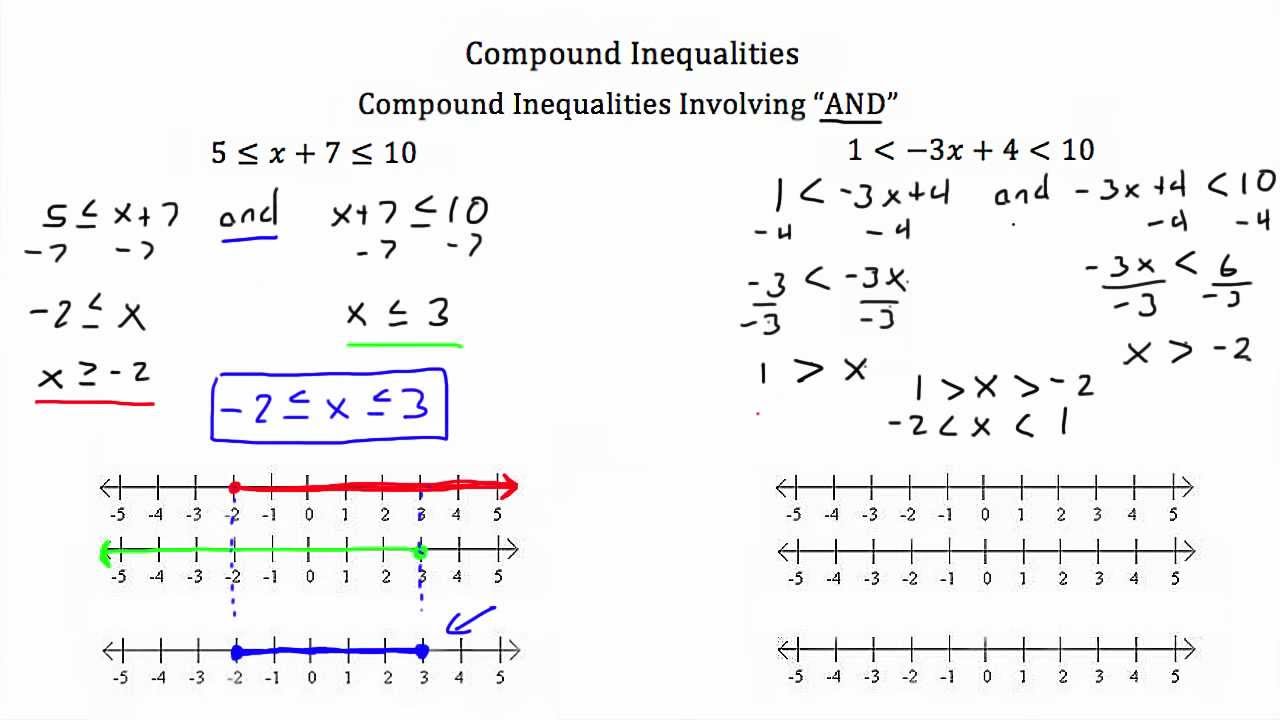
Compound inequalities, sometimes called double inequalities, combine two inequalities into one statement. They define a range of values. For example, -4 ≤ x < 2 means "x is greater than or equal to -4 and x is less than 2".
To solve a compound inequality like -5 ≤ 2x + 3 < 7, you have two reliable methods:
- The 'All-at-Once' Method: Apply the inverse operations to all three parts of the inequality at the same time to isolate
xin the middle. - The 'Split' Method: Break the compound inequality into two separate inequalities (
-5 ≤ 2x + 3and2x + 3 < 7), solve each one individually, and then combine the results.
The 'All-at-Once' method is usually faster if the x term is only in the middle part. Let's see it in action.
Solving Inequalities & Drawing Solutions on a Number Line | Higher & Foundation | GCSE Maths Tutor
This clip clearly demonstrates the 'All-at-Once' method for solving a compound inequality.
Watch from 11:46 to 14:06. Notice how subtracting 3, and then dividing by 2, is applied to the left, middle, and right sides of the inequality simultaneously.
The 'Split' method, shown in the image below, can be a safer approach if the algebra looks more complicated.
Finding Integer Solutions
A very common IGCSE question asks you to find the integer values that satisfy an inequality. Remember, integers are whole numbers (positive, negative, and zero).
- If your solution is
x > 4, the first integer value is 5. - If your solution is
x ≤ 4, the integers are 4, 3, 2, 1, 0, -1, ... - If your solution is
-2 ≤ x < 3, the integers are -2, -1, 0, 1, 2. Notice that 3 is not included.
It's crucial to read the question carefully. Does it ask for "integers", "positive integers", or the "smallest/largest integer"?
All of iGCSE Inequalities with Linear Programming: What You Need To Know
This video from the Ginger Mathematician walks through a typical exam question that requires you to find the integer solutions to a compound inequality.
Watch from 00:13 to 03:35. The presenter first solves the compound inequality and then carefully lists the integer values that fit the solution, explaining why the endpoints are included or excluded.
Practice Using the Error-Loop Method
Now it's time to apply these skills to past paper questions. This is where you can actively use the Error-Loop Method we've discussed: solve, check, and analyze your mistakes. Pay close attention to sign errors and whether you remembered to flip the inequality sign correctly.
The Past Paper Penguin website has a bank of IGCSE questions organised by topic, with separate worked solutions. This is ideal for targeted practice.
Navigate to the webpage. Under the 'Algebra' heading, click on the 'Inequalities' link to download a PDF of past paper questions. Return to the page and scroll down to the 'CIE IGCSE Worked Solutions by Topic' section. Under 'Algebra', click the 'Inequalities' link to download the worked solutions. Attempt several questions from the questions PDF, ideally under timed conditions (aim for about 1 minute per mark). Use the solutions PDF to check your answers and, more importantly, your method. For any incorrect answers, identify exactly where the error occurred.
Conclusion
You've now covered a fundamental topic in IGCSE algebra. Although very similar to solving equations, the single rule about flipping the sign when multiplying or dividing by a negative number is what sets inequalities apart.
Key Takeaways:
- The Golden Rule: Always flip the inequality sign when you multiply or divide by a negative number.
- Number Lines: Use a closed circle (●) for
≤and≥, and an open circle (○) for<and>. - Compound Inequalities: You can solve these by applying operations to all three parts at once or by splitting them into two separate inequalities.
- Read the Question: Pay close attention to keywords like "integer" or "positive integer" when asked to list solutions.
Preview of the Next Lesson:
In the next lesson, we will focus on a skill that is crucial for the more challenging, multi-step problems on Paper 4: translating written information into algebraic equations or expressions to solve multi-step problems. This involves taking a real-world scenario described in words and building the mathematical model needed to solve it.