Hello! Welcome to your eighth lesson in the Mathematics Mastery Sprint.
In our last session, we established two methods—elimination and substitution—for solving systems of linear equations. We also discussed how to choose the most efficient method based on the structure of the equations. This strategic thinking is crucial as we move forward.
Today, we're levelling up to tackle a topic that frequently appears in the higher-tier IGCSE papers: solving simultaneous equations where one is linear and the other is non-linear. This will require us to combine the substitution method with your knowledge of solving quadratics from Module 3. Mastering this process is a key step toward securing a top grade.
Learning Outcome: Formulate and solve simultaneous equations where one is linear and one is non-linear.
From Lines to Curves: A Visual Understanding
In the previous lesson, we saw that solving two linear equations meant finding the single point where two straight lines intersect. But what happens when one of those lines is replaced with a curve (like a parabola from a quadratic equation, or a circle)?
Let's start by visualizing the problem. This will help you understand why you often get more than one solution.
Non-Linear Simultaneous Equations - GCSE Higher Maths
This short clip from the video 'Non-Linear Simultaneous Equations' by 1st Class Maths provides an excellent graphical overview. It shows how a line can intersect a curve in two points, one point, or not at all.
Watch from 00:35 to 02:01. Focus on the graphical representations. Notice how solving these equations is equivalent to finding the coordinates of the intersection points.
As you saw, a line and a curve can intersect at:
- Two points: This gives you two pairs of (x, y) solutions. This is the most common case in exams.
- One point: This happens when the line is a tangent to the curve. You'll get one pair of (x, y) solutions.
- No points: The line and curve don't cross, meaning there are no real solutions.
The Universal Method: Substitution
While we had two methods for linear systems, for a linear/non-linear system, substitution is the standard and most reliable method. The elimination method is generally not suitable here.
The core strategy is always the same:
- Rearrange the linear equation to make one variable the subject (e.g.,
y = ...orx = ...). - Substitute this expression into the non-linear equation. This eliminates one variable, leaving you with a single equation (usually a quadratic).
- Solve the resulting quadratic equation to find the values of one variable.
- Substitute these values back into the rearranged linear equation to find the corresponding values of the other variable.
- Pair up your solutions clearly (e.g.,
x = 1, y = 4andx = -3, y = 0).
Let's walk through this process with a clear, written example.
Simultaneous Equations Worksheets | Questions and ...
This guide from MME Revise provides a concise, step-by-step breakdown of the substitution method for non-linear systems.
Read the section titled 'Type 2: Non-linear Simultaneous Equations'. Follow the 4-step example where they solve x² + 2y = 9 and y - x = 3. Pay close attention to how they rearrange the linear equation first, and then substitute it into the quadratic.
Now, let's see a complete worked example on video.
Solving Simultaneous equations involving one linear & one quadratic equation#IGCSE#Sheyas Pure Math
This video from Sheyas Pure Math provides a full walkthrough of a typical IGCSE-style question. Notice the careful algebraic steps involved.
Watch from 02:25 to 07:31. The video demonstrates the core process: substituting the linear equation into the quadratic, expanding the brackets, forming a quadratic equation in 'y', solving it, and then finding the corresponding 'x' values.
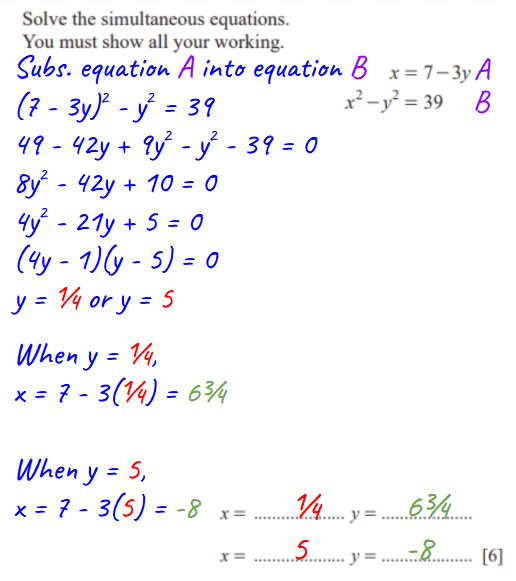
To reinforce this, here is an image showing a complete, neatly laid out solution. This is how you should aim to structure your own work in an exam to ensure you get all the method marks.
Advanced Cases and Strategic Choices
The method remains the same, but the algebra can get more complex. It's important to be methodical to avoid the small arithmetic errors you've mentioned.
Case 1: The Equation Contains y² (or x²)
Sometimes, the non-linear equation involves a squared term like y². When you substitute y = (ax + b), you will need to expand (ax + b)² carefully. Remember that (ax + b)² = (ax + b)(ax + b). Rushing this step is a common source of errors.
Non-Linear Simultaneous Equations - GCSE Higher Maths
Let's return to the 1st Class Maths video to see how to handle this. This example involves a circle equation, x² + y² = 50.
Watch from 07:24 to 11:05. Focus on the expansion of the bracket (2x - 15)². This is a critical step where precision is key. Notice how they simplify the resulting quadratic by dividing by a common factor (5) before solving.
Case 2: Choosing the Path of Least Resistance
You've identified that choosing the "hardest method" can be an issue. When solving non-linear simultaneous equations, this comes down to which variable you choose to isolate in the linear equation.
Rule of thumb: Always aim to isolate the variable with a coefficient of 1 or -1. This will help you avoid working with fractions, which slows you down and increases the chance of error.
Test your understanding!
Consider the system:
x - 2y = 1x² + 3y² = 28
Which variable (x or y) would you make the subject in the linear equation, and why? What would the rearranged equation be?
Show answer
You should make x the subject.
Reason: The coefficient of x is 1. Rearranging for x gives a simple expression: x = 1 + 2y.
If you tried to make y the subject, you would get y = (x - 1)/2. Substituting this would involve fractions, which is much more difficult to work with.
The next video clip demonstrates exactly this strategic choice.
Non-Linear Simultaneous Equations - GCSE Higher Maths
This final clip from 1st Class Maths shows a situation where it's much easier to make 'x' the subject of the linear equation, leading to a quadratic in 'y'.
Watch from 11:05 to 14:59. Pay attention to the reasoning at the start for rearranging to x = ... instead of y = .... Also, note the final step: when writing the answer as coordinates, be careful to put the x and y values in the correct order!
Time for Practice
The best way to master this is through practice. Applying the "Error-Loop Method" here means attempting problems, checking against the mark scheme, and identifying exactly where any errors occurred—was it in the bracket expansion, solving the quadratic, or the final substitution?
Let's start with one problem now.
Problem:
Solve this pair of simultaneous equations algebraically. (From the '6 Simultaneous equations' resource, LINK)x² + y² = 13y = x - 5
Show your steps and check your answer
-
Substitute
y = x - 5into the first equation:x² + (x - 5)² = 13 -
Expand the brackets:
x² + (x² - 10x + 25) = 13 -
Simplify to form a standard quadratic equation:
2x² - 10x + 25 = 132x² - 10x + 12 = 0x² - 5x + 6 = 0(dividing by 2 makes it easier) -
Solve the quadratic:
(x - 2)(x - 3) = 0
So,x = 2orx = 3. -
Find the corresponding
yvalues using the linear equationy = x - 5:- When
x = 2,y = 2 - 5 = -3 - When
x = 3,y = 3 - 5 = -2
- When
-
State the solution pairs:
The solutions arex = 2, y = -3andx = 3, y = -2.
For more practice, the following resource provides IGCSE-style questions and, crucially, the mark schemes.
Simultaneous Equations Worksheets | Questions and ...
This MME Revise page contains downloadable worksheets with exam-style questions. This is perfect for your practice-focused approach.
Scroll down to the 'Simultaneous Equations Worksheet and Example Questions' section. Find the link labelled '(NEW) Simultaneous Equations (Non-linear) Exam Style Questions - MME'. Download both the 'Exam Questions' and the 'Mark Scheme'. Attempt these questions under timed conditions to simulate an exam environment.
Conclusion
You have now extended your skills from linear systems to mixed linear/non-linear systems. This is a significant step and a topic that separates students aiming for the highest grades. The algebraic process is more demanding, but the strategy is straightforward and consistent.
Key Takeaways:
- Substitution is Key: This is the go-to method for solving a system with one linear and one non-linear equation.
- The Process: Rearrange the linear, substitute into the non-linear, solve the resulting quadratic, and substitute back into the linear to find the corresponding values.
- Be Strategic: Avoid fractions by choosing to rearrange for the variable with a coefficient of 1 or -1 in the linear equation.
- Precision Matters: Be extremely careful when expanding squared brackets and solving the quadratic. This is where most marks are lost.
- Two Solutions: Expect two pairs of solutions, representing the two points of intersection between the line and the curve.
Preview of the Next Lesson:
We will move on to the next topic in our algebra module: solving linear inequalities. You will learn how to manipulate inequalities (which has one crucial difference from solving equations) and how to represent the solution sets on a number line.