Hello! Welcome to your tenth lesson in the Mathematics Mastery Sprint.
In the last lesson, we focused on solving linear inequalities. You learned the crucial rule about flipping the inequality sign when multiplying or dividing by a negative number, and how to represent solutions on a number line. This honed your skills in isolating variables, which is a perfect foundation for today's topic.
Today, we're tackling one of the most important skills for the IGCSE Paper 4: translating written information into algebraic equations. These "word problems" often form the basis of high-mark questions that require you to build a mathematical model from a real-world or geometric scenario. Mastering this will directly help you with your identified weaknesses in "show that" questions and multi-step problem-solving.
Learning Outcome: Translate written information into algebraic equations or expressions to solve multi-step problems.
The Core Skill: From English to Maths
At its heart, solving a word problem is a translation exercise. You need to decode the English sentences and convert them into the precise language of algebra. The first step is to recognize the mathematical meaning of common words and phrases.
The revision note from Save My Exams provides a clear and concise table of common phrases and their algebraic equivalents. It's a great starting point for our translation 'dictionary'.
Read the section 'How do I form expressions from words?'. Pay attention to the table and the list of common words for addition, subtraction, multiplication, and division. These are your essential keywords.
Let's summarise those keywords:
| Operation | Keywords | Example | Translation |
|---|---|---|---|
| Addition (+) | sum, total, more than, increase | A number x increased by 5 | |
| Subtraction (-) | difference, less than, decrease | 7 less than a number x | |
| Multiplication (×) | product, times, lots of, double | Double a number x | |
| Division (÷) | shared, split, grouped, halved | A number x shared by 4 | |
| Equals (=) | is, gives, results in, is equal to | A number x plus 2 is 10 |
It's particularly important to be careful with subtraction. "5 less than x" is , not . This is a frequent source of errors.
The following video introduces the same concepts and works through some basic examples, which will help solidify your understanding.
IGCSE/O LEVEL Maths - Algebra Word Problems (Concept and Past Papers)
This video from Mathlete by Saad reinforces the idea of translating from English to Maths and highlights the correct way to handle phrases like 'more than' and 'less than'.
Watch from 07:00 to 15:30. The instructor provides a 'key' for word problems and demonstrates how to translate simple sentences into algebraic expressions, paying special attention to the order of terms in subtraction.
A Systematic Approach to Problem Solving
To avoid getting lost in the details of a word problem, it helps to follow a structured process:
- Read and Understand: Read the entire problem first to understand the scenario. Don't start writing algebra immediately.
- Define Your Variable: Identify the main unknown quantity and assign it a variable, usually . Write down what represents, e.g., "Let be the width of the rectangle in cm."
- Translate into Expressions: Go through the problem statement again, line by line. Translate the relationships into algebraic expressions involving your variable .
- Find the 'Equals' Sign: Look for the piece of information that connects all the parts. This is often a given total (e.g., total area, total time, total cost) or a statement that two expressions are equal to each other. This allows you to form the final equation.
- Form and Solve: Write down the complete equation and solve it using the algebraic methods you've already learned.
- Check and Interpret: Does your answer make sense in the context of the problem? (e.g., a length can't be negative). Make sure you've answered the specific question asked.
Let's see this process applied to a classic perimeter problem.
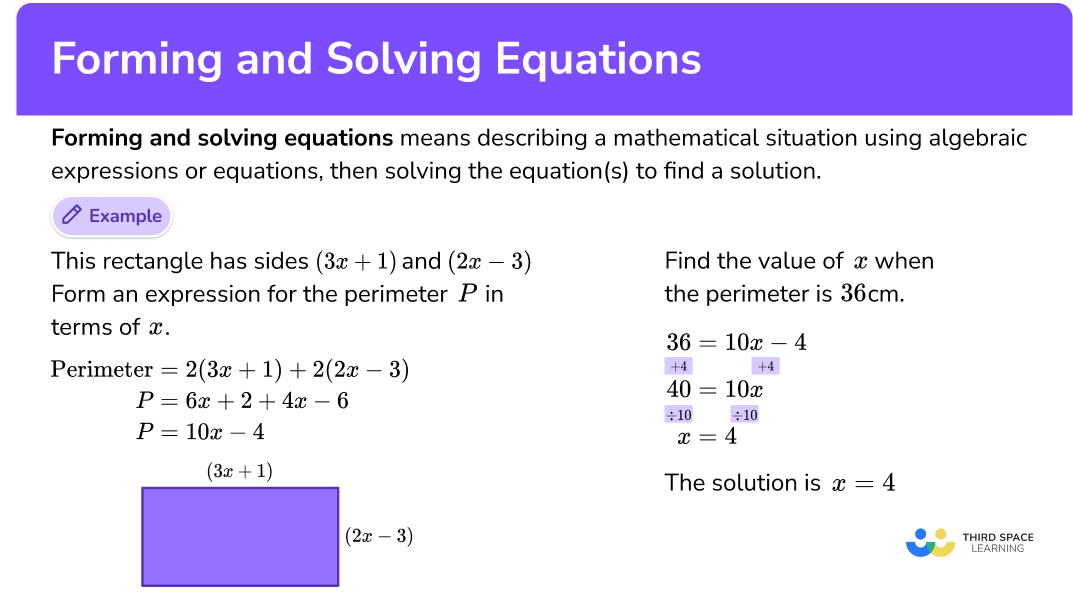
Common Scenarios in IGCSE Questions
Word problems in your exam will often fall into a few common categories. Let's look at how to tackle them.
1. Geometry: Area and Volume
These questions provide a shape with dimensions given as algebraic expressions. You'll typically use a formula (e.g., Area of a triangle = ) to form your equation.
Many of these are "show that" questions. This means you must construct the equation and manipulate it into the exact form given in the question. This is excellent practice for your logical reasoning skills.
IGCSE/O LEVEL Maths - Algebra Word Problems (Concept and Past Papers)
Watch this example involving the area of a triangle. Notice how the formula for the area is used to connect the algebraic expressions for the base and height, leading to a quadratic equation.
Watch from 19:38 to 22:42. Observe the steps: substitute the expressions into the area formula, set it equal to the given area (50), and rearrange to get a quadratic equation.
Test your understanding!
A rectangle has a length of cm and a width of cm. The area of the rectangle is 60 cm².
Form an equation in terms of and show that it simplifies to .
Show answer
-
Form the equation for the area:
Area = length × width -
Expand the brackets:
-
Simplify and set to zero:
This matches the required form.
2. Speed, Distance, and Time
These problems are very common and rely on the relationships:
- Speed = Distance / Time
- Distance = Speed × Time
- Time = Distance / Speed
Usually, you'll form expressions for the time taken for different parts of a journey and relate them using a given total time. This often leads to equations with algebraic fractions.
IGCSE/O LEVEL Maths - Algebra Word Problems (Concept and Past Papers)
This next clip solves a complex speed, distance, and time problem. It's a perfect example of a multi-step Paper 4 question that combines several algebraic skills.
Watch from 49:03 to 56:28. Follow the logic carefully: Identify the two parts of the journey (running and cycling). Form an expression for the time of each part using Time = Distance / Speed. Add these expressions together and equate them to the total time. Observe how this creates an equation with algebraic fractions, which is then simplified to the required quadratic 'show that' format.
3. Cost and Quantity
These problems might involve the cost of items, the number of items bought for a certain amount of money, or wages. A key relationship is:
- Number of items = Total Money Spent / Cost per item
Let's see an example.
IGCSE/O LEVEL Maths - Algebra Word Problems (Concept and Past Papers)
This final example is about two people buying books at different prices. It shows how to form expressions for the number of books each person buys.
Watch from 01:08:27 to 01:12:11. The key here is translating 'Gia buys four more books than Myra' into an equation that connects the two expressions you formed: (Number of Gia's books) = (Number of Myra's books) + 4.
An Important Exam Strategy
Remember that "show that" questions are designed to help you. If you struggle with part (a) where you have to form the equation, you can still use the equation they gave you to solve part (b) and earn follow-through marks. Don't give up on a question just because the first part is difficult!
Conclusion
You've now seen how to break down word problems and convert them into the language of algebra. This is less about learning new maths and more about applying your existing algebraic skills in a structured way.
Key Takeaways:
- Systematic Approach: Always follow the process: Define the variable, translate phrases into expressions, find the connection to form the equation, and then solve.
- Keyword Recognition: Be fluent in translating words like 'sum', 'difference', 'product', and 'is' into mathematical operations.
- Context is King: Most word problems are set in a context (geometry, speed/time, etc.). Use the relevant formulas (area,
T=D/S) to build your equations. - "Show That" Questions: These require you to be precise with your algebraic manipulation. Every step of your working must be clear and logical to earn full marks.
Preview of the Next Lesson:
We've spent this lesson forming equations for "show that" questions. In the next lesson, we will focus specifically on the algebraic manipulation itself: Construct a logical algebraic argument to transform an expression into a required 'show that' format. This will refine your ability to present clear, step-by-step proofs, a skill that is essential for top grades.