Hello! In our last lesson, we connected the dots between your marketing channels and the stages of the customer journey, giving you a strategic blueprint. But strategy is only half the battle. How do you know if your ads are actually working? How do you measure success and failure?
Today, we'll answer those questions by diving into the essential numbers of digital marketing. You'll learn how to measure the performance of your marketing efforts at every stage of the funnel. This lesson is crucial because understanding these metrics is the difference between spending money and investing money.
Your goal for this lesson is to be able to explain the key digital marketing metrics—impressions, clicks, CTR, conversion rate, CPA, and ROAS—using examples relevant to your future fitness equipment store.
The Language of Marketing Performance
In digital marketing, numbers tell a story. They tell you if your ads are catching people's attention, if your website is persuasive, and most importantly, if you're making a profit. Each metric gives you a different piece of the puzzle.
This image provides a great overview of how we can categorize the metrics we'll be discussing today. We'll look at the performance of your campaigns (how you attract people), your website (what happens when they arrive), and your conversions (whether they buy).
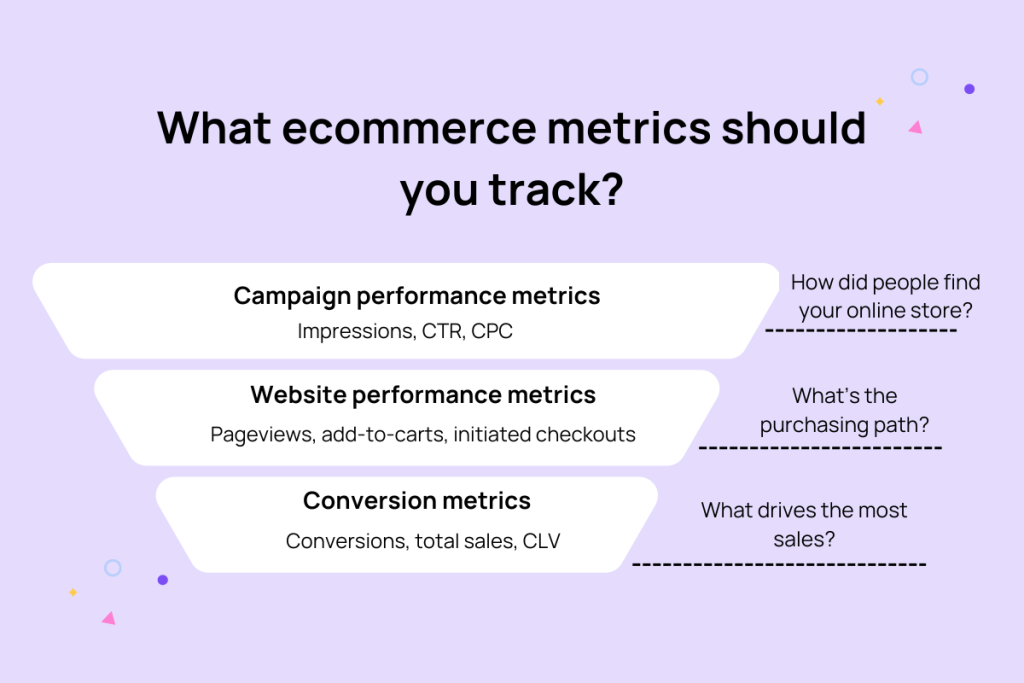
To start, let's get a complete walkthrough of how these numbers fit together in a real campaign, from the initial budget all the way to the final profit.
Marketing Analytics 101 (A Beginner’s Guide To Marketing Metrics)
The video "Marketing Analytics 101" by Adam Erhart provides an excellent, step-by-step example of a marketing campaign. It walks through all the key metrics we're about to cover, showing how they connect to each other.
Please watch the main example in the video, starting from where the budget is set to the final calculation of ROI. This will give you a fantastic foundation for the rest of the lesson. Pay close attention to how each metric is calculated from the previous one. Watch from the main example.
Now that you've seen how the metrics flow together in a campaign, let's break them down one by one so you can master each concept.
Top of the Funnel: Measuring Awareness and Interest
At the top of the marketing funnel, your goal is to get your fitness equipment in front of the right people. Are your ads being seen? And are they compelling enough for people to click?
- Impressions: An impression is a single instance of your ad being shown on a screen. If your ad is displayed 10,000 times, that's 10,000 impressions. It doesn't mean it was clicked, just that it appeared.
- Clicks: This is straightforward—it's the number of times people clicked on your ad. A click means someone was interested enough to visit your website.
- Click-Through Rate (CTR): This is the percentage of impressions that resulted in a click. It's a primary indicator of how relevant and appealing your ad is to your target audience. A high CTR suggests your ad creative and targeting are effective. The formula is:
- Cost Per Click (CPC): This is the amount you pay for a single click on your ad. You want this to be as low as possible while still reaching a quality audience. The formula is:
Example for your store: You run a Facebook ad for your "Adjustable Dumbbells." You spend $100.
- It gets 10,000 impressions.
- It receives 150 clicks.
- Your CTR is .
- Your CPC is .
To solidify these concepts, let's consult two of our excellent written resources.
This guide from the Triple Whale Help Center provides clear, concise definitions for the metrics we're discussing.
Please read the definitions for Click-Through Rate (CTR) and Cost per Click (CPC).
How to Read a Report: CTR vs CR vs CPA (with Examples)
This article from Reacheffect provides practical benchmarks, so you can start to get a feel for what constitutes a "good" or "bad" number.
Scroll down to the table under the heading "What Good vs. Bad Looks Like" to see average CTRs for different types of ads, like Search Ads and Display Ads.
Middle to Bottom of the Funnel: Measuring Action
Once a potential customer clicks your ad and lands on your site, the game changes. Now, the question is: will they take the action you want them to take? For an e-commerce store, the ultimate action is a purchase.
- Conversion: A conversion is any desired action a user takes. For your dropshipping business, the most important conversion will be a purchase. Other conversions could be signing up for your email list or adding a product to the cart.
- Conversion Rate (CR or CVR): This is the percentage of visitors (or clicks) that result in a conversion. This metric is a key indicator of your website's effectiveness. A low conversion rate might mean your product page isn't convincing, your price is too high, or your checkout process is confusing. The formula is:
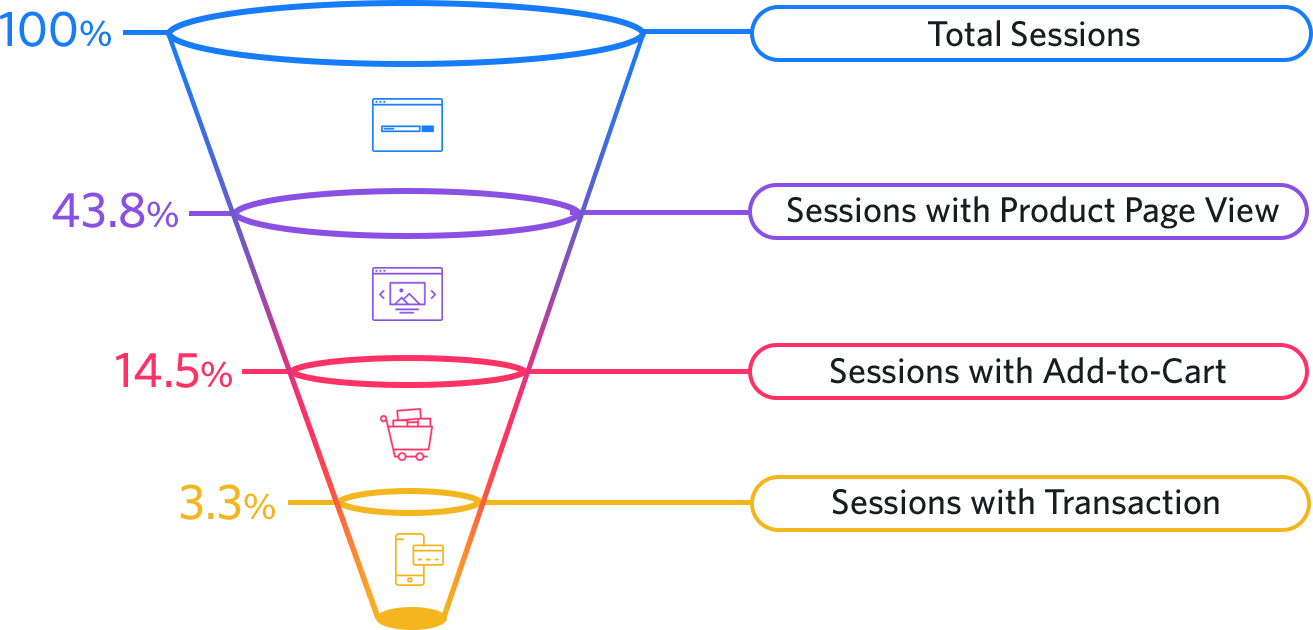
The image below illustrates this perfectly. Out of all the sessions (visits) to a store, only a fraction move to the next step, and an even smaller fraction complete a transaction. Your conversion rate measures the efficiency of this funnel.
- Cost Per Acquisition (CPA): Also called Cost Per Action. This is the total cost you paid to acquire one paying customer. This is one of the most important metrics for determining profitability. If your CPA to get a customer is higher than the profit you make from their order, you are losing money. The formula is:
Continuing our example:
- From the 150 clicks, you get 3 sales (conversions).
- Your Conversion Rate is .
- Your CPA is . This means you paid $33.33 in advertising for each customer you acquired.
Let's turn back to our reference articles for formal definitions and benchmarks.
Let's get the formal definitions for these bottom-of-funnel metrics.
In the Triple Whale guide, please read the sections explaining Conversion Rate (CVR) and Cost per Acquisition (CPA).
How to Read a Report: CTR vs CR vs CPA (with Examples)
Now, let's look at some industry benchmarks for conversion rates.
In the Reacheffect article, find the table under "Industry Conversion Rate Benchmarks" and look at the numbers for e-commerce. This will give you a realistic starting point for what to expect.
The Ultimate Metric: Measuring Profitability
You can have a great CTR and a decent CR, but if the campaign isn't profitable, it's not sustainable. This is where the most important e-commerce advertising metric comes in.
- Return on Ad Spend (ROAS): This metric tells you how much revenue you generated for every dollar you spent on advertising. It is the clearest indicator of whether your ad campaigns are making you money. The formula is: A ROAS of 1 means you broke even. A ROAS of 4 means you generated $4 in revenue for every $1 you spent on ads.
It's important not to confuse ROAS with Return on Investment (ROI). ROAS only considers ad spend, while ROI considers all business costs (ad spend, cost of goods, shipping, etc.). For a dropshipping business, knowing your ROAS is essential to ensure your ad spend is profitable after accounting for the cost of the products you sell.
This short video explains the concept of ROAS and the distinction from ROI very clearly.
What is ROAS? Advertising and Marketing ROAS Explained for Beginners
This video from Surfside PPC is focused entirely on ROAS. It's perfect for understanding this crucial metric.
Watch the sections that define ROAS and its formula, provide an example, and explain the difference between ROAS and ROI. Watch from the beginning until the host discusses what a "good" ROAS is (the explanation).
Tying It All Together: An E-commerce Campaign Example
Let's see how all these metrics work together in a realistic scenario for an e-commerce store. The following reading provides a complete breakdown, from ad spend to ROAS, and interprets what the numbers mean.
How to Read a Report: CTR vs CR vs CPA (with Examples)
This example will help you see how to analyze a campaign from start to finish using the metrics we've learned.
Please find the section titled "How These Metrics Work Together: A Real Campaign Breakdown" and read through the full example. Pay attention to how each metric is calculated and what story the final numbers tell about the campaign's performance.
As you can see from that example, a single set of data allows you to calculate CTR, CR, CPC, CPA, and ROAS. Analyzing them together gives you a complete picture and helps you decide what to do next—for instance, work on improving your conversion rate to make the campaign more profitable.
Conclusion
Congratulations, you've just learned the fundamental language of marketing analytics! These metrics are not just abstract numbers; they are vital signs for your business. They will empower you to make data-driven decisions, optimize your campaigns, and systematically grow your fitness equipment store.
Here are your key takeaways:
- Impressions, Clicks, and CTR measure the reach and relevance of your ads (Top of Funnel).
- Conversions and Conversion Rate (CR) measure the effectiveness of your website and product pages (Middle/Bottom of Funnel).
- Cost Per Click (CPC) and Cost Per Acquisition (CPA) measure the cost-efficiency of your campaigns.
- Return on Ad Spend (ROAS) is the ultimate measure of profitability for your advertising efforts.
This lesson concludes our first module on the foundations of e-commerce marketing. You now understand what digital marketing is, what the main channels are, how the marketing funnel works, and how to measure success.
In our next lesson, we will begin a new module, "Defining Your Customer and Market." We'll start by creating a buyer persona for your ideal customer. This is the perfect next step, as a deep understanding of your customer is the key to improving every single metric we discussed today.