Introduction
In our last lesson, we focused on a powerful physical stimulus for growth: the dead hang. By challenging your grip and shoulders, you create the reason for your muscles to adapt and become stronger. Now, we turn to the other side of that equation: the fuel. To repair and build muscle tissue after training, your body requires specific raw materials. This is where nutrition, and specifically protein, becomes critical.
This lesson will guide you through the process of determining your personal daily protein intake. Your goal is to determine a target daily protein intake appropriate for muscle growth. We will move past the generalized health recommendations you might have heard and into the specific, evidence-based targets used to optimize the results of strength training. Since nutrition is new territory for you, we will break this down into a clear, calculated approach, grounded in the scientific literature.
The Three Pillars of Muscle Growth
To build muscle, three elements must be in place: a training stimulus, adequate nutrition, and sufficient recovery. An infographic from Bar Brothers Groningen frames this nicely.
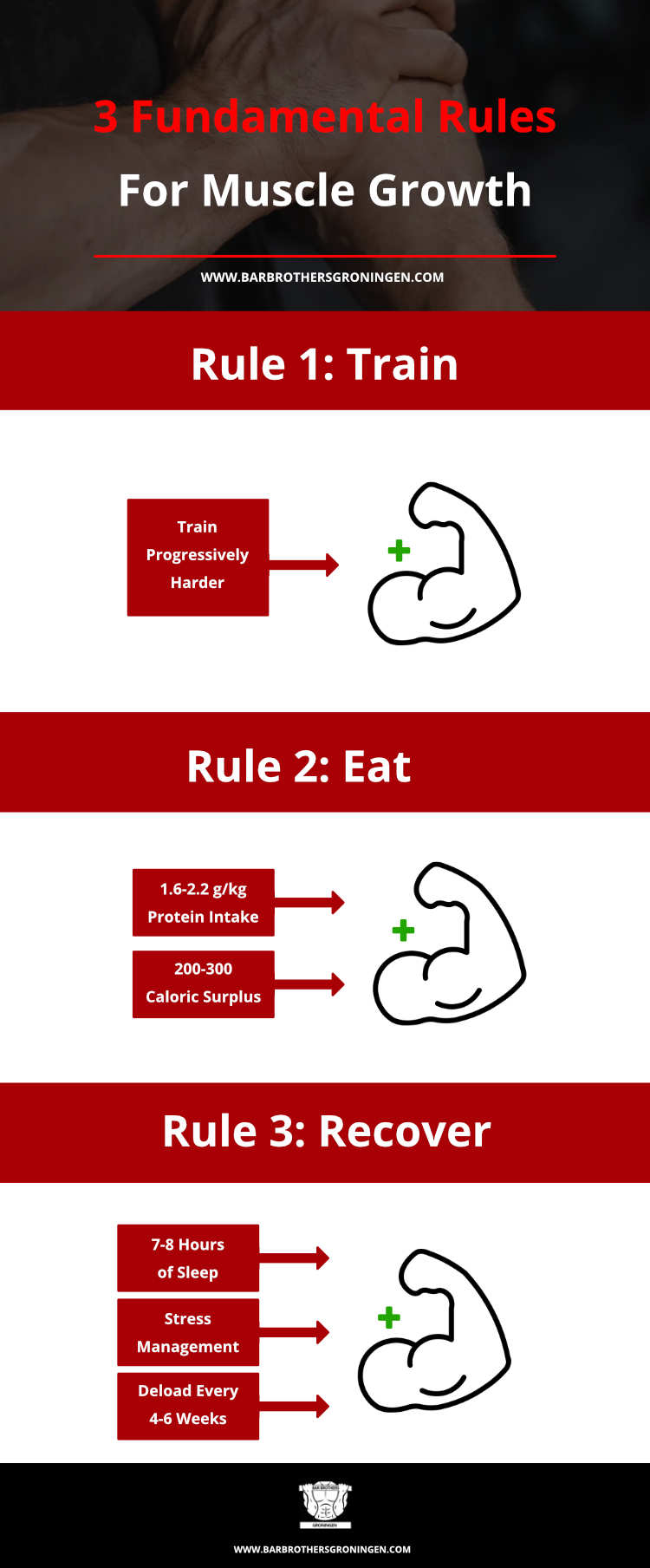
As a chemical engineering student, you can think of muscle growth (hypertrophy) as a complex reaction. The training you do is the catalyst—it initiates the process. Protein provides the essential reactants—the amino acids—that are assembled into new muscle tissue. Without enough of these reactants, the reaction rate (i.e., muscle growth) is limited, no matter how potent the catalyst.
From Survival to Optimization: Why Standard Guidelines Aren't Enough
You may have heard of the Recommended Dietary Allowance (RDA) for protein. However, it's crucial to understand what this number represents. The RDA is the minimum intake required to prevent deficiency in a sedentary person, not the optimal intake for an individual actively trying to build muscle.
To understand this distinction better, the following video provides a clear and concise explanation.
The Smartest Way To Use Protein To Build Muscle (Science Explained)
In this clip from his video "The Smartest Way To Use Protein To Build Muscle," Jeff Nippard debunks the general health recommendations for protein and explains why athletes and lifters have higher requirements.
Please watch from the beginning of the explanation. Notice the difference between the WHO's recommendation of 0.8 g/kg and the needs of someone engaged in weight training.
As you can see, the RDA is analogous to a safety factor designed to prevent system failure, not the operating parameter for peak performance. For our purposes, we need a target that actively supports the process of muscle protein synthesis (MPS), which is the building of new muscle.
Determining Your Optimal Protein Intake
The scientific consensus for active individuals looking to maximize muscle gain points to a specific range. To dig into the evidence, we'll turn to a detailed guide from Examine.com, a trusted source for independent nutrition research.
Optimal Protein Intake Guide & Calculator
This guide provides a thorough, evidence-based look at protein requirements. It's an excellent resource for understanding the science behind the numbers.
Please read the section titled "Optimal daily protein intake for muscle gain". Pay close attention to the primary recommended range of 1.6–2.2 g/kg/d and the graph showing that benefits diminish beyond this point.
The key takeaway is this:
The optimal daily protein intake for maximizing muscle gain is between 1.6 and 2.2 grams of protein per kilogram of body weight (g/kg).
This range is where the dose-response curve for muscle growth begins to flatten, meaning more protein beyond this point yields little to no additional benefit for building muscle.
Tailoring the Target to Your Goal
While the 1.6–2.2 g/kg range is the general standard for muscle gain, it can be refined based on your current caloric intake—whether you're eating at a surplus (bulking), a deficit (cutting), or at maintenance (recomposition). The following video breaks this down perfectly.
The Smartest Way To Use Protein To Build Muscle (Science Explained)
Jeff Nippard returns to provide specific protein ranges for different phases of training. This will help you select the most appropriate target for your current situation.
Watch the segment covering bulking, cutting, and recomp. Then, continue watching the next short segment on a simpler method for higher body fat.
Based on the video and the scientific literature, here are the recommended ranges:
- Muscle Gain (Bulking/Recomposition): Your body is well-fed and at a low risk of breaking down muscle for energy.
- Target: 1.6 - 2.2 g/kg of body weight per day.
- Fat Loss (Cutting): You are in a calorie deficit, making your body more likely to break down muscle tissue for fuel. A higher protein intake helps prevent this muscle loss (it's "muscle-sparing").
- Target: 1.8 - 2.7 g/kg of body weight per day.
Since your primary goal is to build a foundation of strength through calisthenics, you are effectively in a recomposition phase. Therefore, the 1.6 - 2.2 g/kg range is your ideal starting point.
Your Personal Calculation
Let's put this into practice.
- Determine your body weight in kilograms. If you know your weight in pounds, divide it by 2.2.
- Example: 165 lbs / 2.2 = 75 kg
- Calculate your target range. Multiply your weight in kg by the lower and upper ends of the recomp range.
- Lower end: 75 kg × 1.6 g/kg = 120 g
- Upper end: 75 kg × 2.2 g/kg = 165 g
Your daily protein target would be 120 - 165 grams per day. You don't need to hit an exact number; aiming for anywhere within this range will ensure you are providing ample resources for muscle growth. The well-known "1 gram per pound of body weight" rule is a simple heuristic that, for most people, falls conveniently within this scientifically-validated range.
A Note for Higher Body Fat Percentages
If you have a significantly higher body fat percentage, calculating protein based on total weight can overestimate your needs, since fat tissue is less metabolically active and doesn't require as much protein for maintenance. In such cases, the simpler method suggested by Eric Helms and mentioned in the video is very effective: aim for 1 gram of protein per centimeter of your height.
Prioritizing What Matters Most
While topics like protein timing, protein quality (leucine content), and absorption rates are interesting, they are secondary optimizations. As both Jeff Nippard and Jeremy Ethier emphasize, one factor is responsible for over 90% of your results.
The Smartest Way To Use Protein To Build Muscle (Science Explained)
This final clip from Jeff Nippard's video reinforces the most important principle of protein intake for muscle growth.
Watch this concluding statement from the summary.
The hierarchy is clear: Total daily protein intake is, by far, the most important variable. Hitting your target range each day is the number one priority. Spreading that intake over 3-5 meals is likely beneficial for keeping muscle protein synthesis elevated throughout the day, but it's a far less critical detail. Don't let perfect be the enemy of good.
Conclusion
You now have a clear, evidence-based method for determining your daily protein target. This moves you from guesswork to a calculated strategy, ensuring that the hard work you put into your training is supported by the right nutritional foundation.
Key Takeaways:
- The standard RDA for protein (0.8 g/kg) is a minimum for preventing deficiency, not a target for optimizing muscle growth.
- For muscle gain and body recomposition, the optimal range is 1.6 to 2.2 grams of protein per kilogram of body weight per day.
- Calculate your personal range by multiplying your weight in kg by 1.6 (for the low end) and 2.2 (for the high end).
- Hitting your total daily protein goal is the most critical factor. Other variables like timing and per-meal amounts are secondary optimizations.
In our next training lesson, we will put the strength you've been building to use by learning to perform rows and reverse flyes using your chest expander, targeting key muscles in your upper back for improved posture and pulling strength. Following that, we'll dive back into our lifestyle module to help you identify the personal triggers and patterns that lead to your extended distraction episodes.