Introduction
Welcome to our next lifestyle lesson. In our previous session, we established a scientific method for calculating your daily protein needs to fuel muscle growth. We're now going to pivot from the physical to the psychological, tackling a challenge you've identified as significant: distraction. Your goal for this lesson is to identify the personal triggers and patterns that lead to your extended distraction episodes.
This isn't about blaming technology or demanding more willpower. Instead, we'll approach this like a systems analysis problem. You've mentioned losing hours or even days to distractions, and this lesson will equip you with the diagnostic tools to understand why that happens. We will build on our earlier discussion of the dopamine reward cycle by mapping the full, automated process that drives these habits. Our objective is not to "fix" the problem today, but to gather the necessary data by becoming a curious observer of your own mind.
The True Source of Distraction
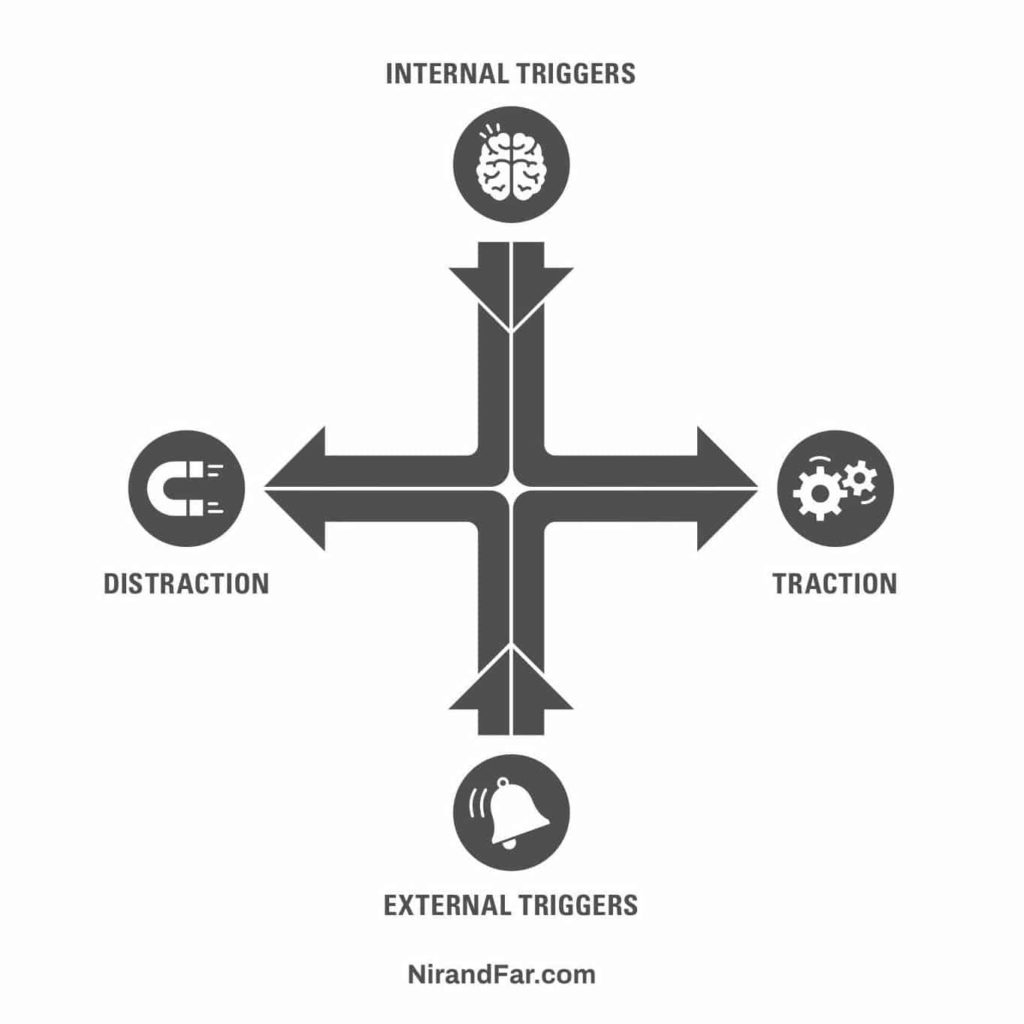
It's common to blame our phones, social media feeds, or the internet at large for our distraction. While these are certainly powerful tools, they are often just the outlet, not the root cause. The impulse to get distracted usually begins not from an external notification, but from an internal feeling.
Nir Eyal, an expert on the intersection of psychology and technology, argues that most distraction is a flight from uncomfortable emotional states: boredom, loneliness, fatigue, uncertainty, or anxiety. Instead of facing these feelings, we seek a quick escape—a scroll through a feed, a new video, or any other digital pacifier.
This diagram from Eyal's work illustrates the fundamental choice we face when a trigger appears.
To grasp this concept more deeply, let's hear directly from Eyal.
Five ways to stop getting distracted | BBC Ideas
This short clip from BBC Ideas features Nir Eyal explaining the critical role of internal triggers as the primary source of distraction.
Please watch from the start of the explanation. Note the examples he gives: checking Facebook when lonely or Google when uncertain. Think about which of these internal states might resonate with you.
The realization that you are the one distracting yourself—not the technology—is a crucial first step. It shifts the locus of control from an external force back to you, which is empowering.
The Habit Loop: Your Brain's Autopilot
So, if an internal trigger is the spark, what is the engine that turns that spark into hours of lost time? The answer lies in a neurological process called the habit loop. As a chemical engineering student, you can think of this as a fundamental process control loop running in your brain. It consists of three parts:
- Trigger: The cue that initiates the behavior (e.g., feeling bored).
- Behavior: The action you take (e.g., opening YouTube).
- Reward: The payoff that reinforces the loop (e.g., temporary relief from boredom).
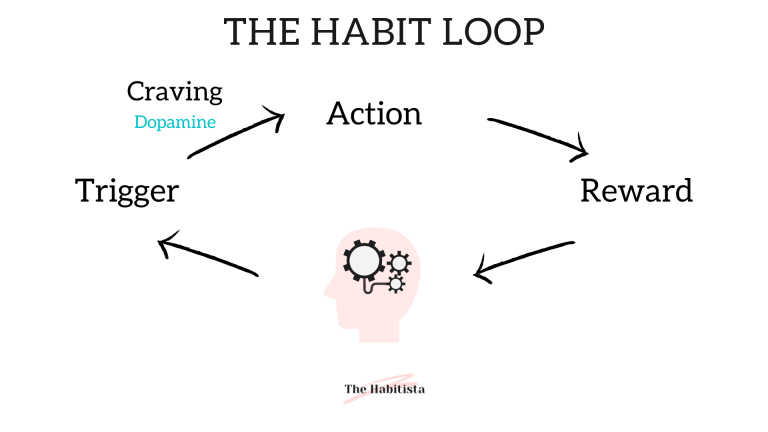
To understand how this loop forms and why it's so powerful, let's turn to psychiatrist and neuroscientist Dr. Judson Brewer.
A Simple Way to Break a Bad Habit | Judson Brewer | TED
In this TED Talk, Dr. Brewer provides a brilliant explanation of reward-based learning and the formation of habits, from survival instincts to modern-day struggles.
First, watch the section from the beginning of his explanation of the reward-based learning process. He clearly lays out the "Trigger, Behavior, Reward" sequence. Then, watch his explanation from this segment on why cognitive control, or willpower, so often fails when we're stressed.
Brewer’s key point is that habits are not stored in the "thinking" part of your brain (the prefrontal cortex). They are encoded in a deeper, more primitive area called the basal ganglia. This is your brain's autopilot system. When you're tired, stressed, or mentally taxed, the prefrontal cortex goes "offline," and the automated habit loops in the basal ganglia take over. This is why you can have the best intentions but still find yourself falling into old patterns. You aren't fighting a lack of willpower; you're up against a highly efficient, automated neural pathway.
Gear 1: Mapping Your Distraction Patterns
To change a system, you first need a process diagram. Dr. Brewer's framework for habit change begins with a step he calls "Mapping Your Habit." This is precisely our goal for today. We will not try to stop the behavior. We will simply observe it and collect data.
The following resource provides a detailed guide to the habit loop and how to map it.
What Is the Habit Loop? - Dr. Jud
This article from Dr. Jud's website is a fantastic deep dive into the neuroscience of the habit loop and the practical steps for mapping it.
Start by reading the introductory section, "What Is the Habit Loop?", for a concise summary. Next, read the breakdown of the three steps and the role of the basal ganglia. This reinforces the concepts from the video with more scientific detail. Then, focus on the section "Gear 1: Map Your Habit". This is your core task. Pay close attention to the specific questions you should ask yourself. Finally, review the practical examples provided, especially the one on procrastination, as it closely mirrors the experience of getting distracted from work or study. If you struggle to identify your triggers, the advice in the FAQ section "What if I can't identify the trigger?" will be helpful.
Your Task: Become the Scientist
For the next day or two, your task is to act as a scientist observing a system—your own brain. Don't judge or try to intervene. Just observe and record.
When you find yourself deep in a distraction episode (or right after it ends), take a moment to map the habit loop that just ran. Ask yourself these three questions:
-
The Trigger: What happened right before I started this activity?
- Internal: What was I feeling? Bored, anxious about a difficult task, tired, lonely?
- External: What was the environmental cue? A notification, the end of a video, finishing a meal? Often, it's a transition between two other tasks—what Nir Eyal calls a "liminal moment."
-
The Behavior: What, specifically, did I do?
- Be precise. Not "wasted time on my phone," but "opened Instagram and scrolled the Reels feed for 45 minutes" or "watched related YouTube videos for 2 hours."
-
The Reward: What did I get out of this in the moment?
- This can be subtle. Was it a feeling of relief from the anxiety of your coursework? A jolt of novelty and entertainment? A feeling of connection? Be honest about the temporary payoff. The loop wouldn't exist if there wasn't one.
Document 2-3 of these loops. This data is the foundation for everything we will do next to manage these habits.
Conclusion
You have now moved beyond simply labeling distraction as a "bad habit" and are equipped with a scientific framework to analyze it. Understanding that distraction is often an escape from internal discomfort, driven by an automated trigger-behavior-reward loop, is the critical first step toward regaining control.
Key Takeaways:
- Distraction is primarily an attempt to escape uncomfortable internal triggers like boredom, anxiety, or fatigue.
- Compulsive habits run on an automated, three-part Habit Loop: Trigger, Behavior, and Reward.
- This loop is managed by the basal ganglia, which operates on autopilot and can override the conscious intentions of the prefrontal cortex, especially under stress.
- The first and most crucial step to managing distraction is to mindfully map your personal habit loops by identifying the specific triggers, behaviors, and rewards without judgment.
In our next lifestyle lesson, we will use the data you've collected to take the next step. Now that you can identify the triggers and the urges they create, you will learn a technique called "urge surfing" to manage them in the moment without giving in. Our next training lesson will return to building physical strength, where you'll learn to perform rows and reverse flyes using your chest expander to target key muscles for posture and pulling power.