Welcome to our second-to-last lesson. In our previous discussion, we explored how recovery—through sleep, hydration, and rest—is the critical process that turns the stress of a workout into tangible progress. We established that improvement is a cycle of stress and adaptation. Today, we will focus on the tool that makes this cycle measurable and deliberate: the workout log.
This lesson is about creating a simple, effective system for tracking your training. For someone with a background in chemical engineering, the logic here will be familiar: you cannot optimize a process you do not measure. A workout log is your personal data-collection system, allowing you to verify that you are consistently applying progressive overload and making informed decisions about your training. This data will be invaluable as we move into our final lesson on building an integrated weekly schedule.
Why Keep a Workout Log?
Before diving into the "how," let's solidify the "why." It's easy to think you can remember what you did last week, but memory is notoriously unreliable, especially when you're focused on performing an exercise. A workout log removes the guesswork and provides objective data.
Workout Log Example: 5 Filled Templates to Track Progress and ...
This article from Setgraph provides an excellent overview of why tracking is essential and some common pitfalls to avoid.
First, read the introduction and the section on benefits, from the beginning of the article down to the benefits. This will frame the purpose of our lesson. Then, jump to the end and read the section Common mistakes. Keeping these in mind from the start will help you build a more effective tracking habit.
As the article highlights, the primary goal is to facilitate progressive overload. By knowing exactly what you did last session, you can make a concrete plan to do slightly more this session—whether that's one more rep, a little more weight in your backpack, or better form.
What to Track: The Essential Data Points
A useful log captures key information without being overly complex. For each workout, you should aim to record the following:
- Date: The most basic and essential data point.
- Exercise: The specific movement you performed (e.g., "Negative Push-ups," "Backpack Squats").
- Sets and Reps: The number of sets you completed and the number of repetitions in each set. It's crucial to log what you actually did, not what you planned to do. For example:
8, 8, 7instead of3x8. - Resistance/Weight: For your hybrid program, this might be "Bodyweight," the weight you put in your backpack ("Backpack + 10kg books"), or a description of the setup ("Table rows @ 45-degree angle").
- Notes: This is for qualitative data. How did it feel? Did you notice anything about your form? A great tool to use here is the Rate of Perceived Exertion (RPE), a scale from 1 (very light) to 10 (maximal effort, no more reps possible). Noting "RPE 8" tells you that you had about two reps left "in the tank," which is valuable information for planning your next workout.
How to Track: Finding Your System
There is no single "best" way to log your workouts; the best system is the one you will use consistently. Given your preference for flexibility over rigid systems, let's explore three effective methods, ranging from digital and detailed to minimalist and analog.
Method 1: The Digital DIY Approach
For a student comfortable with digital tools, using a simple note-taking app is often the most practical and flexible solution. You can create a template and update it from your phone during your rest periods.
The following video provides an excellent walkthrough of setting this up using an app like Notion, but the principles apply to any note-taking app (Google Keep, Apple Notes, etc.).
Full Guide to TRACKING your workouts.
In "Full Guide to TRACKING your workouts," the presenter demonstrates how to create a flexible and powerful workout log using a note-taking app.
Please watch the section covering DIY solutions. Pay close attention to how he structures the log with a schedule, workout templates (using both bullet points and tables), and a notes section for cues and progression schemes. This method is highly customizable to your needs.
This approach allows you to keep everything in one place and easily review past performance without carrying a physical notebook.
Method 2: The Classic Pen and Paper
There's a certain power in the simplicity of an analog system. It's distraction-free and forces a moment of reflection as you write. James Clear, an author focused on habits and performance, outlines a very effective method.
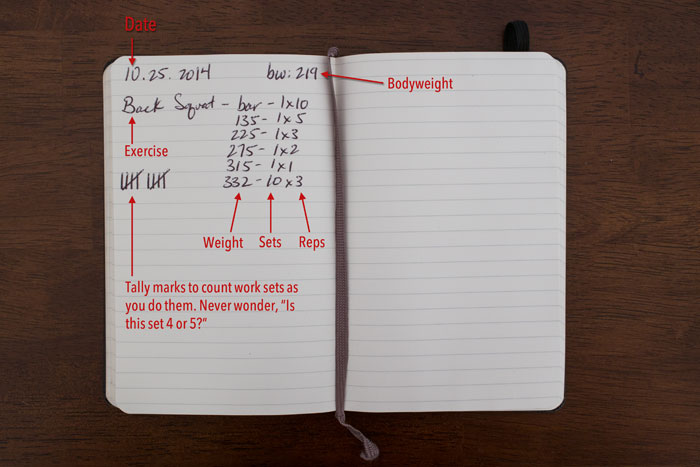
Hacking the Workout Journal: How to Track Your Workouts
This article details a streamlined, effective method for using a physical notebook to track workouts.
Read from Step 1 to Step 4. Note the simplicity of the process: plan the workout, then use tally marks during the session to track completed sets. This prevents you from losing your place when fatigued. As he mentions, this system is versatile enough for strength, bodyweight, and other training styles.
If you prefer a more structured layout, you can use a pre-designed template like the one below, either printed out or drawn by hand.

Method 3: The Minimalist "Scoreboard"
If you find detailed logging to be tedious, a more minimalist approach might be more sustainable for you. This system focuses only on one thing: progress. The idea is to simply record your personal best for each exercise and only update the log when you set a new record.
My Simple Way To Track & Progress Calisthenics
The Red Delta Project's video, "My Simple Way To Track & Progress Calisthenics," introduces a minimalist 'scoreboard' system.
Watch from the beginning of the video to understand the philosophy and see examples. The presenter explains that he only records his personal bests for sets and reps, along with a key technical cue he's focusing on. He doesn't change the log unless he surpasses his previous best. This keeps the focus squarely on improvement.
This method is particularly well-suited for calisthenics, where progress is often measured in reps or improved form rather than small increments of weight. You could start with a more detailed method and transition to this once your routine is more established.
Conclusion
Tracking your workouts closes the loop on the stress-and-adaptation cycle. It transforms your training from a series of disconnected events into a measured, data-driven process aimed at consistent improvement.
Key Takeaways:
- Tracking is for progress, not perfection. The goal is to collect enough data to ensure you're applying progressive overload.
- Log the essentials: Date, Exercise, Sets, Reps, and Resistance are key. Subjective notes on RPE and form provide crucial context.
- Choose your weapon: Whether you prefer a flexible digital app, a simple notebook, or a minimalist scoreboard, the best system is the one you stick with.
- Record what you actually do, not what you planned. This honest data is what will guide your future progress.
In our final lesson, we will synthesize everything we've covered. You will learn how to create a personalized weekly template that integrates your training (informed by your new workout log), nutrition, study, and rest, building a sustainable lifestyle that supports all of your goals.