Introduction
Welcome to your next lesson. In our previous session, we established a critical baseline for your nutrition by estimating your Total Daily Energy Expenditure (TDEE). We treated the body as a system with energy inputs and outputs. Today, we'll apply a similar systematic approach to the mind, focusing on the very architecture of your behaviors.
You've identified that managing distractions is a key goal. To do this effectively, we first need to understand the underlying mechanism that drives them. This lesson is dedicated to describing the habit loop, a fundamental concept from behavioral science that explains how our actions—both productive and distracting—are formed, reinforced, and automated. By the end of this lesson, you will be able to deconstruct any habit into its core components, which is the first and most crucial step toward consciously changing it.
The Neurological Blueprint for Habits
At its core, a habit is a behavior that has been repeated enough times to become automatic. Your brain does this to conserve energy. Conscious thought, which occurs in the prefrontal cortex, is metabolically expensive. By offloading recurring tasks to more primitive brain regions like the striatum, your brain frees up mental bandwidth for novel problems. Think of it as compiling a frequently used piece of code into a highly optimized executable that runs without needing to be interpreted line by line each time.
Let's begin by exploring the science behind this process and the classic three-part structure of a habit.
How Habits Can Change Your Life (and Your Brain)
The video "How Habits Can Change Your Life (and Your Brain)" from the channel Be Smart provides an excellent overview of the neuroscience and the foundational model of habits.
First, watch from the beginning until the bike riding example. This section explains how the brain automates tasks to become more efficient, moving them from conscious effort to automatic processes. Then, watch the following segment from the toothpaste example. This introduces the three essential components of the habit loop: the cue, the behavior (or routine), and the reward.
As the video explained, the simplest model of a habit, popularized by Charles Duhigg in his book The Power of Habit, consists of a three-step loop.
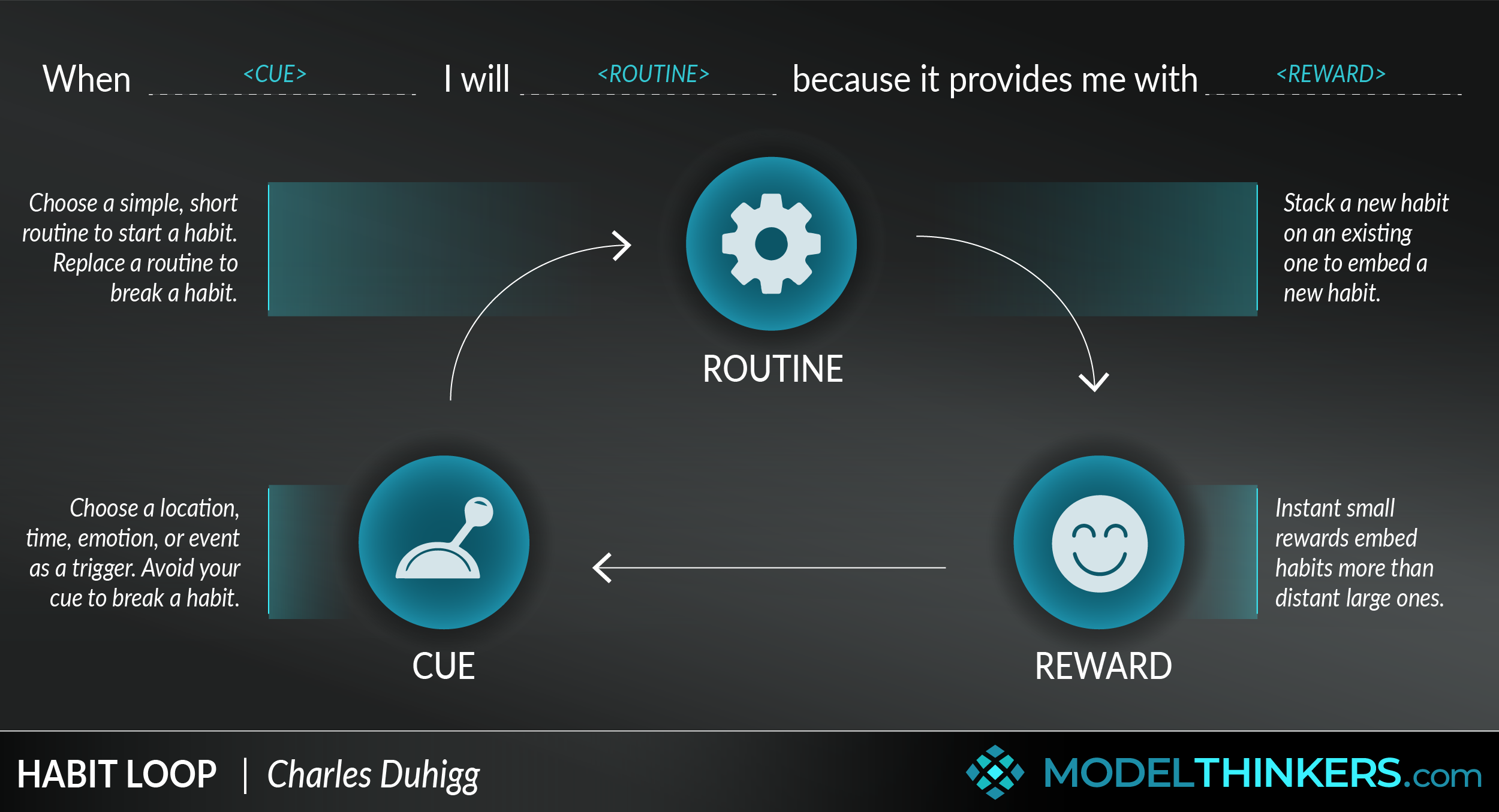
To solidify your understanding of these three parts, let's examine them in more detail.
The Habit Loop Explained (Cue → Routine → Reward)
This article from Routinery offers a concise and clear breakdown of each stage.
Please read the section titled "The Three Stages of the Habit Loop." Pay close attention to the examples provided for each component: Cue, Routine, and Reward. Notice the different types of cues mentioned, such as time of day, location, and emotional state.
A Refined Model: The Engine of Desire
The Cue-Routine-Reward model is a powerful starting point, but it raises an important question for an analytical mind: if habits are just a simple stimulus-response loop, why do two people react completely differently to the exact same cue? For instance, why does one person see a notification and feel an irresistible urge to check their phone, while another sees the same notification and ignores it?
The answer lies in a crucial intermediate step. Author James Clear, in his book Atomic Habits, refines the model by inserting a fourth component: Craving.

In this model, the cue doesn't directly trigger the routine. Instead, the cue triggers a craving, which is the motivational force that drives you to act. The craving is essentially the brain's prediction or interpretation of what the cue means. It’s not the phone notification itself that makes you act; it’s the craving for the potential social connection, information, or novelty that the notification represents to you.
James Clear himself explains this distinction and why it's so critical.
The Habit Loop explained by James Clear 🧠 Cue, Craving, Reward, Response | Atomic Habits
In this clip, James Clear explains the evolution from the three-stage to the four-stage model and the pivotal role of our internal states.
Watch the segment from his explanation of the craving stage. He explains that the craving is about the prediction or meaning you assign to a cue, which is why different people have different responses. He uses the powerful example of two people seeing a pack of cigarettes.
This four-part framework—Cue, Craving, Response, Reward—gives us a more complete schematic for analyzing our behaviors.
- Cue: The trigger. A notification on your phone.
- Craving: The motivation. The desire to know what the notification is about.
- Response: The action. Picking up the phone and opening the app.
- Reward: The satisfaction. The temporary relief or pleasure from seeing the message.
The reward satisfies the craving (not the cue) and reinforces the entire loop, teaching your brain that this sequence is worth remembering and repeating.
An Engineer's Approach: Deconstructing Your Habits
Now that you have the schematic, you can begin to act as an engineer of your own mind. The first step is not to judge or immediately try to fix a habit, but simply to observe and document the system as it currently operates. This objective analysis is the foundation for any effective change.
Your task now is to pick one of your recurring distraction habits and map it onto the four-stage loop. Be a neutral observer collecting data.
How to Master Habit Formation: A Science-Backed Guide ...
This article from Dr. Paul McCarthy provides a structured method for self-observation.
Read the short section titled "How to identify your own habit loops." It provides a simple protocol for deconstruction.
Let's walk through a hypothetical example relevant to your context as a student:
- Habit to Analyze: Mindlessly browsing social media after studying.
- 1. Identify the Response (Routine): Opening Instagram/Twitter/YouTube and scrolling for an undefined period.
- 2. Identify the Cue: What happens right before you open the app?
- Time: Is it always around 10 PM?
- Location: Does it happen when you're at your study desk?
- Preceding Action: Did you just finish a challenging problem set?
- Emotional State: Are you feeling mentally fatigued, bored, or anxious about your work? (Often, this is the most powerful cue).
- 3. Identify the Reward: What is the immediate benefit you get from the routine?
- A feeling of relief from mental strain?
- A hit of novelty and entertainment?
- A sense of connection from seeing what others are up to?
- 4. Identify the Craving: Based on the reward, what was the feeling you desired right after the cue?
- Was it a craving for mental rest? For effortless entertainment? To escape a feeling of being overwhelmed?
By putting these pieces together, you might discover a loop like this:
- Cue: Closing your chemical engineering textbook after a long study session.
- Craving: A desire for an easy, novel distraction to relieve mental fatigue.
- Response: Opening social media.
- Reward: A flood of new information and stimulation that satisfies the craving for novelty and distraction.
Spend a few minutes now trying to map one of your own distraction habits in this way. Don't worry about changing it yet—just observe and understand the mechanism.
Conclusion
In this lesson, you have learned the fundamental structure that governs all of your automatic behaviors: the habit loop. We started with the simple Cue-Routine-Reward model and then refined it to the more comprehensive Cue-Craving-Response-Reward framework.
Key Takeaways:
- Habits are neurological shortcuts the brain creates to save energy.
- The classic habit loop consists of a Cue (trigger), a Routine (action), and a Reward (reinforcement).
- A more precise model includes Craving as the engine of the habit. The cue triggers a craving, and the response is an attempt to satisfy that craving.
- The reward reinforces the connection between the cue and the craving, making the habit more likely to occur in the future.
- You can begin to manage your habits by first deconstructing them into these four components without judgment.
You now possess the analytical tool to understand why your distractions occur. You can see them not as a personal failing, but as a well-oiled system that is simply running its programmed loop.
In our next lesson, we will build on this by introducing a simple, practical method for directing your conscious attention: the daily top-3 priority system. This will help you proactively choose the "responses" that align with your goals, rather than letting automated cravings run the day.