Introduction
In our last lesson, you built a foundational core routine, learning to stabilize your spine—a critical skill for safety and performance in all exercises. Today, we pivot from the physical structure of training to the fuel that powers it. As you've identified nutrition as "uncharted territory," this lesson will provide your first navigational tool.
The single most important number in nutrition is your Total Daily Energy Expenditure (TDEE). It represents the total amount of energy, measured in calories, that your body uses in a 24-hour period. Understanding this number is the bedrock for any goal, whether it's losing fat, gaining muscle, or maintaining your current weight.
Our objective is to demystify this concept and equip you with a simple, practical method to estimate your own TDEE, giving you the starting point for a structured nutritional approach.
Your Body's Energy Budget
Before we calculate anything, it's useful to understand what contributes to your TDEE. Just as a chemical process has various energy inputs and outputs, your body's energy expenditure is not monolithic. It's primarily the sum of three components: your metabolism at rest, your daily activity, and the energy used to digest food.
How To Calculate Maintenance Calories | 2 Ways
The video "How To Calculate Maintenance Calories" by professional coach Paul Revelia provides a concise breakdown of these components.
Watch the segment from the beginning of his explanation. Pay attention to his description of: Basal Metabolic Rate (BMR): The energy for "keeping the lights on." Non-Exercise Activity Thermogenesis (NEAT): The calories burned from all activity other than formal exercise. Exercise: The energy burned during your workouts.
As you can see, TDEE is a dynamic figure that reflects your unique biology and lifestyle. While direct measurement is complex, we can use estimation formulas that are remarkably effective as a starting point.
Method 1: The "First Principles" Approach
Given your engineering background, let's first look at a common two-step method for estimating TDEE. This involves calculating your Resting Metabolic Rate (RMR)—which is practically very similar to BMR—and then multiplying it by an activity factor. This helps you see how the final number is constructed.
3.3 Estimating Energy Expenditure – Nutrition and Physical Fitness
This educational text from "Nutrition and Physical Fitness" breaks down the calculation step-by-step.
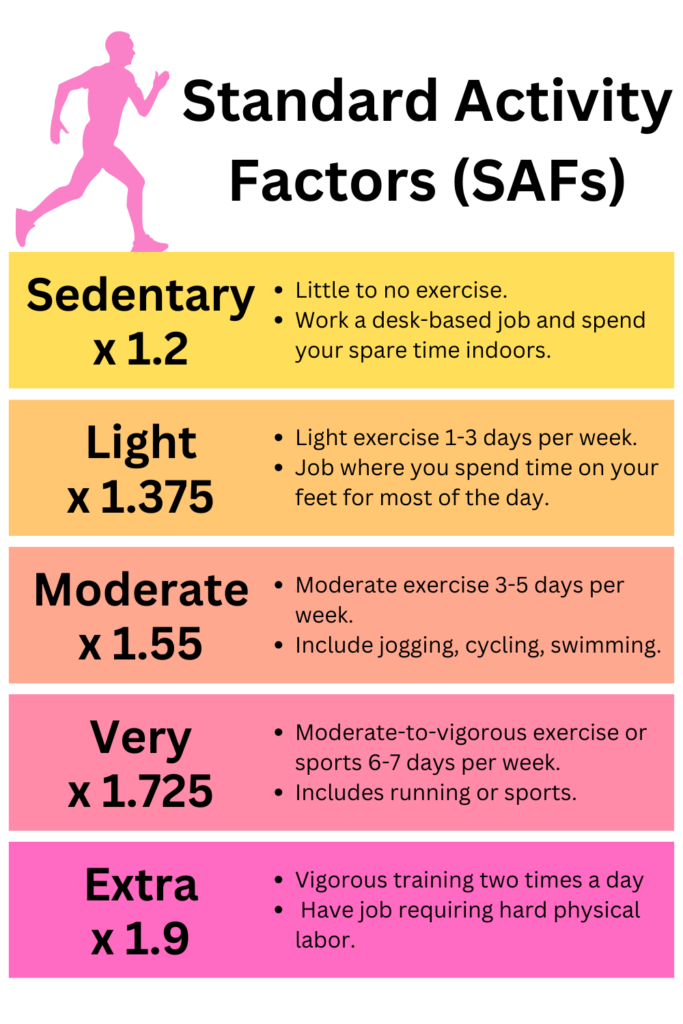
First, read the section on RMR. Use the Simplified Equation for Men to calculate your own estimated RMR. The formula is: RMR = (Your weight in kg) × 1 kcal/hr × 24 hr/day (Remember: 1 kg ≈ 2.2 lbs) Next, skip down to the section on TEE. This section explains how to multiply your RMR by an activity factor to get your final TDEE. Use the activity factor table provided in the text to select the multiplier that best fits your current lifestyle.
This method gives you a solid estimate based on fundamental components. The most subjective, and therefore error-prone, part of this calculation is choosing the correct activity level. The image below provides another clear visual guide for these activity factors.
Method 2: The Simple Multiplier Shortcut
While the RMR-based method is instructive, many coaches and nutrition professionals use an even more direct approach: a simple body weight multiplier. This shortcut effectively combines the RMR and activity factor into a single step and is the main tool for this lesson.
This method is fast, easy, and provides a reliable range for your maintenance calories.
How to Calculate Daily Calorie Needs to Meet Your Goals
This article from Zing Coach presents the body weight multiplier method clearly and concisely. It's a pragmatic tool used for quick and effective diet planning.
Read the section titled "Quick Estimation With Body Weight Multipliers." Focus on the multipliers provided for kilograms (kg) and the example calculation.
Now, let's put it into practice for you.
- Find your weight in kilograms (kg).
- Choose your multiplier range based on your activity level:
- Sedentary or Lightly Active: 26–30
- Moderately Active: 31–37
- Very Active: 38–40
- Calculate your TDEE range.
For example, for a moderately active 70 kg individual:
- Lower end: 70 kg × 31 = 2170 calories/day
- Higher end: 70 kg × 37 = 2590 calories/day
Your estimated maintenance intake would fall within this range. As a sanity check, this result should be reasonably close to the number you calculated using the RMR method.
From Estimate to Reality: Testing Your Hypothesis
It is critical to understand that any number you calculate is an educated guess—a starting hypothesis. Your unique genetics, diet history, and the nuances of your daily movement mean that the true value can only be found through real-world testing. Online calculators can be inaccurate for many reasons, as the next video explains.
The Easiest Way To Calculate Maintenance Calories
In "The Easiest Way To Calculate Maintenance Calories," Sean Nalewanyj explains why calculators have limitations and what the most accurate method truly is.
First, watch the segment explaining why calculators can be inaccurate. This highlights the importance of not treating the calculated number as absolute truth. Next, watch his explanation of a more accurate method, which involves tracking your current intake.
Since you're new to nutrition, the most practical approach is to use your calculated TDEE as a starting point and adjust.
Your Action Plan:
- Calculate your TDEE using the simple multiplier method (kg × multiplier). Choose a number in the middle of your calculated range to start.
- Track your calorie intake for one week, aiming to hit this target number each day. You can use a free app on your phone for this (e.g., MyFitnessPal, Cronometer, MacroFactor). Be as honest and consistent as possible.
- Monitor your body weight every morning under the same conditions (e.g., after waking up, before eating/drinking). Don't panic over daily fluctuations; look for the weekly trend.
- Adjust:
- If your average weight stayed the same, you’ve found your maintenance!
- If your average weight went up, your maintenance is slightly lower. Reduce your daily intake by ~200 calories.
- If your average weight went down, your maintenance is slightly higher. Increase your daily intake by ~200 calories.
This process of systematic testing and adjustment is the key to finding the true number that works for your body.
Conclusion
You have now moved from having no nutritional framework to establishing the most critical baseline: your estimated daily energy needs. This number will be the foundation upon which we later build strategies for muscle gain.
Key Takeaways:
- TDEE is your daily calorie budget, composed of your resting metabolism (BMR/RMR), activity levels (NEAT + exercise), and digestion (TEF).
- A simple body weight multiplier (e.g., weight in kg × 31-37 for moderate activity) is a fast and effective way to estimate your TDEE.
- Your calculated TDEE is a starting hypothesis, not a final answer. The most accurate way to find your true maintenance calories is to eat at your estimated level for a week and adjust based on how your body weight responds.
In our next lesson, we will shift our focus back to the mental aspect of your goals. You'll learn about the "habit loop," the fundamental neurological process that drives all of our behaviors, including the distractions you're looking to manage.