Introduction
In our last lesson, we deconstructed the anatomy of your habits, revealing the Cue-Craving-Response-Reward loop that drives your automatic behaviors. You now have the analytical framework to understand why you get distracted. Today, we shift from analysis to action. We're going to build a simple, powerful system to proactively choose your "responses" for the day, ensuring your conscious goals win out over automated cravings.
You've mentioned a dislike for overly rigid schedules, and that's a key insight. The goal isn't to cram your day into a restrictive timetable, but to direct your focus where it counts. This lesson introduces the daily top-3 priority system, a flexible tool designed to help you identify and execute your most important tasks. By the end of our session, you'll be able to use this system to bring clarity to your day and ensure you're consistently making progress on what truly matters.
The Problem: Why Long To-Do Lists Fail
You're a chemical engineering student, so you're familiar with the concept of a limited energy budget in a physical system. Your brain operates under a similar constraint. When faced with a long to-do list, your brain expends significant mental energy just deciding what to do next and in what order. This phenomenon is known as decision fatigue.
Mastering Focus with the 3-Task Rule (And Why It Works) - Brain.fm
The article "Mastering Focus with the 3-Task Rule" from Brain.fm explains the cognitive science behind this effect.
Read the section titled "The Science Behind Why the 3-Task Rule Works," focusing on the part about Decision Fatigue and Mental Energy Depletion. This will clarify why choosing from too many options is counterproductive.
As the article explains, the constant micro-decisions involved in managing a long list drain your cognitive capacity before you even start the real work. Productivity isn't just about managing time; it's about strategically managing your time, energy, and attention.
Let's watch a short video that introduces this core concept.
THE PRODUCTIVITY PROJECT by Chris Bailey | Animated Core Message
This animated summary of Chris Bailey's "The Productivity Project" provides a great high-level framework for thinking about productivity.
Watch the introduction from the core ingredients of productivity. It frames productivity as the optimization of time, energy, and attention, which is the perfect mindset for our approach.
The Solution: The Rule of Three
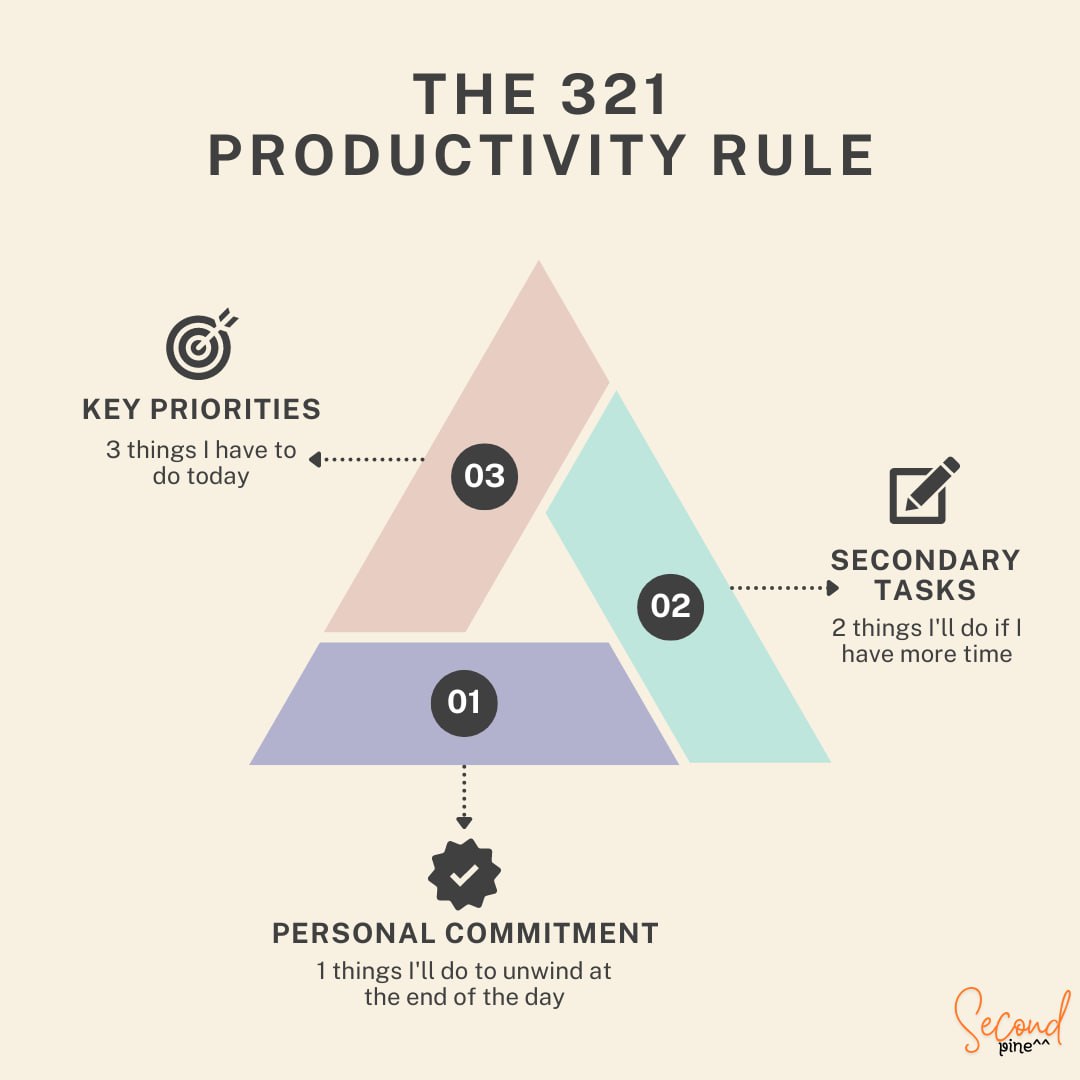
The most effective way to combat decision fatigue and manage your three core resources is to impose a constraint. By intentionally limiting your focus, you preserve your mental energy for execution. This is the principle behind the daily top-3 priority system.
The rule is simple: at the start of each day (or the night before), you define the three most important things you want to accomplish. These are your "wins" for the day. Completing them means the day was a success, regardless of what else happens.

These aren't just any three items from your list; they are your highest-impact activities. But how do you determine what those are?
How to Choose Your Top Three
Identifying your most critical tasks requires shifting your perspective from "what is urgent?" to "what is important?". The video we just watched offers a powerful analogy for this.
THE PRODUCTIVITY PROJECT by Chris Bailey | Animated Core Message
Let's return to "The Productivity Project" summary to explore how to categorize our tasks.
Watch the section from the dartboard analogy. Pay close attention to the concept of the "highest impact workboard." The video gives excellent sentence prompts to help you identify these activities based on your current goals (e.g., academic, career, entrepreneurial).
As the video suggests, your three priorities should be the tasks that land on your "highest impact workboard." For you as a student, these are the activities that will most directly contribute to your academic success and personal goals. To help you select these tasks, you can use a few mental models:
- The 80/20 Rule (Pareto Principle): Ask yourself, "What 20% of my efforts will produce 80% of my results?" Your top three should come from that critical 20%. This might be working on a challenging problem set, drafting a key section of a lab report, or studying a foundational concept for an upcoming exam.
- Urgent vs. Important: Many tasks feel urgent (like answering a routine email) but are not truly important. Your top three should be chosen for their importance—their contribution to your long-term goals—even if they don't have an immediate, pressing deadline.
A Practical Protocol: The Ivy Lee Method
Knowing what to focus on is half the battle. The other half is execution. For this, we can turn to a century-old method known for its remarkable simplicity and effectiveness.
The Ivy Lee Method was developed in 1918 for Charles Schwab, then one of the richest men in the world. It provides a simple, stress-free algorithm for structuring your day.
Ivy Lee Method | A 100-Year Old Productivity System for Stress Free Prioritization
The video "Ivy Lee Method" by Vihan Chelliah explains this powerful, time-tested system.
First, watch from the introduction to the steps to understand the method's core process. Then, continue watching from the explanation of its effectiveness. This addresses the "why" by highlighting its simplicity and focus on single-tasking.
We will adapt the Ivy Lee method to our top-3 system. The process is a simple daily algorithm:
- Plan the Night Before: At the end of your workday, decide on the three most important tasks you need to accomplish tomorrow. Write them down.
- Prioritize: Order those three tasks from most to least important.
- Execute Sequentially: The next day, start with task #1. Work on it with your full attention until it is finished.
- Proceed Down the List: Only after finishing task #1, move to task #2, and then to task #3.
- Reset: At the end of the day, any unfinished items can be moved to the next day's list (if they are still a top priority). Repeat the process.
A Crucial Tip for Students: Many academic tasks, like "write thesis" or "study for finals," are too large to be completed in one sitting. Trying to do so can lead to frustration. A more effective approach is to define your tasks by the time you will invest.
The Rule of Three - Work Smart and be Remarkable!
The article "The Rule of Three" by Helmut Hauser provides an excellent modification for handling large tasks.
Read the sections "What kind of tasks should I choose?" and pay special attention to the examples under "Daily Goals."
Instead of "Finish fluid dynamics problem set," a better top-3 task would be: "Work on fluid dynamics problem set for 90 minutes." This makes the goal achievable and measures success by focused effort, not just completion.
Advanced Application: Aligning with Energy and Goals
To make this system even more powerful, you can add two more layers of thought.
1. Align Tasks with Your Energy:
When do you feel most alert and focused? For many, it's in the morning. For others, it's late at night. These are your "biological prime times." The most effective way to use the top-3 system is to schedule your most demanding tasks during these peak energy windows.
Let's revisit the first video for a quick explanation of this concept.
THE PRODUCTIVITY PROJECT by Chris Bailey | Animated Core Message
This final clip from "The Productivity Project" summary explains how to leverage your natural energy cycles.
Watch the segment from the discussion on energy management. This explains the concept of "biological prime times" and the importance of scheduling your most important work during these periods.
2. Align Daily Tasks with Weekly Goals:
Your daily actions are most powerful when they build towards a larger objective. You can use the Rule of Three on a weekly scale as well. At the start of each week, ask: "What are the three most important things I want to accomplish this week?" Then, ensure your daily top-3 tasks are steps toward achieving those weekly goals. This connects your day-to-day work with your bigger ambitions.
Conclusion
Today, you've learned a practical, flexible system for directing your focus and winning the day. This isn't about rigid scheduling; it's about conscious, deliberate prioritization.
Key Takeaways:
- Long to-do lists cause decision fatigue, draining the mental energy needed for focused work.
- The daily top-3 priority system combats this by forcing you to identify and commit to your highest-impact tasks.
- Use frameworks like the 80/20 rule and the distinction between urgent vs. important to select your top three.
- Implement the system using an adapted Ivy Lee Method: plan the night before and work sequentially.
- For large academic projects, define tasks by time invested (e.g., "Work for 60 mins") rather than completion to build momentum without frustration.
- For maximum effectiveness, align your top-3 tasks with your biological prime times.
Start small. Tonight, before you finish your work, take five minutes. Identify the three most important things you need to do tomorrow. Write them down. Tomorrow, make them your priority.
Now that you have a proactive tool for focusing on what you want to do, our next lifestyle lesson will equip you with a tool for handling distractions in the moment. We will explore how to identify the personal triggers and patterns that pull you off course, giving you the awareness needed to stay on track.