In our last lesson, you deconstructed and mastered the form for the full push-up, a cornerstone of bodyweight strength. This sets a strong foundation for your upper-body pressing ability. Now, we will broaden your training toolkit to align with your goal of creating a "hybrid" program. While calisthenics is powerful, applying the principle of progressive overload to all movement patterns—especially for your lower body—requires adding external resistance.
This lesson is your guide to building a home gym out of everyday objects. We will identify common household items that can serve as effective, improvised weights. You'll learn how to categorize them, how to safely prepare them for use, and why a simple backpack might be the most valuable piece of "equipment" you own. This knowledge will be the foundation for the next several lessons, where we will incorporate these items into loaded exercises.
Your Home Arsenal: Seeing Equipment Everywhere
The first step is to shift your perspective and see the potential for resistance training in the objects you have around you. From the kitchen pantry to the cleaning closet, your home is full of items that can be used to add weight to your exercises.
This infographic gives a quick, creative overview of some common items and their approximate weights.
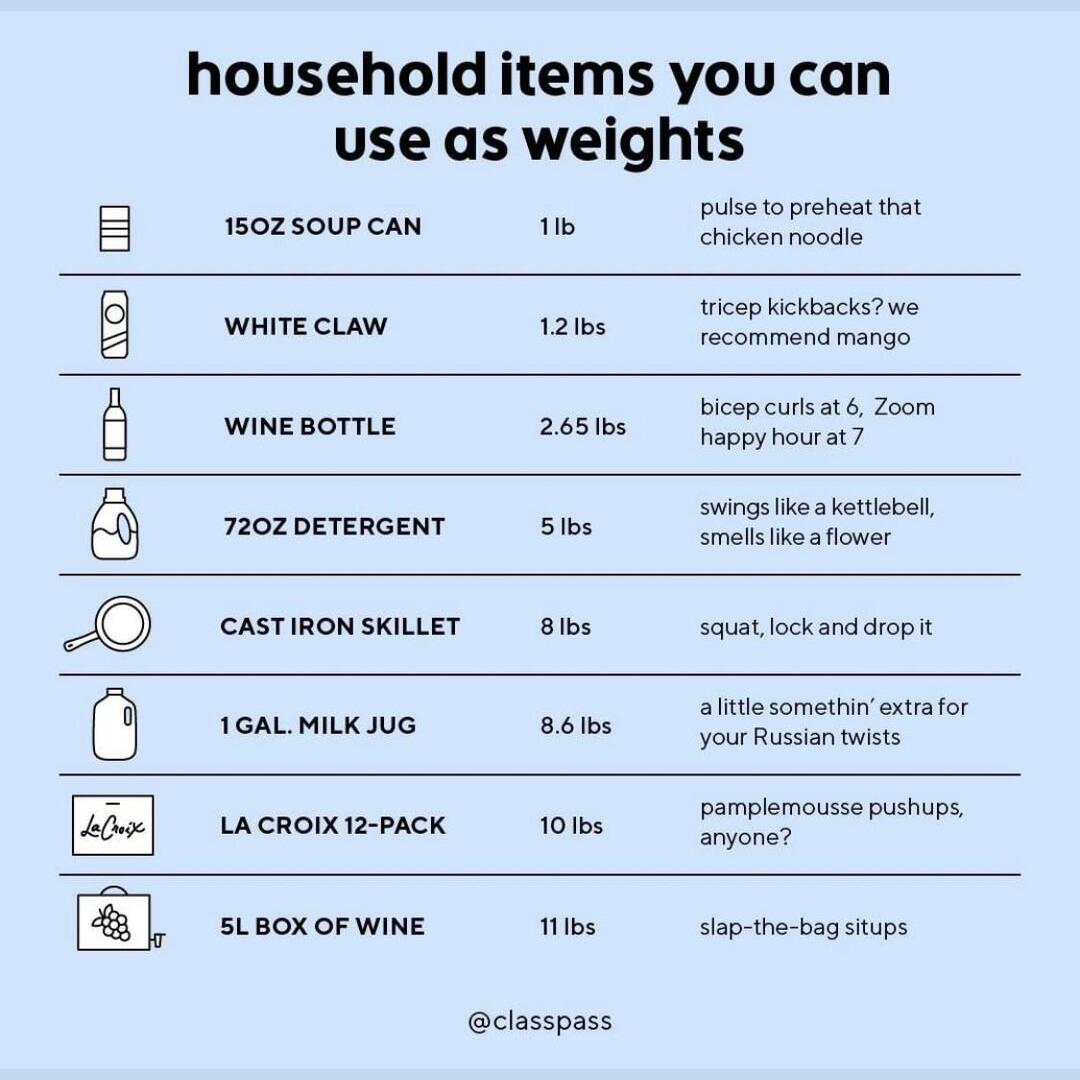
To build on this, let's systematically explore the options, categorized by their potential use. The following article provides an excellent breakdown of items by weight class.
Best Alternatives to Weights For At-home Workouts | Kaneka Ubiquinol
This article from the Ubiquinol Center provides a well-organized list of household items you can use as weights, helpfully grouped by weight.
Read the first three main sections: light items, medium items, and heavy items. As you read, take a mental inventory of what you have available in your own home.
As you can see, you can easily find objects to serve as light, medium, and heavy weights.
- Light Weights (e.g., soup cans, water bottles): These are perfect for isolation exercises like lateral raises or for high-repetition movements to build muscular endurance.
- Medium Weights (e.g., gallon jugs, laundry detergent): The handles on these items make them ideal substitutes for dumbbells or kettlebells in exercises like single-arm rows, bicep curls, or even kettlebell-style swings.
- Heavy Weights (e.g., large bags of rice, bulk supplies): These are best for major compound movements like squats and loaded carries, where you need a significant challenge.
The image below gives some great visual examples of how different items can be used for specific exercises.

The Weighted Backpack: Your Most Versatile Tool
Of all the improvised options, the single most valuable and versatile is a sturdy backpack. Its key advantage is adjustability. Unlike a 5-pound detergent bottle, a backpack can be loaded to be 5 pounds, 10 pounds, 20 pounds, or more, allowing you to precisely apply progressive overload. You can fill it with a combination of the items we've just discussed—books, water bottles, and cans—to dial in the exact weight you need for a given exercise.
However, loading a backpack correctly is crucial for both safety and effectiveness. A shifting, unbalanced load can throw off your form and risk injury. The following video provides an excellent guide on how to pack your bag like a pro.
Backpack Workout Guide - 36 Backpack Exercises Using A Backpack Weight
The "Backpack Workout Guide" by Derek Maker Fitness offers practical, clear instructions on preparing a backpack for a workout.
Watch the section from the beginning. Pay close attention to the technique of wrapping weights (like books or water bottles) in towels. This is a simple but critical step to create a stable, solid mass that won't shift during your movements.
As you progress, the backpack will be your primary tool for adding resistance to squats, lunges, and even push-ups and rows. As the creator of the "Beginners Homeworkout Guide" video explains, increasing the weight in your backpack is the main way you will make exercises harder over time.
You CAN get JACKED from home. | Beginners Homeworkout Guide
This video by Randumb Fitness quickly illustrates the principle of progressing with a backpack.
Watch the short clip from on progression. This reinforces how you'll use the backpack to continue challenging yourself once you can hit a certain number of reps.
Safety with Improvised Weights
Since household items aren't designed for exercise, safety is your top priority. An object breaking or leaking mid-lift can easily lead to injury. Your engineering mindset will be an asset here; think of it as assessing the material integrity and stability of your chosen equipment before putting it under load.
Best Alternatives to Weights For At-home Workouts | Kaneka Ubiquinol
We return to this article for its excellent section on safety.
Read the section titled Safety Tips. This is mandatory reading before you begin using any of the items we've discussed.
Here are the critical safety checks to perform before every workout:
- Check for Leaks: Ensure all lids on water jugs, detergent bottles, and other containers are screwed on as tightly as possible. Give them a shake over a sink first.
- Test the Grip: Handles on milk jugs or detergent bottles can be flimsy. Make sure they can support the weight and that your hand can hold on securely. If a grip feels precarious, don't use it.
- Ensure Stability: When using a backpack, follow the video's advice to pack it tightly. A shifting load is an unstable load.
- Avoid Glass: Never use glass containers. The risk of shattering and serious injury is too high.
- Start Light: Before performing a full set, do a few slow, controlled reps with a new improvised weight to feel its balance and ensure it's stable.
Conclusion
You now have a framework for looking at your home environment as a source of training equipment. By getting creative and prioritizing safety, you can effectively load every major movement pattern without needing a commercial gym.
Key Takeaways:
- Common household items like water jugs, canned goods, and books can serve as effective weights.
- A sturdy backpack is your most important tool, as it allows for precise and adjustable resistance for progressive overload.
- Packing a backpack tightly with items wrapped in towels is crucial to create a stable, safe weight.
- Safety is paramount: always check that lids are secure, handles are strong, and loads are stable before beginning an exercise.
In our next lesson, we will immediately put this new knowledge to use. You will learn to perform loaded squats and lunges, using a weighted backpack or other items you've identified to begin building serious lower-body strength.